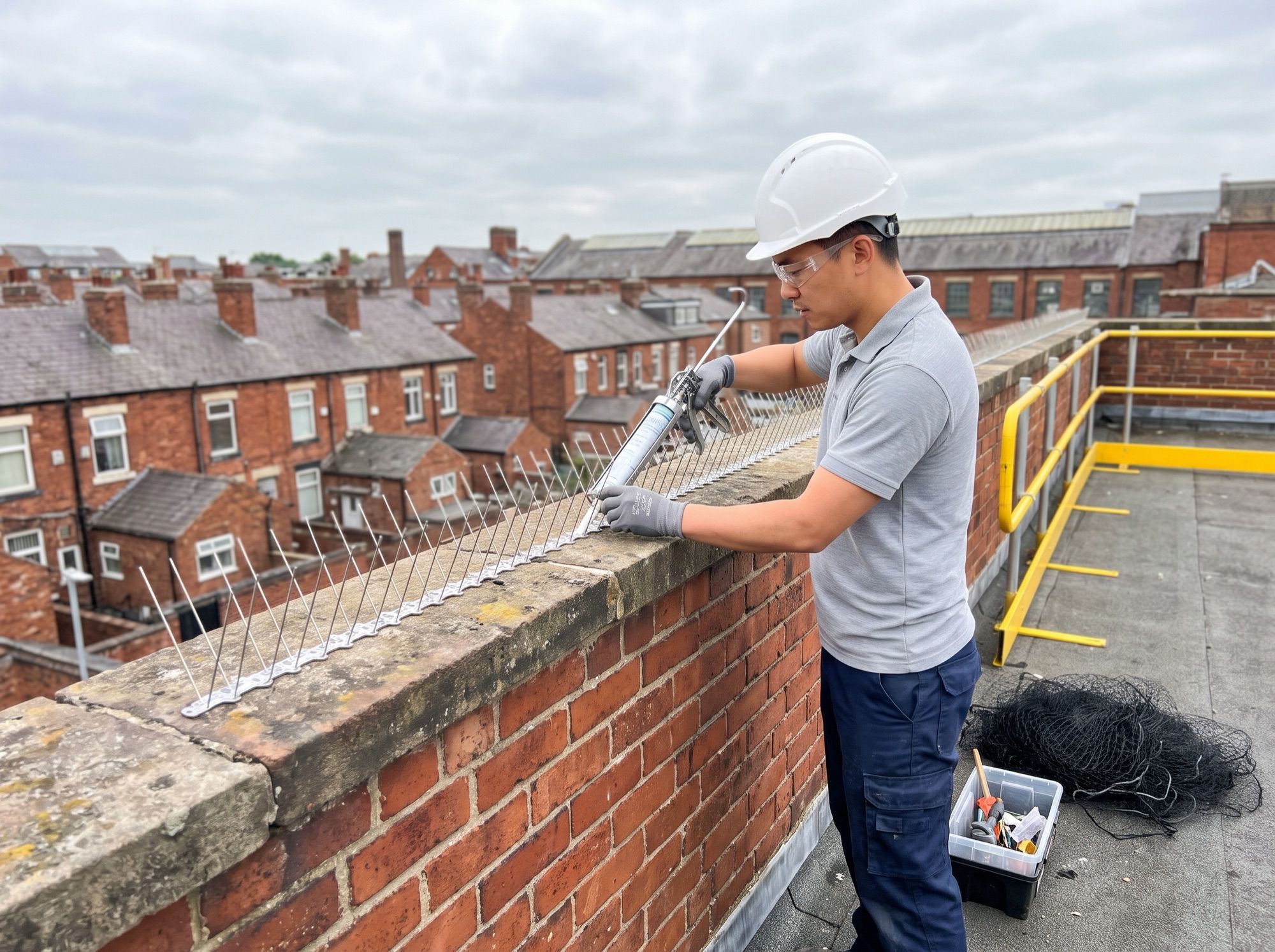
EnviroEx designs and installs bird proofing for commercial premises, residential blocks and homes across Manchester and all ten Greater Manchester boroughs. We survey the building, check for active nests, then fit netting, spikes, post-and-wire or gel that keeps pigeons and gulls off lawfully. Surveys are arranged promptly; call us or use the contact form to book.
What are the signs that birds have settled on your building?
Most sites notice the fouling before they notice the birds. Streaks of droppings down brickwork below a ledge, a crust on a canopy or loading-bay floor, and feathers collecting in a roof void all point to birds that are roosting, not just passing through.
Other signs worth logging:
- nesting material, twigs and broken eggshell behind signage, in gutters, under solar panels or inside plant rooms;
- birds lined up on the same parapet at dusk, which tells you the building is a night roost;
- blocked gutters and hoppers, and damp patches inside where rainwater has backed up;
- gulls swooping at staff or delivery drivers in late spring and early summer, which usually means chicks nearby;
- mites or small beetles around a window or vent, sometimes moving in from an old nest.
A few pigeons feeding on a forecourt is a housekeeping issue. A flock that sleeps on the building every night is a structural one, because those birds will return however clean the ground is.
Why do pigeons and gulls choose buildings in Greater Manchester?
Feral pigeons descend from cliff-nesting rock doves, and Manchester’s Victorian and Edwardian commercial buildings give them sheltered cliffs: deep window reveals, cornices, terracotta detailing and the undersides of railway viaducts and canopies. Converted mills and warehouses add balconies, cavities and redundant ductwork. In the city centre, food is rarely far away, with takeaways, bin stores and people who feed birds deliberately.
Further out, the large flat-roofed and portal-frame buildings on industrial and retail estates such as Trafford Park offer open loading canopies, warm roof plant and racking just inside roller doors. Gulls, mostly herring and lesser black-backed, also nest on flat roofs well inland and defend them noisily, sometimes aggressively, through the breeding season. In the suburbs, a common problem is pigeons nesting under rooftop solar panels on semis and terraces, where the gap between panel and tiles makes a dry, warm ledge.
Feral pigeons can breed in any month, so a colony will keep raising young for as long as nest sites are available, which is why exclusion, not removing birds, is the method that lasts.
How does the bird-proofing process work?
Every job starts with a survey, not a quote from a photograph. We identify the species and how birds use each area (feeding, loafing, roosting or nesting), what the fixings will go into, and how we will reach the work safely. We also check for active nests, because that decides when work can start, and whether the building is listed, because fixings into historic fabric may need listed building consent.
You then receive a written proposal with photographs, the system specified for each area, the access method and the timing. For trading premises and managed blocks, a risk assessment and method statement lets your facilities team, managing agent or principal contractor approve the work.
On installation day we clear empty nests and fouling, check no birds are inside any area about to be enclosed, then fit the system and hand over a record of what was installed.
Which proofing system suits which part of a building?
- Netting closes off large spaces such as loading canopies, light wells, courtyards, viaduct arches and roof plant areas. Mesh size follows the smallest target bird, from around 19 mm for sparrows to 75 mm for gulls.
- Spikes suit ledges, signage, lamps and parapets where birds stand rather than nest.
- Post-and-wire is the discreet choice for architectural ledges, stone detailing and sensitive frontages.
- Gel suits narrow features where spikes would look wrong or cannot be fixed.
- Electric track gives landing birds a mild, harmless pulse; it is unobtrusive on prominent ledges but needs more upkeep.
- Solar panel mesh clips around the edge of an array to stop birds nesting underneath.
Hawk flying and scaring devices can move birds on from open sites, but on their own they rarely shift a settled roost.
What does the law allow you to do about pigeons and gulls?
All wild birds, their eggs and nests that are in use or being built are protected under the Wildlife and Countryside Act 1981. Proofing and deterrence are lawful, provided they do not injure birds, destroy an active nest or trap a bird inside. Killing or taking birds, or taking or destroying an active nest or its eggs, generally needs a licence.
For feral pigeons, Natural England’s general licence GL41 lets an owner, occupier or someone they authorise kill or take birds, or remove nests and eggs, to prevent slips and falls, the spread of disease to people or safety problems caused by nesting, subject to its conditions. The current GL41 runs to 31 December 2026 and does not override other law. Herring gulls and lesser black-backed gulls are not listed on GL41, so dealing with an active gull nest on a building normally needs an individual licence. In most cases the practical answer is to proof the roof between breeding seasons.
Is bird proofing safe for staff, customers, children and pets?
Proofing is exclusion, not poison. No baits or chemicals are used to deter the birds, so once installation is finished there is nothing for a child, pet or customer to come into contact with.
The risks sit with the work itself. Dried droppings can carry organisms linked to illnesses such as psittacosis and cryptococcosis. The risk to passers-by is low, but cleaning disturbs dust, so our team damps fouling down, wears respiratory protection, bags waste and disinfects the surface rather than dry-sweeping or jet-washing it into the air. Work at height is planned under the risk assessment, with an exclusion zone below. If you find dead birds, do not handle them; Defra’s current guidance explains which finds should be reported.
How many visits does bird proofing take?
Most buildings need a survey visit and one installation visit. Large sites, heavy fouling, several elevations or phased work around tenants add days. Where a nest is active, that area waits until it is no longer in use, so the installation may be split. Netted areas should then be inspected periodically and after storms, because one torn panel can let a pigeon in and trap it.
How do you stop birds coming back after proofing?
The proofing does most of the work, but birds return to whatever still attracts them. Keep bins lidded and bin stores closed, clear food waste from yards quickly, and ask staff and tenants not to feed birds. Keep gutters clear, and report damaged netting early. Food waste that draws pigeons also draws rats, so on food sites bird proofing often sits alongside rodent control in the same pest-management plan.
When does DIY bird control stop being enough?
A householder can fit a strip of spikes to a ground-floor ledge. Beyond that, DIY tends to fail for predictable reasons: plastic owls and reflective discs stop working once birds get used to them, cheap netting sags and traps birds, and anything above first floor brings real work-at-height risk.
Get help if there is an active nest, if birds are inside a roof void or plant room, if the job involves solar panels or a listed building, or if fouling has built up over a walkway or entrance. Avoid improvised glues and sticky pastes too: they can hold small birds, and using bird-lime or a similar substance to take a wild bird is an offence under section 5 of the 1981 Act.
What should a business or landlord record?
For food businesses, an environmental health officer is likely to treat birds in a loading bay or near open food as a pest-control issue. Retained Regulation (EC) No 852/2004, enforced in England through the Food Safety and Hygiene (England) Regulations 2013, requires adequate procedures to control pests, so file the survey, proofing specification, photographs and inspection reports with your HACCP pest-management records or Safer Food Better Business pack. That evidence helps when an inspector scores your premises and management under the Food Hygiene Rating Scheme. Our commercial pest control and food premises pest control services can include checks of the proofing at each routine visit.
For landlords and managing agents, pigeons nesting in a roof or blocking gutters can become a repair issue. Section 11 of the Landlord and Tenant Act 1985 covers the structure and exterior, including gutters and drains, of most residential lets under seven years, pests can be assessed under the Housing Health and Safety Rating System, and the Homes (Fitness for Human Habitation) Act 2018 gives tenants a route to act if a home is unfit. Who pays depends on the lease and the cause, so keep reports of what was found and fixed; our pest control for landlords page covers this.
If lethal control is used under a general licence, Natural England recommends keeping records of methods, species, numbers, dates and locations for at least three years.
How bird control & proofing works with EnviroEx
- 1
Survey and species check
We identify the species, how birds use each area, what the fixings will go into, how we will reach the work safely, and whether any nests are active or the building is listed.
- 2
Written proposal and method statement
You receive photographs, the system specified for each area, mesh sizes, access method and timing, with a risk assessment and method statement for your facilities team to approve.
- 3
Clearance and cleaning
Empty nests and fouling are removed, damped down and bagged, surfaces are disinfected, and we confirm no birds are inside any area that is about to be enclosed.
- 4
Installation
Netting, spikes, post-and-wire, gel, electric track or solar panel mesh is fitted to the agreed specification, timed around trading hours, deliveries or residents.
- 5
Handover and records
You get a record of what was installed and where, including the location of access zips and hatches in netting, plus the maintenance each system needs.
- 6
Inspection and upkeep
Netted areas and fixings are checked periodically and after storms, so a damaged panel is repaired before a bird gets in or becomes trapped.
Typical visits: Usually one survey visit and one installation visit. Large or phased sites, heavy fouling or an active nest that has to be left until it is empty can add visits, followed by periodic inspections.
Safety: Proofing excludes birds without harming them and uses no poisons. We check for live birds and active nests before enclosing an area, damp down and bag fouling rather than dry-sweeping it, and keep staff and the public out of the work zone.
Bird Control & Proofing: your questions answered
How can I get rid of pigeons legally?
Proof the places they roost and nest. The Wildlife and Countryside Act 1981 protects all wild birds, their eggs and any nest in use or being built, but excluding birds with netting, spikes, wire or gel is lawful as long as no bird is harmed or trapped and no active nest is destroyed. Lethal control of feral pigeons is possible under Natural England's general licence GL41 for specific public health and safety purposes, but removed birds are soon replaced while the building still offers a roost, so exclusion is the lasting answer.
Am I allowed to shoot pigeons in my own garden?
Only in narrow circumstances. General licence GL41 lets an owner or occupier act against feral pigeons only for the purposes it lists, such as preventing slips and falls or the spread of disease to people, and you must meet its conditions, including humane killing, as well as firearms law and basic safety. Shooting to stop pigeons eating bird seed or sitting on a fence is unlikely to fit those purposes, and in built-up parts of Greater Manchester it is rarely safe or practical. Proofing the roof, removing the food source and covering solar panels is the realistic route.
Can you remove a gull nest from our roof?
Not while it is in use, unless a licence is in place. Herring gulls and lesser black-backed gulls are not listed on Natural England's public health and safety general licence (GL41), so removing a nest that is being built or holds eggs or chicks normally needs an individual licence. Expect Natural England to ask for evidence of a genuine public health or safety risk and of the non-lethal options considered, so it is not a quick fix. Once the young have fledged and the nest is empty, it can be cleared. The lasting fix is to proof the roof between breeding seasons so gulls cannot nest there next spring.
Which works best: netting, spikes, wire or gel?
It depends on how birds use each part of the building. Netting is the most complete answer for enclosed spaces such as loading canopies, light wells and roof plant areas. Spikes suit ledges and signage where birds stand. Post-and-wire is discreet on architectural ledges and listed frontages. Gel suits narrow features where nothing else will fix, and electric track suits prominent ledges where appearance matters most. Most buildings need a combination, which is why we specify after a survey rather than from a photograph.
What mesh size of bird netting do we need?
Match the mesh to the smallest bird you need to keep out. As a rule of thumb, around 19 mm excludes sparrows, 28 mm starlings, 50 mm pigeons and 75 mm gulls. Fitting pigeon mesh where starlings are the problem lets them straight through, and netting of the wrong size or left slack can trap birds, which is both a welfare problem and a legal one. Netting should be tensioned on a perimeter wire and fitted with zips or hatches so maintenance teams can reach lights and plant.
Does WD-40, a plastic owl or reflective tape keep pigeons away?
Not for long. Pigeons soon learn that a plastic owl never moves, and reflective tape or spinners lose their effect within weeks. Spraying WD-40 or other oils on ledges is a poor idea: it washes off, stains stone and brick, and can damage feathers. At best these products move birds a few metres along the same building. If pigeons are roosting or nesting, only physical proofing that removes the ledge or closes the gap changes their behaviour for good.
Is pigeon guano a health risk, and do you clean it?
Built-up droppings can carry organisms linked to illnesses such as psittacosis and cryptococcosis, and wet fouling on a walkway is a slip hazard. The risk to someone walking past is low; it rises when dried guano is disturbed. We treat clearance as part of the proofing job: fouling is damped down, removed by operatives wearing respiratory protection, bagged as waste, and the surface is disinfected before anything is fixed. Old nests and debris that can harbour mites and beetles are removed at the same time.
Can you stop pigeons nesting under our solar panels?
Yes. Pigeons nest in the sheltered gap between the panels and the roof, and their droppings and nest debris block gutters and dirty the panels. We clear the space, then fit a mesh skirt around the edge of the array using clips that attach to the panel frame without drilling, so the panels and mounting rails are not altered. If you are unsure, check your panel installer's warranty terms first. If there are eggs or chicks, we wait until the nest is no longer in use.
Will the installation disrupt our premises or residents?
We plan the work so it does not. The survey sets out how we will reach each area, whether by tower scaffold, mobile elevating work platform or rope access, and you receive a risk assessment and method statement to approve. On trading premises, installation can be scheduled early, late or at weekends, with a cordoned exclusion zone below the work. For managed blocks we can liaise with the facilities team or managing agent on permits, keys and notices to residents.
Bird Control & Proofing by area
Local detail for the places we serve most often.
Last updated: