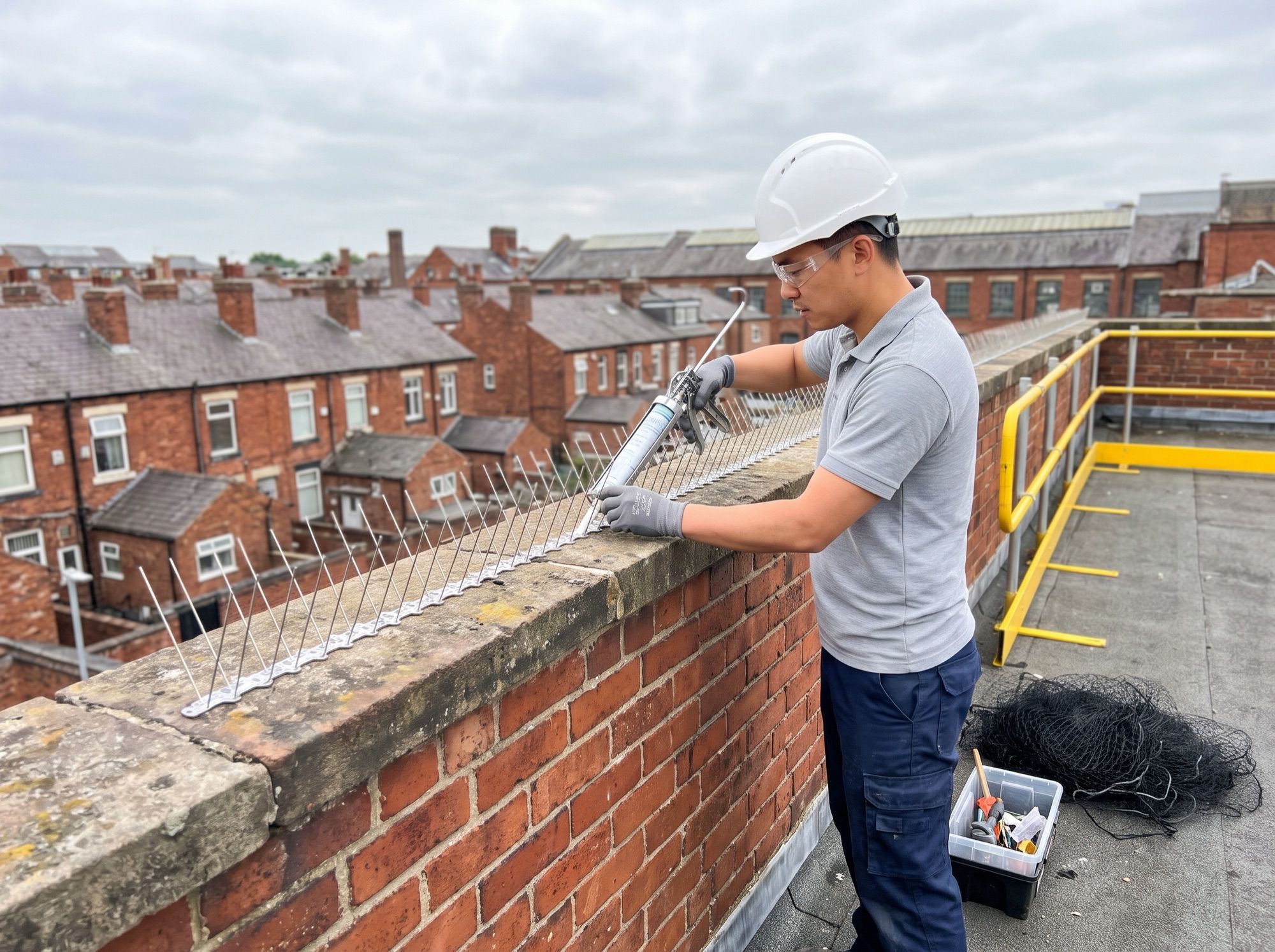
EnviroEx surveys and proofs Manchester City Centre buildings against pigeons and gulls, from Ancoats mill frontages and Northern Quarter warehouses to Castlefield conversions and Spinningfields apartment blocks. We check for active nests and listed status, then fit netting, spikes, wire or gel, often outside trading hours. Surveys are arranged promptly; call or send an enquiry to book.
Why do pigeons stay on city-centre buildings all year?
Pigeons need shelter and food, and in the centre the two are rarely far apart. The Northern Quarter’s converted warehouses, Castlefield’s restored canal and railway warehouses and the Grade II* mills of Ancoats are older buildings of the kind that typically offer window reveals, cornices, string courses and fire escapes to roost on, and shop signage and canopies on the retail streets add more. Food comes from the Arndale’s food court and market, Smithfield Market Hall’s food hall, outdoor seating and the bins behind cafes and bars.
Feral pigeons can breed in any month, so a building with ledges and food nearby holds birds in December as well as June. Gulls are a seasonal addition where they nest on flat roofs and plant decks, mostly in spring and early summer.
What we usually find on a survey here
- Light wells and courtyards in warehouse conversions, where pigeons roost out of sight and droppings build up over windows, bin stores and rear exits.
- Window reveals and lintels on listed frontages, where post-and-wire or low-profile spikes have to be fixed into joints rather than into carved stone or terracotta.
- Loading bays and service yards behind the main shopping streets, often shared by several tenants, where netting beneath the canopy is usually the reliable fix.
- Plant decks, terraces and balconies on apartment towers in Spinningfields and around Deansgate, which need rope access or the building’s cradle and the managing agent’s permits.
- Shop signage and canopies on busy shopping streets, where fouling above an entrance becomes a slip hazard and a customer complaint.
What does the Victoria station cull mean for other buildings?
From October 2025, the train operator at Manchester Victoria station had pigeons shot in early-morning culls. The contractor’s reports described droppings marking walls and walkways, fouled surfaces that turned slippery when wet, a station largely exposed to the weather and earlier proofing that had failed. After a campaign by a local pigeon rescue group, the operator ended culling at all of its stations.
Two points carry over to other buildings. Lethal control can draw public objection quickly, as it did here. And by the contractor’s own account, the proofing already in place had not done its job. We specify each system for the structure it goes on, fit it to a written specification and build inspections into the handover, so a torn panel or loose wire is found before the birds find it.
How a proofing job runs in the centre
The steps follow our bird control service: survey, written proposal with a risk assessment and method statement, clearance and cleaning, installation, handover records and periodic inspection. What changes here is the logistics. Where streets are pedestrianised or loading is limited to set hours, platforms and towers are usually booked for early mornings, evenings or Sundays, with a cordon below the work. On managed estates and in shopping centres, the estate or centre team generally issues permits to work and sets access times, and we fit around them.
Fouling comes off before any system goes on. In light wells and on canopies that clearance is often the largest part of the job, and it is damped down, bagged and followed by disinfection rather than swept dry over a busy street. On listed buildings we record the grade at survey and give you a specification to show the council’s planning team before work starts.
Keeping a proofed building clear
Proofing moves birds on, but it does not change what draws them to the street. Lidded bins, closed bin-store doors and food waste cleared promptly from yards all help, as does asking staff not to feed birds at the back door. In a terrace of old warehouses, birds pushed off one building often try the next, so a word with adjoining occupiers can save repeat work on a shared elevation.
For food businesses, the survey, specification, photographs and inspection reports belong in the pest-management file an inspector will ask to see. Our food premises pest control contracts can include a check of the proofing at each routine visit, and our rodent control team looks at the same bin stores and yards, since the food waste that feeds pigeons also feeds rats.
What we see with bird control & proofing in Manchester City Centre
- Ancoats has been a conservation area since 1989 and its mills, Murrays' Mills among them, are listed at Grade II*, so proofing on those frontages is chosen to avoid harming historic fabric and may need listed building consent.
- At Manchester Victoria station, culling began in October 2025 after earlier proofing had not worked and was later halted after pressure from a local pigeon rescue group, which is why we specify each system for its structure and build inspections into the handover.
- With large-scale construction continuing at Victoria North, St John's, NOMA and Mayfield, the simplest time to agree proofing for balconies, plant decks or roof terraces on a new block is before handover, with the developer or managing agent.
- On towers on the scale of Deansgate Square, whose South Tower has 64 floors, proofing work at height is planned around rope access or a cradle and the managing agent's permits.
- The Arndale's 800-seat food court and market, Smithfield Market Hall's food hall and the Northern Quarter's cafes all generate food waste, so bin-store management matters as much as the netting.
How the job runs
- 1
Survey and species check
We identify the species, how birds use each area, what the fixings will go into, how we will reach the work safely, and whether any nests are active or the building is listed.
- 2
Written proposal and method statement
You receive photographs, the system specified for each area, mesh sizes, access method and timing, with a risk assessment and method statement for your facilities team to approve.
- 3
Clearance and cleaning
Empty nests and fouling are removed, damped down and bagged, surfaces are disinfected, and we confirm no birds are inside any area that is about to be enclosed.
- 4
Installation
Netting, spikes, post-and-wire, gel, electric track or solar panel mesh is fitted to the agreed specification, timed around trading hours, deliveries or residents.
- 5
Handover and records
You get a record of what was installed and where, including the location of access zips and hatches in netting, plus the maintenance each system needs.
- 6
Inspection and upkeep
Netted areas and fixings are checked periodically and after storms, so a damaged panel is repaired before a bird gets in or becomes trapped.
Typical visits: Usually one survey visit and one installation visit. Large or phased sites, heavy fouling or an active nest that has to be left until it is empty can add visits, followed by periodic inspections.
Safety: Proofing excludes birds without harming them and uses no poisons. We check for live birds and active nests before enclosing an area, damp down and bag fouling rather than dry-sweeping it, and keep staff and the public out of the work zone.
Bird Control & Proofing in Manchester City Centre: questions we get asked
Pigeons are roosting in the light well of our converted warehouse. Can it be netted?
Yes, and netting is usually the only lasting answer for an enclosed light well. The net is tensioned across the opening or at a set level, with zipped access so windows, drainage and plant can still be reached. Before closing it we clear fouling and check that no bird is inside. Netting must not obstruct fire escape routes, ventilation or smoke vents, so we agree the layout with the building manager first.
Pigeon fouling is building up over our shopfront. Are we responsible for it?
Usually, for the parts of the building you occupy or control, so check your lease for who maintains the frontage, signage and canopy. Wet droppings on a walkway are a slip hazard, a risk the contractor's reports at Victoria station also recorded, and occupiers owe visitors a duty of care under the Occupiers' Liability Act 1957 as well as duties to staff under health and safety law. We clear and disinfect the fouling, proof the ledge or canopy above it and leave a written record you can share with the landlord.
How often should bird proofing on a city-centre building be inspected?
We usually suggest at least once a year, and more often on busy elevations, light wells and canopies over entrances. Nets can tear or sag, wires loosen, gel weathers, and other contractors working on roofs or signage can disturb fixings. Fresh fouling under a net is the clearest sign that birds have found a way in. Each inspection is photographed and recorded, so a food business can file it with its pest-management records and a managing agent can see the condition of every installed area.
Is general licence GL41 still current in 2026?
Yes. Natural England's latest version of GL41 came into force on 1 January 2026 and lasts for one year, replacing the version that expired at the end of 2025. It covers only the species and purposes listed in the licence document and comes with conditions, so anyone relying on it should read the version in force. We check the current licence at each survey, although for most city-centre buildings proofing is the lasting answer.
How can I get rid of pigeons legally?
Proof the places they roost and nest. The Wildlife and Countryside Act 1981 protects all wild birds, their eggs and any nest in use or being built, but excluding birds with netting, spikes, wire or gel is lawful as long as no bird is harmed or trapped and no active nest is destroyed. Lethal control of feral pigeons is possible under Natural England's general licence GL41 for specific public health and safety purposes, but removed birds are soon replaced while the building still offers a roost, so exclusion is the lasting answer.
Am I allowed to shoot pigeons in my own garden?
Only in narrow circumstances. General licence GL41 lets an owner or occupier act against feral pigeons only for the purposes it lists, such as preventing slips and falls or the spread of disease to people, and you must meet its conditions, including humane killing, as well as firearms law and basic safety. Shooting to stop pigeons eating bird seed or sitting on a fence is unlikely to fit those purposes, and in built-up parts of Greater Manchester it is rarely safe or practical. Proofing the roof, removing the food source and covering solar panels is the realistic route.
Can you remove a gull nest from our roof?
Not while it is in use, unless a licence is in place. Herring gulls and lesser black-backed gulls are not listed on Natural England's public health and safety general licence (GL41), so removing a nest that is being built or holds eggs or chicks normally needs an individual licence. Expect Natural England to ask for evidence of a genuine public health or safety risk and of the non-lethal options considered, so it is not a quick fix. Once the young have fledged and the nest is empty, it can be cleared. The lasting fix is to proof the roof between breeding seasons so gulls cannot nest there next spring.
More in Manchester City Centre
Last updated: