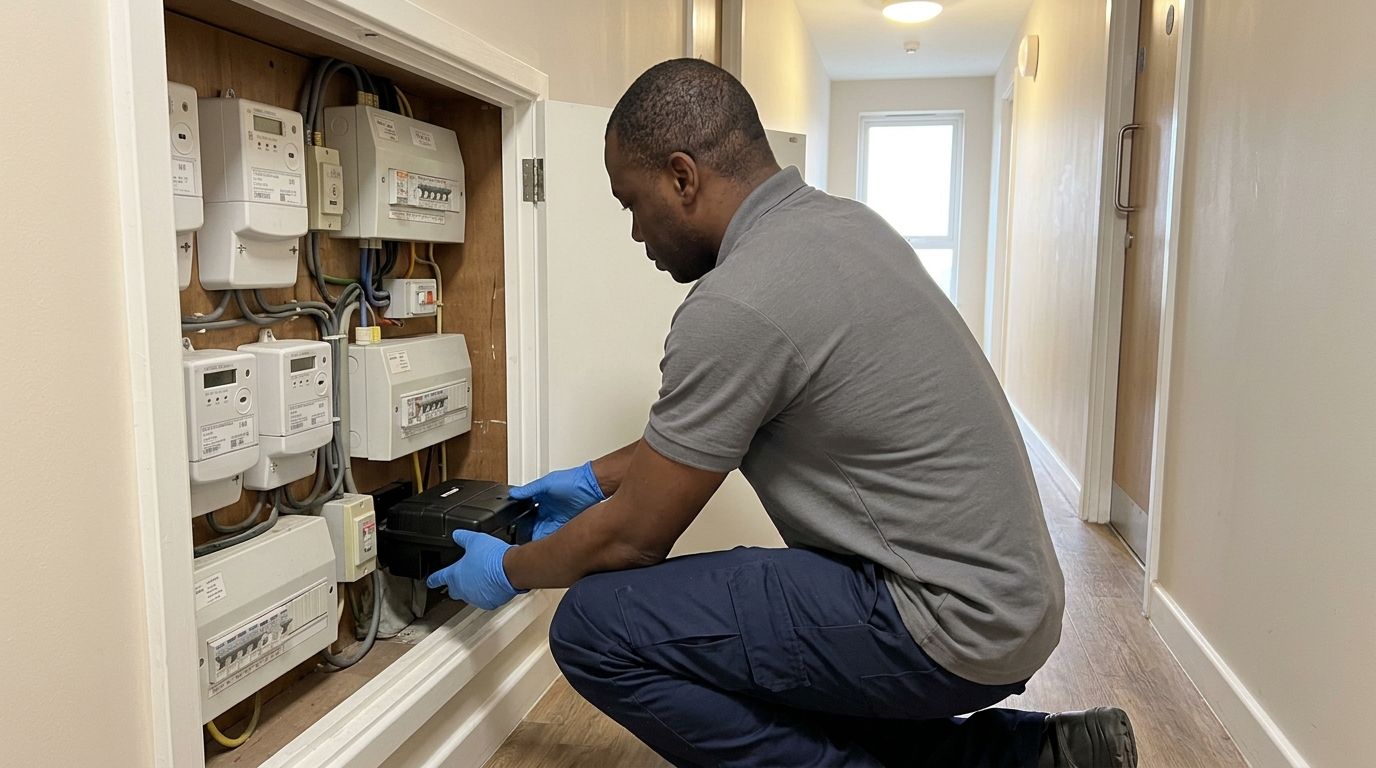
EnviroEx provides pest control for landlords, letting agents and HMO managers across Manchester and all ten Greater Manchester boroughs. We arrange access with your tenant, treat promptly, proof the entry points behind the problem and send a written report for your property file. Call us or pass on the tenant's report through our contact form to book.
How do landlords usually find out there is a problem?
Usually through a tenant’s message, often with a photograph attached. Typical reports from rented homes are droppings in kitchen cupboards or behind the cooker, scratching in ceilings and stud walls at night, gnawed food packaging, and small dark spots on mattress seams alongside bites. In flats, the first sign is often a cockroach near the sink or boiler cupboard after dark, or pigeons nesting on a balcony.
Some problems surface at a void inspection instead: droppings in an empty kitchen, flea bites on whoever does the check-in, or a smell from under a bath panel. Treat any of these as a report in its own right and date it. Your repairing obligations for problems inside the property usually start to run once you have been told about them.
Why do rented properties in Manchester attract pests?
Many private rented homes across Greater Manchester are Victorian and Edwardian terraces. These houses share party walls and, in many rows, connected roof spaces and sub-floor voids, so mice move between properties with little to stop them. Back alleys lined with shared bins, old clay drains and broken air bricks give rats easy routes in.
Newer stock has its own weak points. Converted mills and city-centre apartment blocks have service risers, boxed-in pipework and communal bin stores that link one flat to the next, which is how cockroaches and mice spread through a building. Student houses and HMOs in areas such as Fallowfield see frequent changes of occupier, with luggage and second-hand furniture moving in and out every summer, which is a common route for bed bugs.
A property left empty for a few weeks can be colonised quietly, and the incoming tenant is the one who finds out.
Who is responsible: the landlord or the tenant?
It depends on the cause, the tenancy agreement and the condition of the property. In England, though, the law points towards the landlord more often than many expect.
- Repair. Section 11 of the Landlord and Tenant Act 1985 requires landlords of most residential tenancies under seven years to keep the structure and exterior in repair, including drains, gutters and external pipes. If rats or mice are getting in through a broken air brick, a defective drain or gaps in the fabric, fixing that entry point is usually the landlord’s job.
- Fitness. The Homes (Fitness for Human Habitation) Act 2018 requires most rented homes to be fit to live in at the start of the tenancy and throughout it, and tenants can go to court if they are not.
- HHSRS. The Housing Health and Safety Rating System lists domestic hygiene, pests and refuse as a hazard. A council can inspect and, where the risk is serious enough, serve an improvement notice.
- Rats and mice. Under the Prevention of Damage by Pests Act 1949, a council can serve notice on an owner or occupier to deal with rats or mice, including structural work, and can do the work itself and recover its costs if the notice is ignored.
Tenants have obligations as well. They are expected to look after the home in a tenant-like manner, which includes keeping it reasonably clean and disposing of rubbish properly. Fleas from a tenant’s own pet, or an infestation fed by food waste left out for weeks, may fall to the tenant depending on the agreement. Bed bugs are harder to attribute, because they usually arrive in luggage or furniture and it is rarely clear who brought them in.
The practical advice is the same either way: act quickly, get the cause identified in writing and settle the cost afterwards. The Renters’ Rights Act 2025 is changing private renting in England in stages, with further property standards expected later, so check current government guidance.
How do we handle a tenant’s pest report?
We start with what you already know: the tenant’s report, the property type and who holds the keys. If you authorise it, we contact the tenant directly to book access and explain what will happen, and we copy you or your letting agent into every arrangement.
At the first visit the technician inspects the whole property, not just the room where the pest was seen: kitchen voids, under the bath, the loft hatch, the exterior, drain covers and any shared areas we can reach. The aim is to find where the pest is living and how it gets in.
Treatment then follows the pest. For rats and mice our rodent control work may use traps, monitoring or bait in tamper-resistant stations. Bed bug treatment is planned around the tenant preparing the room beforehand. Cockroaches in a block are treated with gel baits and monitoring across linked flats rather than one unit in isolation. The tenant receives written preparation and aftercare instructions, and you receive a report setting out what we found, what we did and which repairs are needed.
How do you keep tenants, children and pets safe?
Every property is risk-assessed before treatment, taking account of children, pets and elderly or vulnerable occupiers. Professional rodenticides are used under the UK rodenticide stewardship regime overseen by CRRU UK, which expects non-chemical methods to be considered first and bait to be secured and accounted for. Where bait is justified, it goes in locked tamper-resistant stations, out of reach, marked on a plan so every station can be collected at the end.
Since 31 July 2024, under the Glue Traps (Offences) Act 2022, it has been an offence in England to set a glue trap to catch a rodent without a Natural England licence. Licences go only to professional pest controllers in exceptional circumstances, so glue traps are not an option for landlords or tenants.
Insecticide treatments for bed bugs, fleas and cockroaches come with specific instructions on re-entry, pets and cleaning, which we give the tenant in writing.
How many visits does it usually take?
Most rat and mouse jobs need two or three visits, roughly a week to ten days apart, so the technician can check activity, adjust the treatment and confirm it has stopped. Bed bugs normally need a follow-up treatment two to three weeks after the first, because eggs can survive the initial treatment. Cockroach work in blocks can run over several weeks, particularly where neighbouring flats are affected.
Access is a common cause of delay. Where a tenant cannot be in, we log every attempt so you have a record of what was offered and when.
What proofing stops pests coming back?
Treatment without proofing tends to buy a few months. The repairs that make the difference in older rental stock are usually modest: replacing broken air bricks with mesh-backed ones, sealing gaps where pipes and cables pass through walls, closing voids behind kitchen units and under baths, fitting brush strips to external doors, and repairing or capping redundant drain runs that rats use to reach sub-floors. Where a drain is the suspected route, a CCTV drain survey is often the most reliable way to find the defect.
For blocks and HMOs, bin stores deserve as much attention as the flats themselves. Lidded bins, regular collections and a clean refuse area remove the food source. Pigeons nesting on balconies or ledges are a job for bird control and proofing. Wild birds, their eggs and nests in use or being built are protected under the Wildlife and Countryside Act 1981, so any action beyond exclusion has to fit the terms of a general licence.
We fit the proofing we can on the day and list the rest with photographs, so your maintenance contractor can price and complete it.
When does DIY stop being enough?
A tenant setting a couple of snap traps for a single mouse is reasonable. Shop-bought sprays used on bed bugs or cockroaches are not: they tend to scatter the insects into neighbouring rooms and flats, which makes professional treatment slower.
Bring in a professional when activity continues after a week or two, when more than one room or flat is affected, when the property is an HMO, or when the tenant is vulnerable or has young children. Treat a council letter or a tenant’s formal disrepair complaint as an immediate trigger too: from that point the paperwork matters as much as the treatment.
What should a landlord keep on record?
Keep a simple trail for each property: the date of each tenant report, your response, every access attempt, the technician’s reports, photographs of defects, the repairs carried out and the date the problem was signed off. Our reports are written to drop straight into that file.
That record helps if a tenant complains to the council, if a deposit deduction is disputed, or if an HMO or selective licensing team asks how the property is managed. For portfolios, or blocks with shops and food businesses on the ground floor, our commercial pest control contracts can bring scheduled inspections into the same reporting.
How pest control for landlords works with EnviroEx
- 1
Report and triage
Tell us what the tenant has reported, the property type, whether it is an HMO or part of a block, and who holds keys. We confirm the likely pest and agree how access will work.
- 2
Tenant liaison and inspection
With your authority we contact the tenant directly, book a slot and survey the whole property, including shared areas and the exterior, for activity and entry points.
- 3
Treatment
We treat with the least hazardous method that will work, secure any bait in tamper-resistant stations and give the tenant written preparation and aftercare instructions.
- 4
Proofing and repair notes
We seal the gaps we can on the day and list structural defects such as broken air bricks or damaged drains, with photographs, for your maintenance contractor.
- 5
Follow-up and sign-off
We revisit to confirm the problem has stopped, remove any bait and send a written report you can keep on the property file.
Typical visits: Most rat and mouse jobs take two or three visits over two to three weeks; bed bugs and cockroaches usually need at least one follow-up treatment.
Safety: Every property is risk-assessed for children, pets and vulnerable occupiers before treatment. Any rodenticide is kept in locked tamper-resistant stations and tenants receive clear written instructions.
Pest Control for Landlords: your questions answered
Is the landlord or the tenant responsible for pest control?
It depends on the cause and the tenancy agreement. Where pests get in through disrepair, such as a broken air brick or a defective drain, the landlord's repairing duty under section 11 of the Landlord and Tenant Act 1985 usually applies. A serious infestation can also make a home unfit under the Homes (Fitness for Human Habitation) Act 2018. Tenants may be responsible where their own actions caused it, for example fleas from their pet or rubbish left to build up. In practice it is usually quicker and cheaper to act first and settle the cost question with evidence afterwards.
Do landlords legally have to get rid of mice?
No single law says a landlord must treat mice, but in most cases the obligation follows from several. Mice usually enter through gaps in the structure, which falls under the landlord's repairing duty. A significant infestation can count as a hazard under the Housing Health and Safety Rating System, which the council can enforce, and the Prevention of Damage by Pests Act 1949 lets councils require owners or occupiers to deal with rats and mice. If the tenant's behaviour is clearly the cause, the position may be different.
Can the council take action against me over pests in a rented property?
Yes. If a tenant complains, the council can inspect under the Housing Health and Safety Rating System, where domestic hygiene, pests and refuse is one of the listed hazards, and serve an improvement notice if the risk is serious enough. Under the Prevention of Damage by Pests Act 1949 it can also require an owner or occupier to take steps against rats or mice, including structural work, and recover its costs if it has to do the work itself. A prompt response and a written record put you in a far stronger position.
Will you deal with my tenants directly?
Yes, if you authorise it. We contact the tenant to book access, explain what the treatment involves and send them preparation and aftercare instructions in writing. You or your letting agent are copied into every arrangement, and if access is refused or missed we log each attempt so you have a dated record. It also takes you out of the middle of a conversation that can become tense when a tenant has been living with pests.
Can I charge pest control to the tenant's deposit?
Sometimes, but be careful. Under the Tenant Fees Act 2019, requiring a tenant to pay for a professional treatment as a condition of the tenancy, such as a compulsory end-of-tenancy flea treatment, is generally treated as a banned payment. You can usually claim the reasonable cost of putting right damage caused by a breach of the tenancy, such as an infestation from an unauthorised pet. Deposit schemes will expect evidence: check-in and check-out reports, photographs and a dated technician's report. Take advice on individual cases.
How do you handle pests in an HMO or a block with shared areas?
We treat the building as one system. In an HMO, bed bugs and cockroaches move between rooms, and in blocks mice and cockroaches travel along service risers, boxed-in pipework and bin stores. Treating only the room that complained rarely works. We inspect shared kitchens, bathrooms, corridors and refuse areas, and plan treatment across every affected unit. HMO managers also have duties under the Management of Houses in Multiple Occupation (England) Regulations 2006 to keep common parts clean and in repair and to provide adequate refuse facilities.
What paperwork do I get after each visit?
A written report for every visit. It records the pest identified, where activity was found, the method and any products used, the position of bait stations, proofing carried out on the day, structural defects needing repair with photographs, what the tenant has been asked to do, and the follow-up date. The final report confirms sign-off. It is written to sit in your property file and to answer the questions a council officer, deposit adjudicator or licensing team is likely to ask.
Can you treat an empty property between tenancies?
Yes, and a void period is often the best time. With no one living there we can inspect every cupboard and void, treat without working around a household, and complete proofing before the new tenant moves in. We also carry out pre-let checks for fleas and bed bugs after a previous tenant has left, and the report gives you a dated record of the property's condition at the start of the new tenancy, which helps if a dispute arises later.
Pest Control for Landlords by area
Local detail for the places we serve most often.
Last updated: