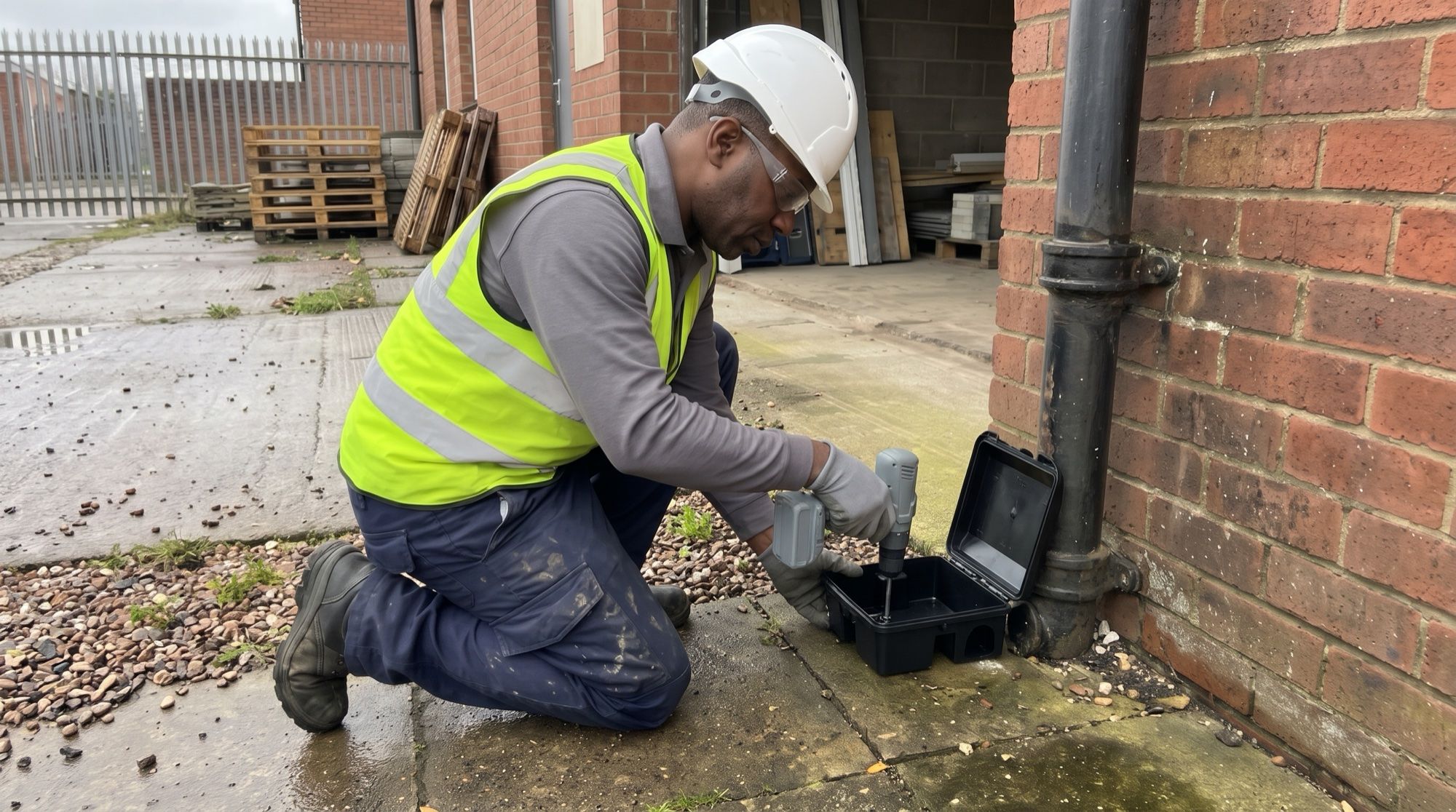
EnviroEx deals with rats and mice in food premises, offices, rented property and homes across Manchester and the ten Greater Manchester boroughs. We arrange a prompt survey, trace how rodents get in, treat with tamper-resistant stations or traps, proof entry points and leave a written report after each visit. Call or send an enquiry to book.
What are the signs of rats or mice in a building?
Droppings are usually the first sign. Mouse droppings are small, around 3 to 6 mm, dark and pointed at the ends, and tend to be scattered wherever mice have fed. Rat droppings are larger, roughly 10 to 14 mm with blunter ends, and collect in fewer places along a regular route.
On a survey we also look for:
- gnawed packaging, skirting boards, pipe lagging and cable sheathing
- dark, greasy smear marks where rats brush repeatedly against walls, joists and pipe entries
- scratching in ceiling voids, stud walls or behind kitchen kickboards, mostly at night
- a stale, ammonia-like smell in stores, cupboards and under counters
- burrows beside walls, under decking and sheds, and around bin stores
- footprints and tail marks in dust in plant rooms, lofts and cellars
In a commercial kitchen, staff often see mice first in dry stores and behind cooking ranges, where warmth, cover and spilt food sit together. Rats are more likely to show themselves around bin compounds, yards and drainage.
Why do rats and mice get into Manchester buildings?
Many Greater Manchester neighbourhoods are built around Victorian and Edwardian terraces, with back alleys, shared drainage runs and old clay pipes that can crack or shift with age. Brown rats commonly live in sewers and drains. A broken pipe, an open junction left behind after a kitchen or bathroom refit, or a missing cap on a rodding point gives them a way up into the void under a floor. It is a common reason fresh activity appears a few weeks after a house has been cleared.
Commercial premises add their own pressures. The city centre and many borough town centres fit restaurants, takeaways, bars and food shops into older buildings, often with shared yards and commercial waste stored close to back doors. Converted mills and warehouses have service risers, ceiling voids and ducting that connect one unit or flat to the next, so mice can move through a whole building. Railway arches, distribution sheds and industrial estates such as Trafford Park combine loading doors that stand open for long periods with stored goods and pallets that give cover.
Season plays a part. As temperatures fall in autumn and food outdoors gets scarcer, rats and mice move indoors, which is when many people first notice them. Drainage works and redevelopment can also disturb established rat populations and push them into neighbouring property.
How does our rat and mouse treatment work?
Every job starts with a survey, not a bait station, because rats and mice behave differently and need different placement. Mice feed in small amounts from many points within a few metres of their nest, so stations or traps go close together along walls and into voids. Rats travel further along fixed runs and are wary of new objects in their path, so it can take several days before they feed from a station placed in their way.
We then trace how they are getting in, including the drainage. Where the evidence points to a drain defect, we say so and recommend a CCTV drain survey or repair, rather than baiting the same property indefinitely.
Treatment uses tamper-resistant stations secured in place, or traps, chosen after an environmental risk assessment of the site. Professional rodenticides in the UK are sold under the UK Rodenticide Stewardship Regime, which CRRU UK runs under government oversight. Buyers must show proof of competence, and the product label sets legally binding conditions on where bait can be laid and how it is used. If baiting has not worked within about five weeks, CRRU guidance is to find out why rather than carry on. Bait comes out once activity stops rather than staying down as a precaution; on contract sites, non-toxic monitoring blocks show whether rodents have returned.
Is treatment safe for children, pets, staff and customers?
Safety comes down to placement and product choice. Bait goes only inside locked stations fixed to the wall or floor, or into voids and areas that children and animals cannot reach. Every station is numbered and marked on a plan, so staff, tenants and the next technician know where it is.
In homes with young children, dogs or cats, and in nurseries, schools and care settings, we often take a trapping-led approach in the areas people use, with traps inside enclosed boxes. In food premises, nothing goes where it could contaminate food, packaging or food-contact surfaces, and loose bait is never used in food-handling areas.
Glue traps are no longer an option for general use. Under the Glue Traps (Offences) Act 2022, using them to catch rodents in England has been an offence since April 2024 unless a licensed pest controller is using them. Licences are issued by Natural England only in exceptional circumstances, to protect public health or safety where no other satisfactory solution exists.
We remove any bodies we can reach on follow-up visits. If a rodent dies in an inaccessible void there can be an odour for a short time; trapping in sensitive areas reduces that risk.
How many visits will it take?
For a typical rat or mouse problem, expect two to four visits. The first covers the survey, treatment and any immediate proofing. Follow-ups usually come every seven to ten days to check stations, record what has been taken and adjust placement. Once a visit finds no fresh activity, equipment containing rodenticide is removed and the job is closed with a written report.
Larger or more complex sites take longer, particularly where a drain defect needs repair first or several units share voids. Food businesses, warehouses and multi-occupancy buildings often move onto a scheduled contract afterwards, with visit frequency set by the site’s risk rather than a fixed number. Our commercial pest control and food premises pest control services explain how that works.
What proofing stops rats and mice coming back?
Rodents exploit very small gaps. A young mouse can get through an opening of about 6 mm and a rat through about 15 mm, so proofing focuses on details that are easy to miss:
- gaps around pipes and cables where they pass through walls and floors
- worn door sweeps and gaps under external doors and roller shutters
- broken or missing airbrick covers
- open cavities behind kitchen units and boxed-in pipework
- defective drains, open junctions and uncapped rodding points
- gaps under eaves and at roof-line junctions
We use materials rodents struggle to chew through, such as steel mesh, stainless steel wool sealed in place, metal kick plates, brush strips and cement-based fillers. Where structural or drainage work is needed beyond what we fit on the day, we photograph and record it for the landlord, managing agent or maintenance contractor.
Housekeeping matters as much as hardware: lidded bins kept away from doors, food stored off the floor in sealed containers, and no cardboard or pallet stacks left against walls.
When does DIY stop being enough?
A single mouse in a kitchen can sometimes be dealt with using snap traps and better food storage. DIY stops being enough when activity continues after a week or two, when you are seeing rats rather than mice, when there are signs in more than one room or unit, or when you can hear movement in walls and ceilings you cannot get into.
Shop-bought rodenticides are usually lower strength, come in smaller packs and tell you nothing about where the rodents are coming from. For a business or a landlord there is also the question of evidence: an environmental health officer, a tenant or a letting agent will want to see what was done, when and by whom.
What should a business or landlord keep on record?
Food businesses must have adequate pest-control procedures under food hygiene law: Regulation (EC) No 852/2004 as kept in UK law, enforced alongside the Food Safety Act 1990 and the Food Safety and Hygiene (England) Regulations 2013. In practice an inspector will usually want to see a plan of station locations, visit reports with findings and recommendations, details of any products used, and evidence that recommendations were acted on. These belong with your HACCP or Safer Food, Better Business documentation. A pest control contract does not move legal responsibility away from the food business operator, but good records show the risk is being managed.
Landlords should keep a log of tenant reports, response dates, contractor reports and proofing work. In most tenancies, section 11 of the Landlord and Tenant Act 1985 places repairs to the structure, exterior and drains with the landlord. The Homes (Fitness for Human Habitation) Act 2018 requires the home to be fit to live in, and “domestic hygiene, pests and refuse” is one of the hazards assessed under HHSRS. Our pest control for landlords service covers HMOs, common parts and access arrangements in more detail.
How rat & mouse control works with EnviroEx
- 1
Survey and identification
We confirm whether it is rats or mice, map droppings, runs and gnawing, and trace the entry route through walls, voids, service ducts and drains.
- 2
Written treatment plan
You get a short plan setting out the method, where stations or traps will go, any proofing needed and what we need from you, your staff or your tenants.
- 3
Secure treatment
After a site risk assessment, tamper-resistant stations or traps go on active runs, with any rodenticide used in line with the product label and CRRU UK stewardship guidance.
- 4
Proofing and exclusion
Gaps around pipes, under doors, at airbricks and in drainage are sealed, screened or photographed and flagged for repair so the problem is not simply reset.
- 5
Follow-up and close-out
Return visits check activity, adjust placement and remove bait and bodies, finishing with a written report you can keep with your records.
Typical visits: Usually two to four visits: a survey and first treatment, then checks roughly every seven to ten days until activity stops. Food premises and larger sites often move onto a scheduled contract afterwards.
Safety: Rodenticide only goes inside locked, fixed, tamper-resistant stations or into voids children and animals cannot reach, and every station is marked on a plan. Where pets or young children share the space, we often use enclosed traps in those areas instead.
Rat & Mouse Control: your questions answered
Will one mouse sighting affect our food hygiene rating?
Not automatically. The inspector scores what they find on the day across food hygiene and safety, the condition of the structure and confidence in management. A sighting that was reported, treated, proofed and recorded shows your controls working. Live activity, droppings near food, gaps left open or missing pest records count against you, and where there is an imminent risk to health the council can close premises with a hygiene emergency prohibition notice. Early action and a clear paper trail make the difference.
Who pays for rat control in a rented property, the landlord or the tenant?
It depends on the cause and the tenancy. In most tenancies, section 11 of the Landlord and Tenant Act 1985 makes the landlord responsible for keeping the structure, exterior and drains in repair, so rodents getting in through defects usually fall to the landlord. The Homes (Fitness for Human Habitation) Act 2018 also requires the home to be fit to live in. Where an infestation comes from how a tenant stores food or rubbish, the tenancy agreement may put the cost on them. We can report directly to the landlord or managing agent.
Do I have to report rats to the council?
The Prevention of Damage by Pests Act 1949 requires the occupier of land, other than agricultural land, to tell the local authority in writing if they know rats or mice are living on or visiting it in substantial numbers. The council can then require treatment or structural work. Whether your situation meets that threshold depends on the circumstances: a few droppings in a store room is not the same as an established colony. A treatment plan backed by written visit records shows the problem is being dealt with.
Is rat poison safe if we have children or pets at home?
Used properly the risk is low, and placement does most of the work. We put rodenticide only in locked, tamper-resistant stations fixed in place, or in voids children and animals cannot reach, and we mark every station on a plan. Where young children, dogs or cats have access to the treated area, we often use enclosed traps instead. Pets can also be harmed by eating a poisoned rodent, which is one reason we collect any bodies we can reach. Please tell us about pets when you book, and do not move, open or refill stations yourself.
How long does it take to get rid of rats or mice?
Most domestic and small commercial jobs take two to four weeks. Mice usually start feeding quickly but spread across many small territories, so placement has to be thorough. Rats are cautious of new objects and may avoid a station for several days before feeding from it. The bigger variable is the entry route: if it is a drain defect or a gap into shared voids, the job is not finished until that is fixed or the repair is in hand.
Why do rats keep coming back after treatment?
Usually because the way in has not changed. Clearing rodents from inside a building without dealing with how they arrived leaves the route open for the next ones. In older Greater Manchester terraces the cause is often a broken or disconnected drain beneath the floor. In commercial units it is more often gaps around services, worn door seals or voids shared with a neighbouring business. We look for the route on the first visit and record exactly what needs proofing or repair.
Who is responsible if rats are coming up from the drains?
It depends where the defect is. In England, a drain that serves only your property and sits within its boundary is usually the owner's responsibility. Since October 2011, most shared drains, and the pipework beyond the boundary that joins the public sewer, have been the responsibility of the local water and sewerage company. That matters in terraced streets where one run serves several houses. A CCTV drain survey shows where the break is, and we can pass our findings on. Treatment and proofing inside the building stay with the owner or occupier.
Can I buy professional rat poison and deal with it myself?
Not the professional products. Under the UK Rodenticide Stewardship Regime, professional-use rodenticides are only sold to buyers who can show proof of competence, and the most potent products are no longer sold for use in open areas away from buildings. Products sold to the public are usually lower in concentration and come in smaller packs. For a single mouse, traps and tidy food storage may be enough. For rats, repeat activity or any business premises, a survey that finds the entry route is usually quicker in the end.
Rat & Mouse Control by area
Local detail for the places we serve most often.
Last updated: