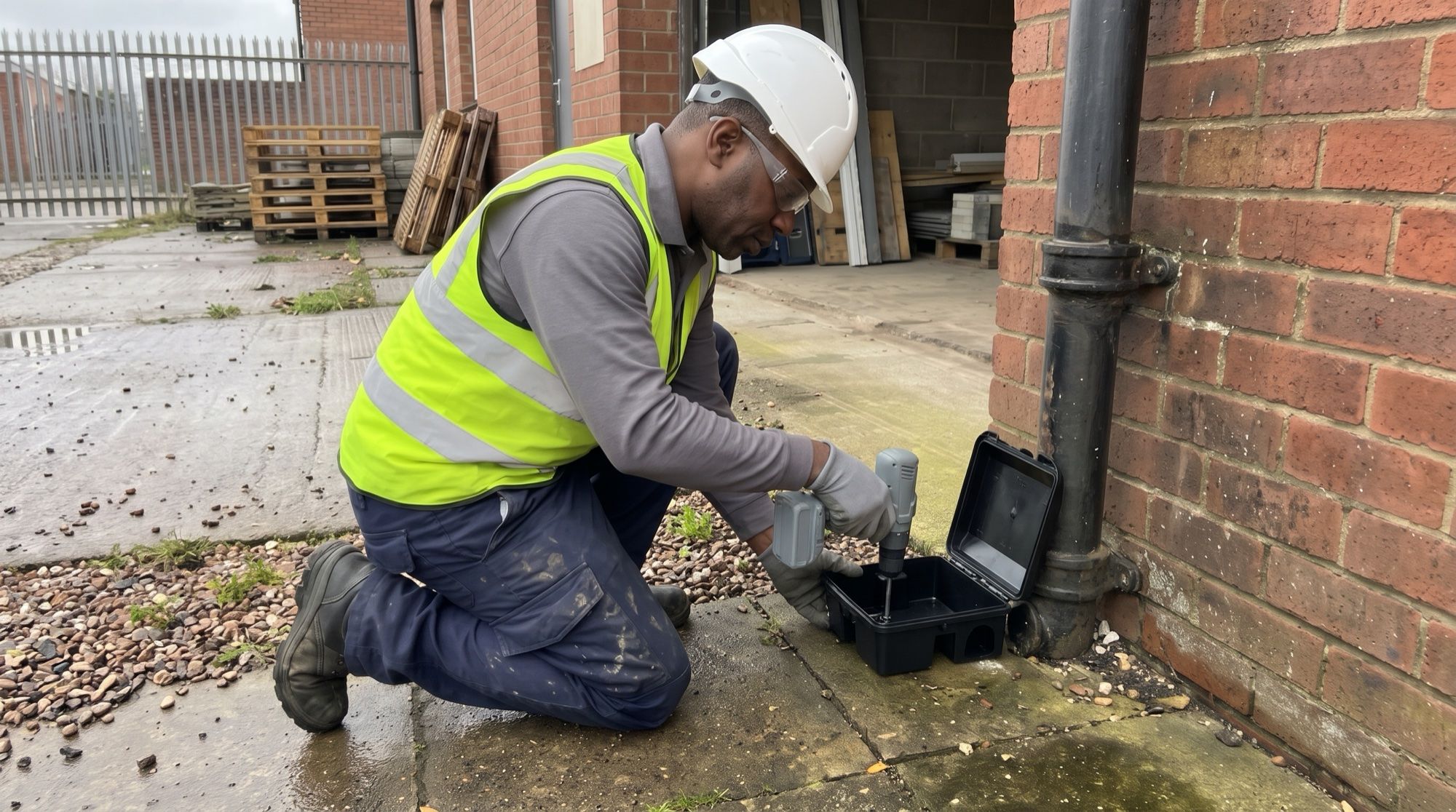
EnviroEx tackles rats and mice in Oldham food premises, shops, care homes, industrial units and houses, including Werneth, Chadderton and Failsworth. A prompt survey finds the way in, often a drain or shared terrace void, before secured stations or traps go down, gaps are proofed and every visit is written up. Phone or fill in the enquiry form to book.
What do the council’s rat figures tell Oldham premises?
Council figures put rat infestations at 475 in 2020, 497 in 2021 and 506 in 2022. Calls made to private landlords or housing associations are not counted, so the true figure across the borough’s homes and businesses is likely to be higher. Several local conditions keep rats supplied. General household waste has been collected every three weeks since October 2016, so food scraps that end up in the wrong bin wait a long time for the lorry. Fly-tipping fills the gaps: on one council round in Werneth, a rat was seen feeding on rubbish dumped outside a house. And once the weather turns around mid-September, rodents start looking for a way indoors, which is when small gaps in a building begin to matter.
Shops, care settings and industrial units
Units trading inside the Spindles and Town Square typically share service corridors and waste stores, and mouse activity in one unit often has a route through to the next, so a station plan has to work with centre management rather than stop at the shop door. Care and residential homes need a trapping-led approach indoors and a firm grip on the bins; at one Failsworth residential home, a council round found dozens of rats in a single wheelie bin. Hospitals, colleges and nurseries call for the same caution, with visit times agreed in advance.
On industrial and business parks, from Salmon Fields in Royton to the Hollinwood Junction scheme by M60 Junction 22, the focus shifts to dock doors, shutter seals, pallets stacked against walls and the perimeter fence line, with non-toxic monitoring blocks showing whether rodents return between visits. Each visit report lists station checks, activity found and proofing still needed, ready to file in a food safety record or audit pack.
Waterside premises and the Medlock valley
The Rochdale Canal at Failsworth, the Medlock’s wooded valley separating Lees from Ashton-under-Lyne, the Beal on the Royton side and the Huddersfield Narrow Canal through Saddleworth all give brown rats long, sheltered corridors. One Saddleworth café had rats coming up from the canal for food. On sites like these the survey covers the boundary, drains and any outfalls as well as the building. Product labels tightly restrict bait close to water, and the Rochdale Canal is a Site of Special Scientific Interest, so waterside jobs rely on trapping, external stations fixed well back from the water’s edge and solid proofing of doors, drains and service entries.
What do we find in Oldham’s terraces?
Oldham’s mill-worker housing, mostly two-up-two-down rows dating from around 1870 to 1920, sets the pattern for a lot of the domestic rodent work here. Typical findings are a clay drain that has cracked or lost a joint under the back kitchen, often where an extension or bathroom was added later; a waste pipe leaving the rear wall with an open gap around it; and mice moving between houses through the shared roof space or along voids behind skirting boards. Because one drain run can serve a whole row, we ask about neighbours at the first visit, and treating one house while the activity carries on next door rarely ends the problem.
Chadderton’s early-twentieth-century rows behave in much the same way. Saddleworth does not. Its millstone grit cottages sit on a rural edge, so mice and rats arrive from fields, walls and canal banks in autumn, and the usual entry points are open joints in old pointing and gaps around timber frames rather than drains alone.
How a rat job runs in Oldham
The first visit maps the activity, the drainage and the likely way in, then sets stations or traps out on a numbered plan. Further visits follow at gaps of about a week to ten days until one finds no fresh activity, and each ends with a written report. Where the evidence points to a broken drain, we recommend a CCTV survey instead of topping up bait week after week. Residents on Council Tax Reduction may qualify for a free council treatment, and social housing tenants should report to their landlord first, so we say so when you call if either applies to you.
What keeps rats away from an Oldham property afterwards?
Put food waste in the weekly caddy rather than the three-weekly general bin, keep lids shut and never leave bags beside a full bin. Report fly-tipping near your property to the council promptly. On business premises, trade waste belongs in closed bins well away from doorways, and cardboard and pallets should not be stacked against yard walls. In brick terraces, rodent-proof airbrick covers keep ventilation working while closing the gap; in Saddleworth’s stone cottages, open joints are best repointed with a mortar that suits the stone. Check door sweeps every year before mid-September, when rodents tend to start moving indoors.
What we see with rat & mouse control in Oldham
- The council's rat call-outs rose in both 2021 and 2022, reaching 506, and because calls made to private landlords and housing associations are not counted, the real number is likely to be higher.
- In the borough's two-up-two-down mill terraces one drain run often serves several houses, so a survey here checks how far along the row the activity reaches before any station goes down.
- A Saddleworth café had rats arriving from the canal for food, while the Rochdale Canal, the Medlock and the Beal give rats similar corridors elsewhere in the borough, so waterside sites get boundary and outfall checks.
- General waste has gone out three-weekly since October 2016 while food waste stays weekly, which makes food scraps in the wrong bin, side bags and fly-tipping, as seen in Werneth, a steady source of food for rats.
- A council technician has described rodents trying to get indoors from around mid-September, so late summer is the time for Oldham premises to check door sweeps, airbricks and bin stores.
How the job runs
- 1
Survey and identification
We confirm whether it is rats or mice, map droppings, runs and gnawing, and trace the entry route through walls, voids, service ducts and drains.
- 2
Written treatment plan
You get a short plan setting out the method, where stations or traps will go, any proofing needed and what we need from you, your staff or your tenants.
- 3
Secure treatment
After a site risk assessment, tamper-resistant stations or traps go on active runs, with any rodenticide used in line with the product label and CRRU UK stewardship guidance.
- 4
Proofing and exclusion
Gaps around pipes, under doors, at airbricks and in drainage are sealed, screened or photographed and flagged for repair so the problem is not simply reset.
- 5
Follow-up and close-out
Return visits check activity, adjust placement and remove bait and bodies, finishing with a written report you can keep with your records.
Typical visits: Usually two to four visits: a survey and first treatment, then checks roughly every seven to ten days until activity stops. Food premises and larger sites often move onto a scheduled contract afterwards.
Safety: Rodenticide only goes inside locked, fixed, tamper-resistant stations or into voids children and animals cannot reach, and every station is marked on a plan. Where pets or young children share the space, we often use enclosed traps in those areas instead.
Rat & Mouse Control in Oldham: questions we get asked
Can Oldham Council treat our rats for free instead?
Possibly. According to the council's current page, a household receiving Council Tax Reduction may qualify for one free treatment in any 12-month period, and rats and mice are among the pests it covers; a Council Tax discount on its own does not count, and you need your Council Tax reference ready when booking. Other homeowners and private renters pay for the council service, social housing tenants are directed to their landlord, and businesses are quoted individually by email. If one of the free routes fits your situation, we will tell you when you call.
Rats are coming from the canal behind our premises. Can you treat the bank?
Usually not directly. The towpath and bank normally belong to the waterway's owner rather than to you, and baiting beside water is restricted by product labels and CRRU guidance, with extra care on the Rochdale Canal because of its protected status. What we can do is secure your side of the boundary: trap or fit fixed stations set back from the water, proof doors, drains and service entries, and record the evidence so you can pass it to the waterway owner if activity continues.
Will you need to get into neighbouring houses on our terrace?
Not always, but it helps. In Oldham's mill terraces the drain run and roof space are often shared, so mice or rats in one house can be living under or above the next. We treat and proof the property that called us, ask whether neighbours have noticed anything, and where the evidence points next door, suggest a joint survey. Landlords who own several houses on one street usually get a quicker result by having them surveyed together rather than one at a time.
Our business is in part of an old multi-storey mill building. How do you handle mice there?
As one building, even if you only rent one floor. Mice in large mill-era buildings travel through lift and stair cores, service risers and old floor voids, so a station plan that stops at your door tends to move them around rather than remove them. We map your floor first, then agree with the landlord or managing agent where monitoring should go in shared areas, so every occupier is working from the same plan and your own reports stay separate.
Will one mouse sighting affect our food hygiene rating?
Not automatically. The inspector scores what they find on the day across food hygiene and safety, the condition of the structure and confidence in management. A sighting that was reported, treated, proofed and recorded shows your controls working. Live activity, droppings near food, gaps left open or missing pest records count against you, and where there is an imminent risk to health the council can close premises with a hygiene emergency prohibition notice. Early action and a clear paper trail make the difference.
Who pays for rat control in a rented property, the landlord or the tenant?
It depends on the cause and the tenancy. In most tenancies, section 11 of the Landlord and Tenant Act 1985 makes the landlord responsible for keeping the structure, exterior and drains in repair, so rodents getting in through defects usually fall to the landlord. The Homes (Fitness for Human Habitation) Act 2018 also requires the home to be fit to live in. Where an infestation comes from how a tenant stores food or rubbish, the tenancy agreement may put the cost on them. We can report directly to the landlord or managing agent.
Do I have to report rats to the council?
The Prevention of Damage by Pests Act 1949 requires the occupier of land, other than agricultural land, to tell the local authority in writing if they know rats or mice are living on or visiting it in substantial numbers. The council can then require treatment or structural work. Whether your situation meets that threshold depends on the circumstances: a few droppings in a store room is not the same as an established colony. A treatment plan backed by written visit records shows the problem is being dealt with.
More in Oldham
Last updated: