EnviroEx provides pest control and bird proofing for Salford businesses, landlords and households, covering Salford Quays, Pendleton, Ordsall and Broughton. We deal with rats, mice, cockroaches, bed bugs and wasps, proof buildings against pigeons and gulls, and report every visit in writing. Phone or send an enquiry to arrange a prompt survey.
What do Quays offices, hotels and venues need?
Over four decades after the Manchester Docks shut in 1982, the Quays provide more than 10,000 jobs. Soapworks, Quays Reach and Laser House hold office tenants, the Quayside outlet mall and its Vue cinema draw shoppers, and the Golden Tulip and Copthorne take overnight guests. What they share, from a pest point of view, is a waterside setting.
For a facilities manager here, the pest question is rarely about a single sighting. It is about keeping a defensible record across many tenants, plant rooms and loading bays. In multi-let offices, the station plan must take in risers and other shared areas, not only each tenancy. Hotel kitchens and bars come under food hygiene law, and an environmental health officer will usually want to see visit reports, a site plan and evidence that recommendations were closed out. A venue such as The Lowry, the arts centre at the tip of Pier 8 with a 1,730-seat theatre and galleries, needs monitoring that reaches stores, backstage areas and plant rooms without disturbing performances.
Birds are the other recurring issue. Deep ledges, canopies and rooftop plant beside open water give pigeons shelter, and fouling on entrances and terraces is usually the first complaint a building manager hears. Bird proofing at the Quays is planned around trading hours, events and residents.
Why does water matter so much for rats in Salford?
Salford is closely bound by water. The River Irwell, heavily altered over the years with bends removed, its channel straightened and levees built, forms the boundary with Manchester city centre. To the south run the Manchester Ship Canal and the Quays basins, the Bridgewater Canal dates from 1761, and the Manchester, Bolton & Bury Canal passes Pendleton.
Brown rats live along banks, culverts and outfalls, and reach buildings through the drains and service gaps that connect to them. Flood risk is part of the picture too. When the Irwell broke its banks on Boxing Day 2015, some 400 homes across Lower Broughton and Kersal took on water, nearly 300 of them on the Spike Island and Riverside estates. The old Manchester Racecourse site at Kersal is now an Environment Agency wetland that stores floodwater, intended to protect around 2,000 homes and businesses. High water drives rats out of burrows and can damage drain runs, so after any flood we check drainage and ground-floor entry points first.
For premises near these waterways, baiting indoors seldom holds for long on its own. External stations along the boundary, sealed service entries and capped rodding points do more, and our rodent control visits are planned around that perimeter.
Shops, the hospital and the university
Salford Shopping Centre sits in Pendleton, an inner-city part of Salford on a junction of routes to Liverpool, Preston, Bolton and Manchester. Units in a shopping centre typically share service corridors, bin compounds and delivery yards, so one tenant’s mice soon become the next tenant’s, and a station plan agreed with centre management works better than each shop treating alone. Retail matters across the wider city as well: at the 2011 census, retail and wholesale was the City of Salford’s biggest employment sector, at 17.8%.
Salford Royal, a large NHS hospital at Hope, and the University of Salford, dating from 1967 and with more than 19,000 students, are sensitive settings of a different kind. Peel Park and the David Lewis Recreation Ground sit beside the campus, so estates teams have green space, bin stores and outbuildings to watch as well as the buildings themselves. Healthcare and education sites call for low-risk methods: enclosed traps where people are present, bait kept to locked stations in plant and service areas, and visits timed around patients, staff and term dates.
Freight and logistics at Port Salford
In the wider City of Salford, Port Salford at Barton-upon-Irwell is a Ship Canal freight terminal owned by Peel Ports, opened in 2016 with a rail link into its intermodal interchange. Warehouses and distribution units carry their own risks: roller doors open during loading, pallets stacked against walls, and canopies where pigeons roost above goods. Sites audited by retail customers often need monitoring, dock-door proofing and bird exclusion written into one pest-management plan, much as they do across the Ship Canal at Trafford Park.
What does Salford City Council offer businesses?
Many councils run a pest control service for residents, but what is covered, who can book and the charges all vary and can change, so check the council’s own pest control pages before you book. If you rent, report the problem to your landlord first. If you would rather book a private firm, phone or use the enquiry form and we will arrange a survey.
Landlords, managed blocks and the old terraces
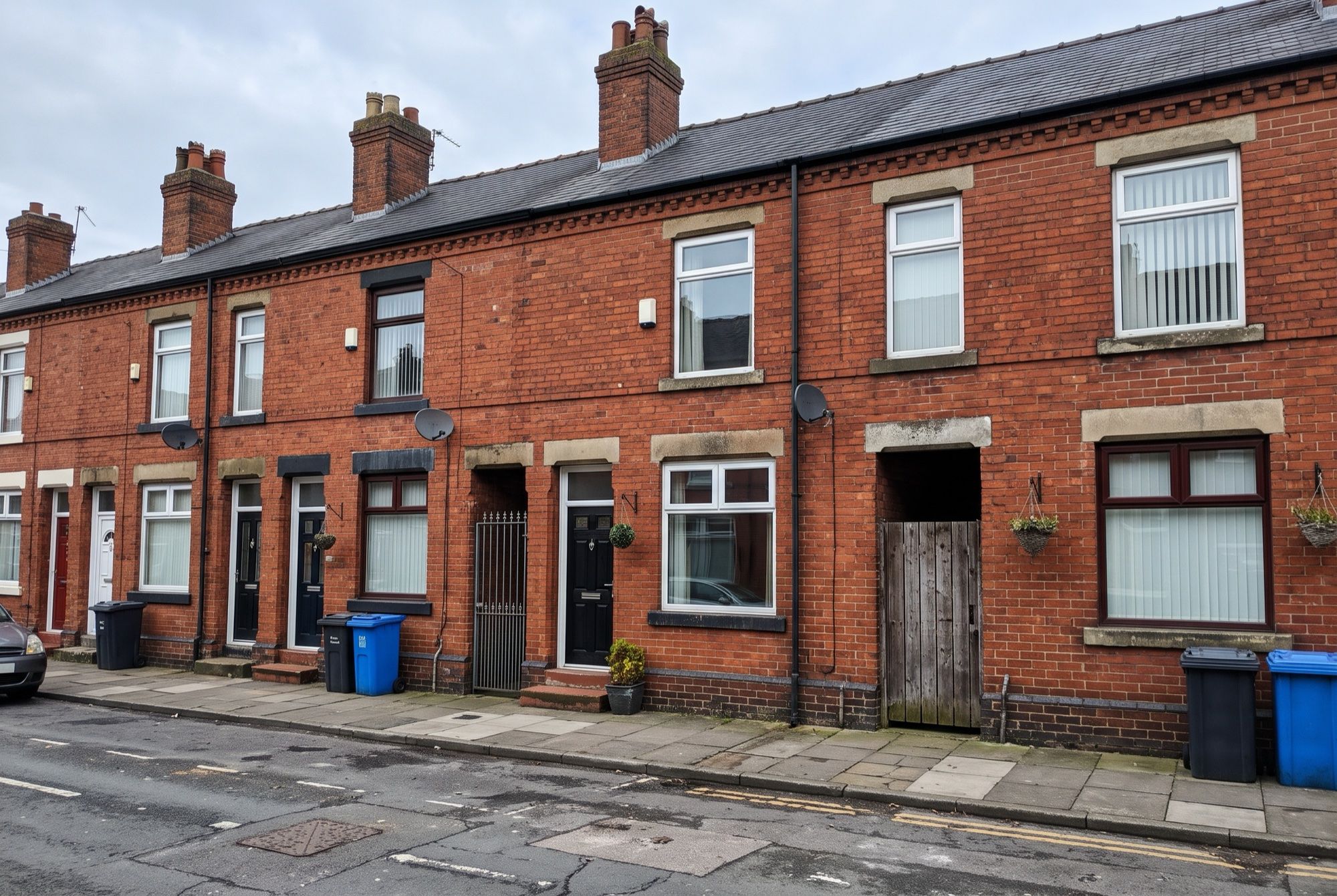
Salford’s housing shows several rounds of rebuilding. Victorian terraces were once crammed in at roughly 80 to the acre. Clearance had started by the early 1930s, the 1960s brought upwards of 30 tower blocks, and the 1990s took many of those down again. Seedley and Langworthy, both terraced districts, have since been reworked under Housing Market Renewal, Pendleton keeps its high-rise flats, and the Quays have added apartment towers such as the 20-storey Sovereign Point.
Because the council tells tenants to raise pests with their landlord, managing company or housing association, the call usually lands with whoever runs the building. Shared bin rooms, chutes and risers are where problems spread. A July 2026 report described residents on Camp Street in Lower Broughton who had put up with rats and cockroaches for four years, the cockroaches turning up in bin rooms, while the managing landlord pointed to estate-wide baiting and work to close entry points. Our pest control for landlords service treats the whole block when the evidence calls for it and leaves a report trail that holds up if a tenant raises disrepair or the council assesses the home under HHSRS.
Homes: what Salford households ask about
Domestic pests follow the seasons. According to the council, rats may be seen more often in autumn and winter, when they are hunting for food and a dry place to shelter. Its advice is practical: look beneath decking, sheds and trampolines, wrap food waste for the weekly collection, keep lids down and keep bird tables lightly stocked. Its guide for students makes the same point from another angle: rubbish draws rats and other vermin, lids must shut, and bags left beside a bin will not be taken. In shared houses near the university, agreeing who puts the bins out is real pest prevention.
The housing itself shapes what turns up. Higher Broughton was built with villa-type houses and Lower Broughton with terraces, while Pendleton and the Quays add flats in tall blocks. Mice move along terraces through shared voids, and bed bugs and cockroaches travel between flats. Our domestic pest control service covers all of these, with the same written reporting we give businesses.
What does Salford City Council offer?
Check the Salford City Council website for current pest control services, who can book and what it charges, because these change. If you rent, ask your landlord who is responsible for treatment.
See the council's pest control page (checked 2026-10-24).
Local context that shapes pest problems in Salford
- Quays businesses include office tenants at Soapworks, Quays Reach and Laser House, outlet stores and a Vue cinema at Quayside, and the Golden Tulip and Copthorne hotels. [Wikipedia (Salford Quays)]
- Water surrounds much of Salford: the Manchester Ship Canal of 1894 and the Quays' Erie, Huron and Ontario basins, the Bridgewater Canal, dating from 1761, and the Manchester, Bolton & Bury Canal running past Pendleton. [Wikipedia (Salford Quays)]
- Salford Shopping Centre stands in Pendleton, an inner-city area that sits where roads heading to Liverpool, Preston, Bolton and Manchester come together. [Wikipedia (Pendleton, Greater Manchester)]
- Established in 1967, the University of Salford now has upwards of 19,000 students, with Peel Park and the David Lewis Recreation Ground on its doorstep. [Wikipedia (Salford)]
- Industrial-era Victorian terraces were built so densely that some parts of Salford reached about 80 homes per acre. [Wikipedia (Salford)]
- When the Irwell overtopped on Boxing Day 2015, roughly 400 homes flooded across Lower Broughton and Kersal, close to 300 of them owned by Salix Homes; an Environment Agency basin on the former racecourse land at Kersal now aims to protect some 2,000 homes and businesses across Lower Broughton and Lower Kersal. [Salix Homes]
- A July 2026 report quoted tenants of a Camp Street block in Lower Broughton who had lived with rats and cockroaches for four years, with cockroaches present in the bin rooms; the managing landlord said it was baiting the whole estate and closing up entry points. [Brit Brief]
Our services in Salford
Commercial Pest Control in Salford
More than 10,000 people work at the Quays and Pendleton has Salford Shopping Centre, so most commercial sites here are better served by scheduled monitoring, a numbered station plan and dated reports than by one-off call-outs.
Bird Control & Proofing in Salford
For bird control here we survey first, trace how pests are getting in and seal those routes as well as treating, so the problem does not simply come back.
Rat & Mouse Control in Salford
The Irwell, the Ship Canal and two other canals run through or around Salford, and the 2015 floods reached hundreds of homes in Lower Broughton and Kersal, so drains and waterside boundaries are checked before any station goes down.
Pest Control for Landlords in Salford
For pest control for landlords here we survey first, trace how pests are getting in and seal those routes as well as treating, so the problem does not simply come back.
Bed Bug Treatment in Salford
Quays hotels and a university with more than 19,000 students mean constant bed turnover, so discreet room-by-room inspection with planned follow-up visits suits hotel housekeeping teams and student landlords.
Cockroach Control in Salford
In tower blocks and apartment buildings, bin rooms, chutes and service risers can carry cockroaches from flat to flat, which is why treatment in Salford's managed blocks covers communal areas as well as individual kitchens.
Also available in Salford:
Pest control in Salford: your questions answered
Do you cover Salford Quays, Pendleton, Ordsall and Broughton?
Yes. We cover all five Salford post town districts: M3 on the Salford side of the Irwell, M5 around Ordsall and Weaste, M6 for Pendleton and Langworthy, M7 for Broughton and Kersal, and M50 for the Quays and MediaCityUK. Premises elsewhere in the City of Salford, such as Eccles and Swinton, are covered too, as are sites across the river in Manchester city centre, so a business with several addresses can keep them under one contract and one reporting format.
Does Salford City Council treat pests for free?
Many councils run a pest control service for residents, but what is covered, who can book and the charges all vary and can change, so check the council's own pest control pages before you book. If you rent, report the problem to your landlord first. If you would rather book a private firm, phone or use the enquiry form and we will arrange a survey.
Do premises next to Buile Hill Park, Kersal Moor or the Broughton parks see more pests?
They can see more pressure at the boundary, though the park is rarely the whole story. Large green spaces such as Buile Hill Park in Pendleton, Kersal Moor and Kersal Dale, and Broughton's Albert Park and Clowes Park give rats, grey squirrels and foxes cover close to buildings, and wasps nest in hedges, banks and outbuildings in summer. What brings them inside is usually food waste, open bins and gaps at ground level or along the roofline. Cutting vegetation back from walls, closing bin stores, meshing airbricks and checking roof edges does most of the work.
Are premises beside the Irwell, the canals or the Quays basins more likely to get rats?
They face more pressure from outside, since brown rats live along riverbanks, culverts and drains, but an infestation is not inevitable. The test is whether the building gives rats a way in. We look at drain covers and rodding points, gaps where services enter, door seals, airbricks and bin stores, then put monitoring on the boundary rather than waiting for activity indoors. After high water, such as the 2015 floods in Lower Broughton and Kersal, check drains and ground-floor entry points promptly, because floodwater can damage pipe runs and push rats out of their burrows.
Tenants in our Salford block report cockroaches in the bin room. Who should deal with it?
In most cases the landlord or managing agent, because bin rooms, chutes and risers are common parts under their control. The council points renters to whoever lets or manages their home, so the complaint will usually reach you. Treating one flat while the bin room stays infested rarely works. We survey the communal areas and the neighbouring flats, treat with gel baits and targeted insecticide, seal gaps around pipework and leave a dated report for your repairs log.
What should we do if we find a dead bird on our Salford premises?
Do not touch it, and keep staff and customers away from it. Since early August 2026 Salford City Council has had more reports of ill and dead wild birds from parks, open spaces and areas around water, and its advice is to leave them alone. On private land, follow Defra's current guidance on reporting dead wild birds and on safe disposal. Proofing work can usually still go ahead: our team records any dead birds on the survey, wears suitable protective equipment during clearance and does not handle carcasses without the right precautions.
Areas within Salford
Sources (6)
Last updated: