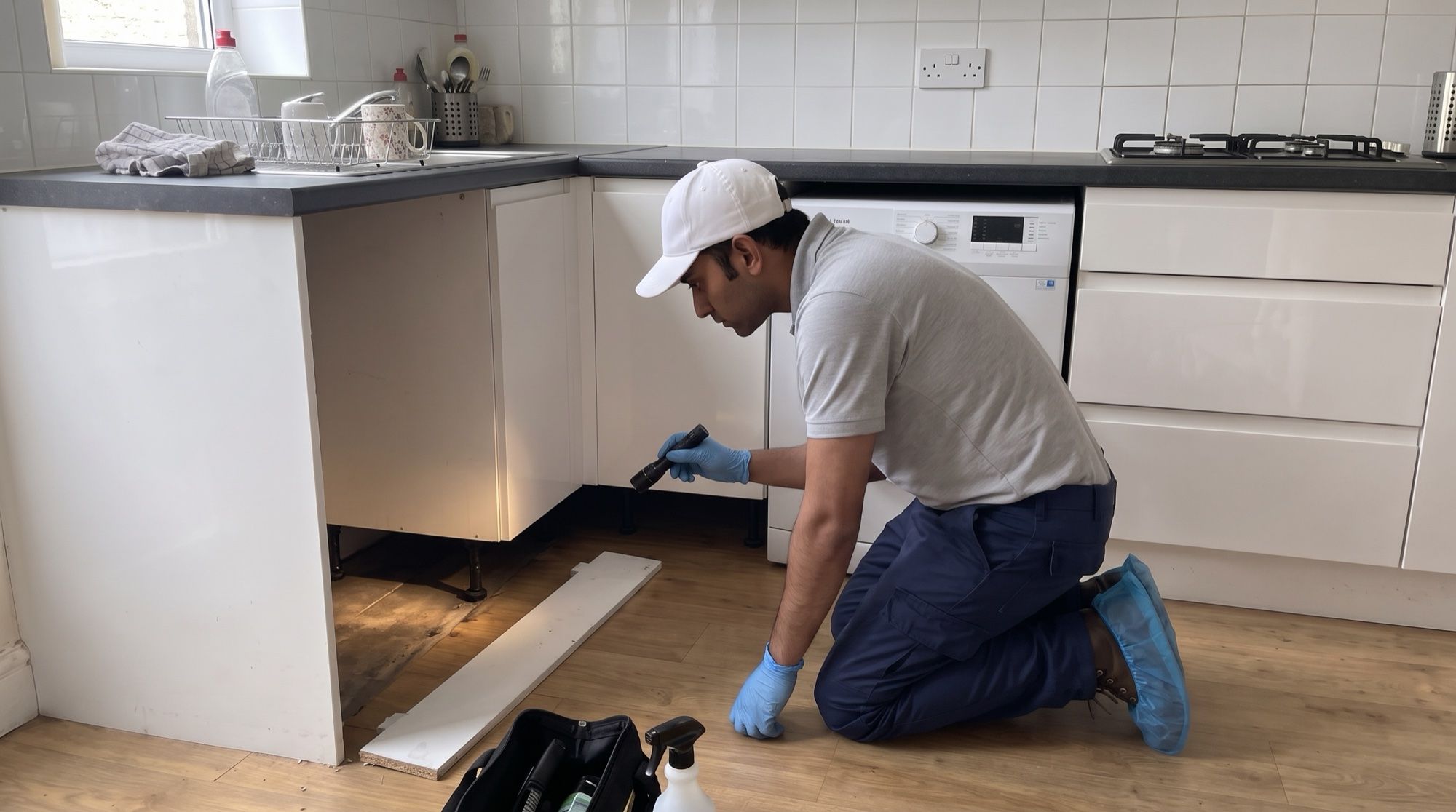
EnviroEx provides domestic pest control for homes across Manchester and Greater Manchester, covering rats, mice, wasps, bed bugs, fleas, cockroaches and other household pests. A technician inspects first, explains the treatment and any proofing, and books the follow-up visits the job needs. Call or send an enquiry to arrange a prompt, discreet home visit.
What are the signs that your home needs pest control?
Most domestic enquiries start small: droppings behind the cooker, scratching above a ceiling at night, bites on an arm.
- Rats and mice. Mouse droppings are about the size of a grain of rice; rat droppings are capsule-shaped and around a centimetre or more. Look also for gnawed packaging, greasy smear marks along skirting boards and scratching in ceilings or stud walls after dark.
- Squirrels. Thumping in the loft early in the morning and through the day, rather than at night, is more often a grey squirrel than a rat.
- Wasps. A steady line of wasps flying in and out of one point, such as an airbrick or a gap under roof tiles, almost always means a nest.
- Bed bugs. Bites in lines or clusters, small blood spots on sheets, and dark spotting along mattress seams and headboards.
- Fleas. Bites around the ankles, pets scratching, or a sudden problem after moving into a property where the previous occupant had animals.
- Cockroaches, ants and moths. Cockroaches appear at night near boilers, fridges and sinks; ants trail to sweet food; clothes moths leave irregular holes in wool.
Why do Manchester homes get pests?
Much of Greater Manchester’s older housing is Victorian and Edwardian terracing, with shared roof spaces, party walls, suspended timber floors and clay drains well over a century old. When a drain joint cracks or a redundant connection is left open under a kitchen, rats can come up from the sewer into the floor void, and in a terrace they can move along the row. Mice use the same routes through gaps around pipes and cavity walls.
Interwar semis have their own pattern: gaps at the eaves, airbricks with broken grilles, and attached garages or later extensions that join the house through shared voids. Converted mills and newer apartment blocks bring service risers, communal bin stores and shared ducts, which let mice and cockroaches move between flats however clean any one of them is.
The Irwell, the Mersey and the canal network give rats sheltered corridors through built-up areas, while overflowing wheelie bins, bird food on the ground and open compost heaps supply food.
Turnover matters too: student lets around Fallowfield see furniture and luggage move in and out every year, which is how bed bugs travel. Season matters too: rodents push indoors in autumn, and wasp nests peak in late summer.
How does our domestic treatment work?
We run domestic jobs with the same discipline as our commercial work, so every one starts with an inspection, not a spray. The technician confirms what the pest is, where it is living and, most importantly, how it is getting in, from under the stairs and behind kitchen kickboards to the loft, airbricks and drain covers.
For rats and mice, we choose between trapping and rodenticide based on how many there are, where they are and who else uses the space. Where rodenticide is the right tool, it is a professional product supplied under the UK Rodenticide Stewardship Regime, run by CRRU UK under government oversight, which restricts these products to trained, certified users. It goes in locked, tamper-resistant stations and is removed once activity has stopped, not left down indefinitely. Traps are set inside covered boxes. Glue traps have no place in domestic work; in England they need a licence for use on rodents.
For insects, treatment targets the places they hide: residual insecticide into cracks, voids and seams for bed bugs and fleas, and gel baits for cockroaches and ants. Wasp nests are treated with insecticide dust at the entrance, and activity usually dies down within a day. Our rodent control, wasp nest removal and bed bug treatment pages cover each in more depth.
Some pests carry legal conditions. Grey squirrels in a loft can be trapped and the entry points proofed, but under the Invasive Alien Species (Enforcement and Permitting) Order 2019 a trapped grey squirrel cannot lawfully be released, so it has to be dispatched humanely. Pigeons under solar panels are a job for our bird control service. The Wildlife and Countryside Act 1981 protects all wild birds, their eggs and nests in use or being built, so any control of feral pigeons must meet the conditions of a general licence, and mesh proofing is usually the lasting answer.
Where the real fix is structural, such as a broken drain, we say so plainly and set out what a drainage contractor or builder needs to do.
Is it safe for children, pets and everyone in the house?
Safety planning starts when you book: we ask about babies, anyone pregnant or with asthma, and any animals, from cats and dogs to reptiles and fish, and plan the method around them.
Bait is never laid loose. Stations are locked, fixed in place where practical and positioned where children and pets cannot reach them. Insecticides go into the gaps where insects hide rather than across open floors and worktops, and for sprayed treatments we tell you how long to keep people and pets out of the room, usually a few hours until surfaces are dry. Fish tanks need covering, with air pumps off, during some insect treatments, because many insecticides are highly toxic to fish.
After each visit you get a note of the product used, where it was placed and any aftercare, such as how long to leave treated floors before washing them.
How many visits does it usually take?
It depends on the pest and how established it is:
- A wasp nest is normally one visit.
- Rats and mice usually take two or three visits over a few weeks: treatment, then returns to check stations or traps, remove them and confirm activity has stopped.
- Bed bugs normally need at least two treatments, roughly two to three weeks apart, so that bugs hatching after the first treatment are dealt with.
- Fleas are often resolved with one treatment, with a second if adults keep emerging.
- German cockroaches, common in flats, usually need several visits over a number of weeks.
How do you stop pests coming back?
Treatment removes the pests that are there; proofing stops the next ones. For rodents that means sealing gaps around pipes with stainless steel wool, metal mesh and mortar, replacing broken airbrick grilles with fine mesh that keeps ventilation working, fitting brush strips to external and garage doors, and closing gaps behind kitchen units. Where rats are coming from the drains, the fix might be a repaired joint, a capped redundant pipe or a non-return valve fitted by a drainage contractor.
Housekeeping does the rest: lidded bins, bird food kept in feeders, compost bins with a base, and less clutter in lofts. For bed bugs, be wary of second-hand mattresses and check luggage after travel.
When does DIY stop being enough?
A single mouse in a kitchen can sometimes be handled with a couple of snap traps set in boxes along the wall. Beyond that, it is time to bring in a professional when:
- activity carries on for more than a week or two after you start;
- you can hear movement in walls, ceilings or under floors that you cannot reach;
- there is any sign of rats indoors;
- you have bed bugs or cockroaches, where shop-bought sprays tend to scatter them rather than kill them;
- a wasp nest is in a roof void, behind fascias or at height;
- young children or pets in the house make handling poison a risk.
The DIY toolkit is also deliberately limited: public-use rodenticides are restricted, and setting a glue trap for rodents is an offence for householders in England.
Who is responsible if you rent, or the problem starts next door?
If you rent, in most cases the landlord is responsible where pests come in through disrepair or the condition of the building. Section 11 of the Landlord and Tenant Act 1985 covers the structure and exterior, and the Homes (Fitness for Human Habitation) Act 2018 requires rented homes to be fit to live in, with pests one of the hazards assessed under the Housing Health and Safety Rating System (HHSRS). Where an infestation starts with a tenant’s own pet or belongings, the tenancy agreement may place it on the tenant.
In terraces and semis, a problem often spans more than one house, and treating one while next door does nothing means repeat work. Councils have powers under the Prevention of Damage by Pests Act 1949 to require owners and occupiers to deal with rats and mice on their land, which can help where a neighbouring property is the source.
Our written report records what we found, the likely cause and what was done, ready to pass to a landlord or letting agent. Landlords will find more on duties and record-keeping on our pest control for landlords page.
How domestic pest control works with EnviroEx
- 1
Booking and triage
You tell us what you have seen or heard, where and for how long. We ask who lives in the home, including children, pets and anyone with health conditions, so the method is planned before we arrive.
- 2
Inspection
The technician confirms the species, finds where it is living and how it is getting in, checking kitchens, under-stairs voids, lofts, airbricks, pipe entries and drain covers.
- 3
Treatment plan
You get a plain explanation of the method, why it suits your home, what to do before and after, and how many visits to expect.
- 4
Treatment
We use the lowest-risk method that will work: traps or locked bait stations for rodents, targeted insecticide or gel for insects, and dust for wasp nests.
- 5
Follow-up and proofing
Return visits check progress, remove bait or traps that are no longer needed, and seal the entry points so the problem is far less likely to return.
- 6
Written report
You receive a short record of what we found, the likely cause, what was used and where, which is useful for a landlord, letting agent or future sale.
Typical visits: One to three visits for most homes: a wasp nest is usually a single visit, rats and mice typically two or three over a few weeks, and bed bugs or cockroaches need at least one follow-up treatment.
Safety: We choose the lowest-risk method that will work, keep any rodenticide in locked, tamper-resistant stations out of reach of children and pets, and tell you what was used, where, and when treated rooms can be used again.
Domestic Pest Control: your questions answered
Is domestic pest treatment safe with children and pets at home?
Yes, when it is planned properly. Before we treat, we ask who lives in the house, including babies, anyone pregnant or asthmatic, and animals from cats and dogs to rabbits, birds and fish. Rodenticide, where it is needed at all, goes in locked, tamper-resistant stations and is never laid loose. Insecticides are applied to cracks, voids and seams rather than open surfaces, and we tell you how long to keep people and pets out of treated rooms. Fish tanks need covering, with air pumps switched off, during some insect treatments.
Do I need to leave the house while you treat it?
For most rodent work and wasp nests, no. You can stay at home, although we may ask you to keep children and pets away from the area while we work. Spray treatments for fleas, bed bugs or cockroaches are different: we normally ask everyone, pets included, to stay out of the treated rooms for a few hours until surfaces are dry. We confirm the exact time for your treatment before we start, so you can plan the day around it.
Will rats or mice go away on their own if I leave them?
Rarely. Once rodents have food, water and a warm place to nest, they breed rather than move on, and both species can produce a new litter every few weeks in good conditions. Activity can seem to drop in summer while rats forage outdoors, then return in autumn as the weather turns. Waiting also gives them time to gnaw cables, pipe lagging and loft insulation and to contaminate food. The sooner the entry point is found, the smaller the job usually is.
Should I call the council or a private pest controller?
Both are legitimate routes. Some councils run their own pest service, but what they treat, what they charge and how long you wait vary between boroughs and change over time, so check your council's current page first. A council service may cover only public-health pests, or exclude proofing and nests at height. A private service is useful when you want an inspection that finds the cause, proofing as part of the same job, appointments that fit around work, or a written report for a landlord or buyer.
My landlord says the pests are my problem. Is that right?
It depends on the cause. In most tenancies in England, the landlord is responsible where pests get in through disrepair or the condition of the building, such as broken airbricks, gaps around pipes or defective drains. Section 11 of the Landlord and Tenant Act 1985 covers the structure and exterior, and the Homes (Fitness for Human Habitation) Act 2018 requires the home to be fit to live in, with pests one of the hazards considered. Where an infestation starts with a tenant's own pet or belongings, the tenancy agreement may place it on the tenant. Our report records what we found, which helps settle the question.
Can I use rat poison or glue traps myself?
You can buy rodenticide for home use, but public products are limited in strength and pack size and must be used exactly as the label directs, which normally means inside a tamper-resistant bait station, in and around buildings. Loose bait in a garden can poison pets, foxes and birds of prey. Glue traps are a different matter: under the Glue Traps (Offences) Act 2022, setting one to catch a rodent in England is an offence unless it is done under a licence, and licences are granted only to pest controllers, in exceptional cases, to protect public health or safety.
What should I do before the technician arrives?
Leave the evidence where it is. Droppings, gnawed packaging and shed skins help us identify the species and judge how established the problem is. Avoid spraying shop-bought insecticide on bed bugs or cockroaches, because it can scatter them deeper into the building and make treatment harder. Keep pets away from the affected area and note when and where you have seen or heard activity. For bed bugs and fleas, preparation makes a real difference to the result, so we give you guidance before the first treatment.
Can you keep the visit discreet?
Yes. Many people would rather the neighbours did not know, and some problems, bed bugs in particular, carry a stigma they do not deserve. Tell us when you book and we will agree an appointment that suits you and send the report and aftercare advice by email rather than leaving paperwork behind. If the problem is shared with an adjoining house, which is common in terraces, we can advise on how to raise it with the neighbour without it becoming a dispute.
Domestic Pest Control by area
Local detail for the places we serve most often.
Last updated: