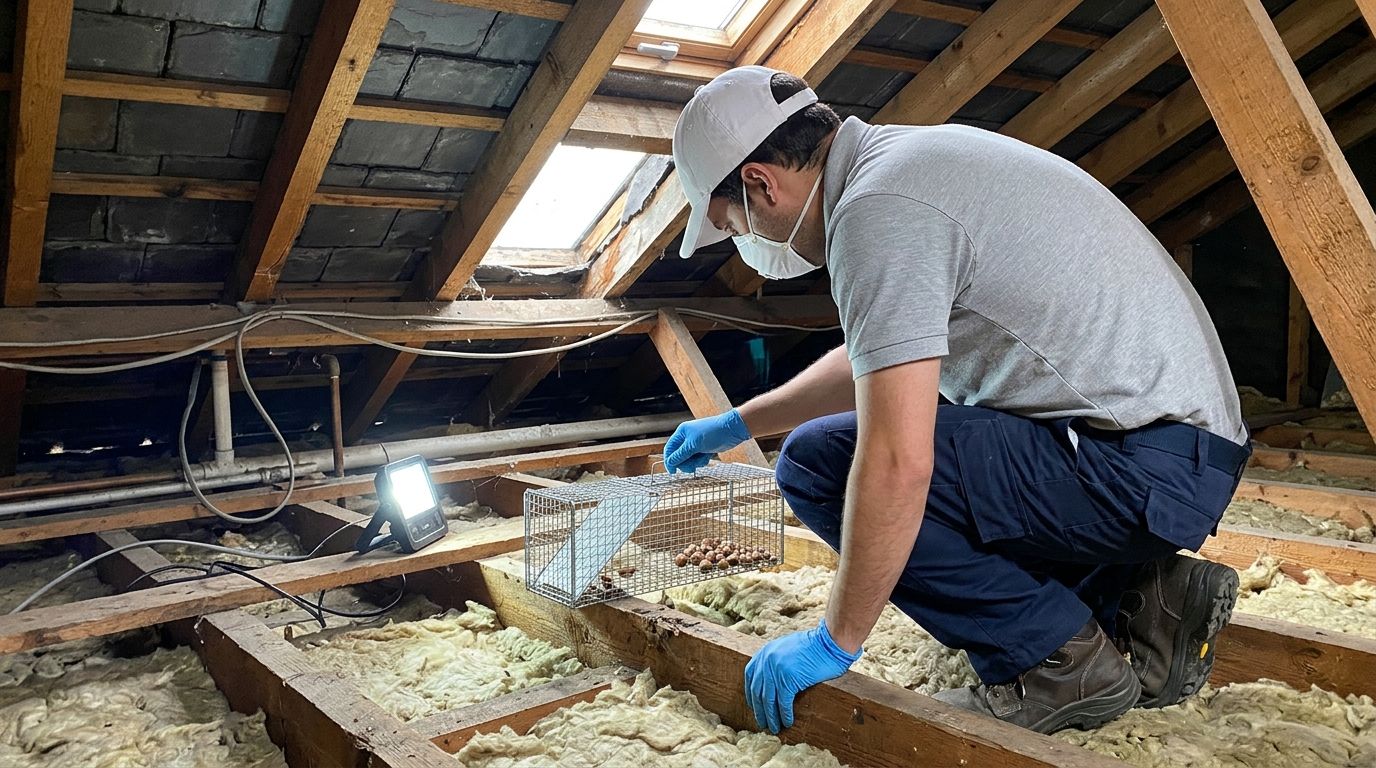
EnviroEx removes grey squirrels from lofts, roof voids and ceilings in homes and commercial buildings across Manchester and all ten Greater Manchester boroughs. We survey the roofline, trap lawfully, then seal the entry points to keep them out. We can usually arrange a survey quickly; book by phone or through the contact form.
How can you tell it is squirrels and not rats in the loft?
Timing is the most reliable clue. Grey squirrels are active by day, so scratching, scampering and rolling sounds across the joists usually start around first light and settle by dusk. Rats and mice are mostly heard at night.
Other signs we look for on a survey:
- a squirrel going in or out at the eaves, a gable end or the junction of a bay roof;
- chewed fascia or soffit boards, or tiles lifted at the verge;
- shredded insulation or roofing felt pulled into a loose ball, which is the drey;
- droppings that are rounder and more barrel-shaped than the capsule-shaped droppings of brown rats, often with urine staining below;
- gnawed cables, plastic pipework or the lid of a cold water tank;
- circuits tripping with no obvious cause, which can mean wiring has been chewed.
On commercial premises the first sign is often noise in a suspended ceiling, or nesting debris above a ceiling tile. If the survey shows rats instead, our rodent control service takes a different route.
Why do squirrels get into roofs across Greater Manchester?
Grey squirrels do well wherever mature trees meet older buildings, and Greater Manchester has plenty of both. Tree-lined suburban roads, large parks, cemeteries and the wooded river valleys of the Mersey, Irwell and Tame all give them food and cover, and overhanging branches, fences and drainpipes give squirrels a route onto the roof.
The housing stock gives them a way in. Victorian and Edwardian terraces and semis often have timber fascias and soffits that have softened with age, and gaps where a bay or dormer roof meets the main wall. Many 1930s semis have hipped roofs with long runs of soffit that are easy to chew through once one corner rots. In some older terraces the party walls in the roof space are incomplete, so a squirrel in one loft can travel along the row.
Grey squirrels can have two litters a year, born in late winter or early spring and again in summer, and an insulated loft is an ideal place to give birth. Autumn brings young squirrels looking for territory and adults looking for winter shelter, which is why loft noise often starts as the weather turns.
Schools, care homes, churches and offices beside parkland face the same pressure, usually with larger roofs and plant-room louvres that offer more ways in.
How do we remove squirrels from a loft or roof void?
We start with a survey inside and out. In the roof space we confirm the species, find the drey, look for young, and check wiring, pipework and the water tank. Outside we walk the roofline to find every entry point, not just the obvious one, and plan safe access for the proofing, checking for bats and nesting birds as we go.
You then receive a written plan with photographs, the method and the proofing specification.
Removal is usually by cage trap, baited and placed on the squirrels’ runs in the roof void and checked at least once a day. Because a grey squirrel cannot lawfully be released, any squirrel caught is humanely dispatched by our technician. Where the survey shows no young and a single entry point, a one-way exclusion door can be used instead.
Once activity stops, we proof every entry point, clear the drey and droppings, and leave a record of what was found and fixed.
What does the law say about catching grey squirrels?
Grey squirrels are a listed invasive non-native species. Under the Invasive Alien Species (Enforcement and Permitting) Order 2019, it is an offence to release one into the wild, so a trapped squirrel cannot be taken to a park and let go. Once caught, it is an animal under human control, and the Animal Welfare Act 2006 makes it an offence to cause it unnecessary suffering. Drowning a trapped squirrel, or leaving a trap unchecked, risks exactly that offence.
No poison is currently authorised for controlling squirrels in buildings. Rat and mouse baits are authorised only for the species on their label, and CRRU stewardship reinforces that for professional users. Since April 2024, using glue traps on rodents, squirrels included, has been an offence in England under the Glue Traps (Offences) Act 2022, bar rare licensed exceptions. Bat roosts are protected under the Conservation of Habitats and Species Regulations 2017 and the Wildlife and Countryside Act 1981 even when empty, so the survey checks for bats before anything is sealed. Red squirrels are also protected, but you are very unlikely to find one in Greater Manchester.
Is squirrel removal safe for children, pets, staff and residents?
The method itself carries little risk, because we use no poison. Cage traps sit in the loft or ceiling void, out of reach of children and pets, and the hatch stays closed while they are set. Nobody but our technician should handle a trapped squirrel; they bite and scratch hard when cornered.
The hazards are mostly what squirrels leave behind. Chewed cables can be a fire risk, so if we find damaged wiring we will advise an electrician’s check before the loft is used again. Droppings, urine-soaked insulation and a squirrel drowned in an open water tank are hygiene problems; we bag soiled material wearing gloves and masks. On commercial sites, work at height and ceiling access are planned under a risk assessment and method statement, timed around pupils, residents or trading hours.
How many visits does squirrel removal take?
Most jobs follow the same pattern: a survey and trap-setting visit, trap checks at least daily while traps are set, a proofing visit once the loft is quiet, and a follow-up check. Several animals, a litter of young or a roof that needs scaffold access all add time. We will not seal a roof while there is any sign of activity inside, because a shut-in squirrel will either chew its way out or die in the void.
How do you stop squirrels getting back in?
Proofing is the part that lasts. Removing squirrels without closing the gaps simply makes room for the next ones.
Good proofing covers:
- every gap at the eaves, verge and soffit, closed with galvanised steel mesh or flashing that squirrels cannot gnaw through;
- rotten fascia, soffit or bargeboards replaced rather than patched;
- uncapped chimneys and redundant flues fitted with a cowl or mesh cap;
- gaps around pipes and cables where they pass through the wall.
Cutting branches back from the roof helps, but check with the council first whether the tree has a Tree Preservation Order or sits in a conservation area, and look for active bird nests. Move bird feeders away from the house. Where pigeons share the same roof, our bird control team can proof both at once.
When does DIY squirrel control stop being enough?
A householder can prune a branch or move a feeder. Beyond that, DIY tends to go wrong. Ultrasonic plug-ins and strong-smelling repellents may unsettle a squirrel for a few days, but rarely shift one that has built a drey. Sealing a hole yourself risks shutting young inside, and a mother trying to reach her litter can do more damage than the original hole. A shop-bought cage trap leaves you with an animal you cannot lawfully release, which must then be humanely dispatched by someone competent.
Call in help if you can hear more than one animal, if wiring or the water tank may be affected, if the entry point is above safe ladder height, or if bats might be present.
Who is responsible, and what should landlords and businesses record?
For landlords, squirrels in a let property usually come back to the building’s condition. Section 11 of the Landlord and Tenant Act 1985 puts repair of the structure and exterior of most residential lets on the landlord, and a rotten soffit that lets squirrels in is generally a repair issue. The council can assess pests and electrical hazards under the Housing Health and Safety Rating System, and the Homes (Fitness for Human Habitation) Act 2018 lets tenants take court action if a home is unfit. Who pays depends on the tenancy and the cause, so keep the survey, photographs and proofing record; our pest control for landlords page has more.
For businesses, an environmental health officer is likely to treat squirrels in a roof over a kitchen or store room as a pest-control issue, because food hygiene law, enforced in England through the Food Safety and Hygiene (England) Regulations 2013, requires adequate procedures to control pests. File the survey, trap log and proofing record with your HACCP pest-management records or Safer Food Better Business pack. For offices, schools and care homes, the same paperwork belongs in your health and safety file. Our commercial pest control contracts can include roofline checks at routine visits.
How squirrel control works with EnviroEx
- 1
Survey inside and out
We confirm it is squirrels, find the drey, check for young, bats and nesting birds, and walk the roofline to locate every entry point and any damage to wiring, pipework or the water tank.
- 2
Written plan
You receive photographs of the entry points, the removal method, the proofing specification and the access needed, with a risk assessment and method statement for commercial sites.
- 3
Lawful removal
Cage traps are set on the squirrels' runs and checked at least once a day. Any grey squirrel caught is humanely dispatched, as the law does not allow release. A one-way door may be used where no young are present.
- 4
Proofing
Once activity has stopped, every entry point is closed with galvanised steel mesh, metal flashing or replacement boarding, using materials squirrels cannot readily chew through.
- 5
Clean-up and handover
We remove the drey, droppings and soiled insulation, and give you a record of what was found, removed and proofed, plus any repairs that need a roofer or electrician.
- 6
Follow-up check
A return visit confirms the roof space has stayed quiet and the proofing is intact.
Typical visits: Usually a survey and trap-setting visit, trap checks at least daily while traps are set, a proofing visit once the loft is quiet, then a follow-up check. Young in the drey, several entry points or scaffold access can add visits.
Safety: We use no poison for squirrels. Cage traps sit inside the loft or ceiling void, out of reach of children and pets, and are checked at least daily. We check for young, bats and nesting birds before any gap is sealed, and bag droppings and soiled insulation wearing gloves and masks.
Squirrel Control: your questions answered
Can I catch a squirrel and release it somewhere else?
No. Grey squirrels are listed as an invasive non-native species, and under the Invasive Alien Species (Enforcement and Permitting) Order 2019 it is an offence to release one into the wild, and in practice no licence is available to free a squirrel caught in a building. That includes driving it to a park, a wood or the countryside. Once a squirrel is in a trap, the Animal Welfare Act 2006 also makes it an offence to cause it unnecessary suffering, so it has to be dispatched quickly and humanely by someone competent. That is why we handle trapping ourselves rather than leaving a householder with a live animal they cannot lawfully let go.
How do I know if it is squirrels or rats in my loft?
Listen to when the noise happens. Squirrels are active by day, so running, scratching and rolling sounds tend to start around first light and fade by dusk. Rats and mice are mainly heard at night. Squirrel droppings are rounder and more barrel-shaped than the longer, capsule-shaped droppings of brown rats, and squirrels shred insulation into a large, loose drey. Outside, look for a chewed hole in the fascia or soffit and squirrels running along the gutter. If you are still unsure, a survey confirms it before any treatment starts.
Can you just block the hole while the squirrels are out?
Only once we are confident nothing is left inside. From late winter into early autumn there may be young in the drey, and sealing the hole would leave them to die in the roof, which is a serious welfare problem and soon becomes a smell. An adult shut out from its young will often chew a new hole close by. We confirm the loft is clear first, by trapping or with a one-way exclusion door where the survey supports it, and only then proof the entry point with steel mesh or flashing.
Do you use poison to get rid of squirrels?
No. There is currently no poison authorised for controlling squirrels in buildings. Rat and mouse baits are authorised only for the species named on their label, so using them on squirrels would be unlawful, and the CRRU stewardship scheme for professional rodenticide users reinforces that. Poison would be a poor idea in a loft anyway: a squirrel that dies in a wall cavity or ceiling void causes a strong smell and can attract flies. We rely on cage trapping, exclusion and proofing, which keeps the method safe for children, pets and other wildlife.
How long does it take to get squirrels out of a loft?
There is no fixed timescale, but most lofts are cleared and proofed within a few weeks of the survey. A single squirrel using one hole can be dealt with quickly. A family with young, several entry points or a roof that needs a tower scaffold takes longer. Traps are checked at least once a day while they are set, and we proof the roof only after several days with no sign of activity. A follow-up check then confirms the roof space has stayed quiet.
Is my landlord responsible for squirrels in the loft?
Often, but it depends on the tenancy and the cause. Section 11 of the Landlord and Tenant Act 1985 makes the landlord responsible for keeping the structure and exterior of most residential lets in repair, and squirrels usually get in through damaged soffits, fascias or roof tiles. The council can also assess pests and chewed wiring under the Housing Health and Safety Rating System, and the Homes (Fitness for Human Habitation) Act 2018 lets tenants take court action if a home is unfit. Report the problem to your landlord or agent in writing, with dates and photographs, so there is a clear record.
Can squirrels chew through electrical cables and cause a fire?
They can. Like all rodents, squirrels have teeth that keep growing, and they gnaw cables, plastic pipework and timber in the roof space. Bare wiring beside dry insulation and nesting material is a genuine fire risk, and a circuit that keeps tripping is a warning sign. If our survey finds chewed cables, we photograph them and recommend that a registered electrician checks the installation before the loft is used again. Water tanks and pipework are worth checking too, because a squirrel can fall into an uncovered tank.
Will cutting back trees stop squirrels getting on the roof?
It helps, but it is rarely enough on its own. Grey squirrels jump well, so branches need cutting back a good distance from the roof, and squirrels will still climb drainpipes, walls and fences. Before any pruning, check with the council whether the tree is protected by a Tree Preservation Order or stands in a conservation area, because consent or advance notice may be needed. Look for active bird nests too, since they are protected under the Wildlife and Countryside Act 1981. Pruning works best alongside proofing the entry points.
Do you remove squirrels from schools, offices and care homes?
Yes. On commercial and public buildings, squirrels most often get into suspended ceilings, roof voids above classrooms or bedrooms, and plant-room louvres. We survey with your facilities team, provide a risk assessment and method statement for the access and trapping, and schedule visits around pupils, residents or trading hours. Traps are placed where staff and the public cannot reach them, and you receive a written record of what was found, removed and proofed for your health and safety or pest-management file.
Squirrel Control by area
Local detail for the places we serve most often.
Last updated: