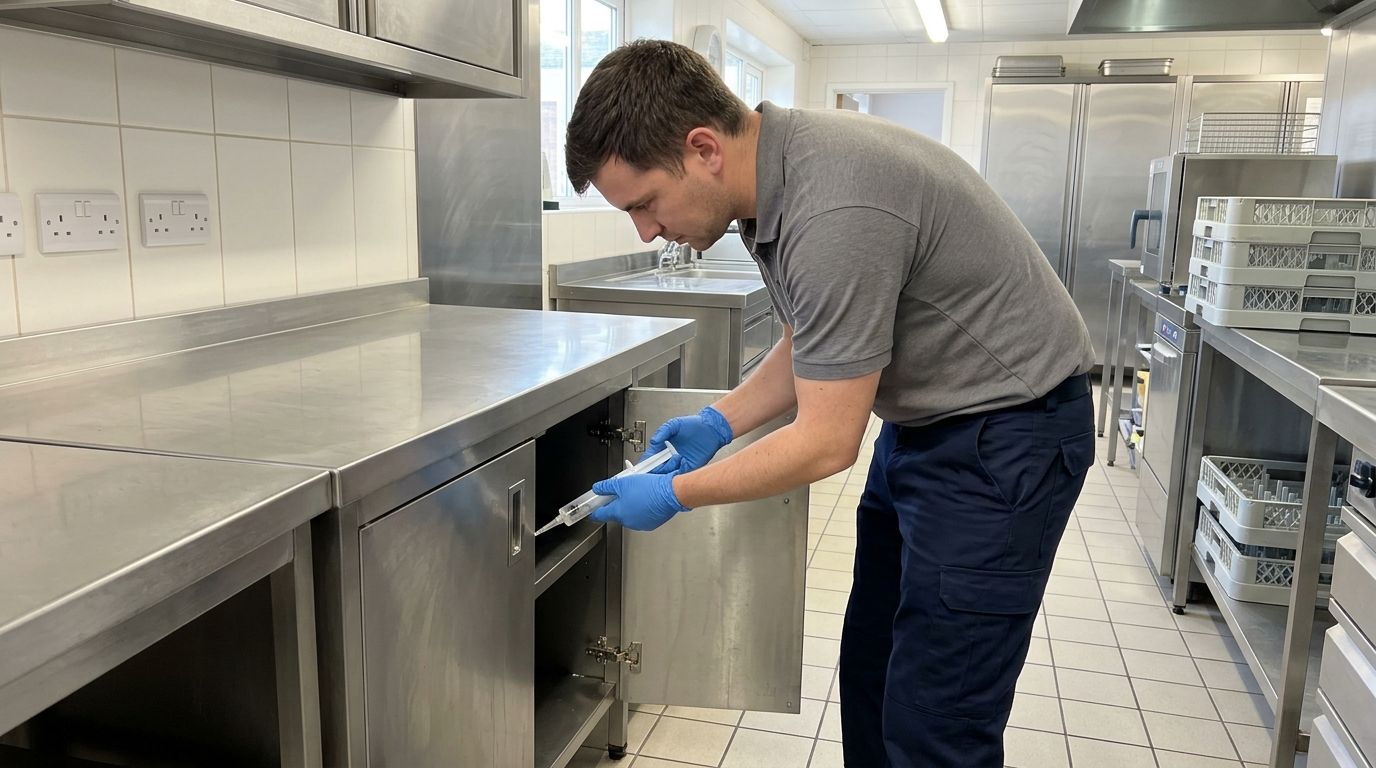
EnviroEx treats German and Oriental cockroach infestations in commercial kitchens, food premises, flats and homes across Manchester and Greater Manchester. We survey first, place targeted gel baits, use residual treatments only where needed and return at planned intervals until monitors show no activity, reporting in writing at each visit. Call or send an enquiry to book a prompt survey.
What are the signs of a cockroach infestation?
Cockroaches are nocturnal and spend most of their lives packed into warm, tight gaps, so the insects themselves are often the last thing anyone sees. A cockroach crossing the floor in daylight often means the hiding places are already crowded.
The more reliable signs are what they leave behind:
- Droppings that look like ground pepper or coffee grounds, or dark smears along edges and in the corners of shelves and drawers.
- Egg cases (oothecae): brown, purse-shaped capsules up to about a centimetre long. German females carry theirs until shortly before hatching; Oriental females hide theirs in crevices. Empty cases mean young have already hatched.
- Shed skins from nymphs as they grow, collecting near harbourage.
- A musty, oily smell in cupboards, dry stores or behind equipment once numbers build.
- Live or dead insects around motor housings, dishwashers, glass washers, door seals, sink pedestals and drainage gullies.
Two species cause most infestations in British buildings: the small, light-brown German cockroach, which favours warm equipment and kitchens, and the larger, glossy, dark Oriental cockroach, which prefers cool, damp cellars, drains and service ducts. Knowing which you have matters, because they shelter in different places and respond to treatment at different speeds.
Why do cockroaches take hold in Manchester kitchens and flats?
Cockroaches need warmth, moisture and food residue. Commercial kitchens supply all three around the clock, which is why restaurants, takeaways, hotel kitchens, cafés and food production units are the premises most exposed.
Manchester’s building stock adds to the problem. Restaurants and bars trading from the basements and ground floors of older buildings often share drainage, cellars and wall voids, which give cockroaches a protected network that does not stop at the property line. Across the city centre, Ancoats and the Northern Quarter, former mills and warehouses have been converted into flats, offices and restaurants, and these conversions often have service risers and ducting that link many units. In larger residential blocks, communal heating pipework lets German cockroaches move between flats along warm runs behind kitchen units and bath panels.
Cockroaches also arrive by delivery. Cardboard outer packaging, returnable crates, second-hand catering equipment and used domestic appliances are all common routes in. One contaminated delivery can start an infestation in a well-run kitchen, which is why goods-in checks belong in any food safety system.
How does our cockroach treatment work?
Every job starts with a survey. We inspect the areas cockroaches use, not only the spot where one was seen: the motor compartments of fridges and dishwashers, voids under counters and around pipe penetrations, drainage, door frames, electrical trunking and stores. Insect monitors are placed to map activity, and we confirm the species before choosing products.
For German cockroaches in kitchens and flats, the main tool is insecticidal gel bait, placed as small spots in the cracks and voids where the insects shelter and feed. Cockroaches carry the active ingredient back to the harbourage, where it can pass to others that never touched the bait. Gel is precise, does not leave a film over open surfaces and suits food premises because it can be placed well away from food and food-contact areas. Where bait aversion or resistance is suspected, we rotate between formulations.
Residual insecticides, insect growth regulators and void dusts are used where the site and species warrant them, for example Oriental cockroaches in cellars, drains and ducts, or a heavy population behind fixed equipment. We use professional products approved or authorised for use in Great Britain and apply them in line with their labels.
Before the first visit we explain the preparation that helps: clearing floor space under units, emptying cupboards in the worst-affected areas, and stopping household sprays, which can drive cockroaches away from bait.
Is the treatment safe for children, pets, staff and customers?
Gel bait is applied in small amounts into gaps and voids that children, pets and customers cannot reach, so most domestic gel treatments do not require anyone to leave. Where a residual spray is needed, people and animals stay out of the treated room until surfaces are dry; we confirm the time for the product used. Cover aquariums and switch off their pumps while spraying takes place.
In food premises we schedule treatment before or after service, cover or remove exposed food, protect food-contact surfaces and leave a clear record of what was applied and where. Staff are told which areas have been treated so that bait points are not cleaned away during the next deep clean. Safety data sheets for the products used are available for your COSHH file.
How many visits will it take?
Most cockroach jobs involve an initial treatment and two follow-up visits over around four to six weeks. The follow-ups are part of the treatment, not an optional extra. Egg cases protect the developing young from most products, so a second wave of nymphs can emerge after the first visit. Each follow-up reads the monitors, tops up or rotates bait and treats any newly found harbourage.
Oriental cockroaches develop more slowly, so their monitoring often runs longer. Heavy infestations, large kitchens with fixed equipment and blocks where neighbouring flats are also affected usually need more visits. We close a job when the monitors show no further activity, not on a fixed date.
How do you stop cockroaches coming back?
Treatment removes the population; proofing and housekeeping prevent the next one. The measures that make the most difference are:
- Sealing gaps around pipe penetrations, behind skirting and along the backs of worktops, and fitting covers to unused drains and gullies.
- Pulling equipment out on a schedule to clean behind and beneath it, particularly cookers, fryers and dishwashers.
- Fixing leaks and drips, since cockroaches cope with a shortage of food far better than a shortage of water.
- Checking deliveries at goods-in and breaking down cardboard outside food areas.
- Keeping dry goods in sealed containers and clearing waste out of the kitchen at the end of each shift.
- Leaving monitors in place after sign-off, so any new activity is picked up early.
For food businesses, these measures sit naturally inside a planned contract: our food premises pest control and commercial pest control services include routine inspections, monitoring and written reports.
When should you stop trying to deal with it yourself?
Shop-bought sprays and traps rarely resolve a cockroach problem. Sprays kill the insects they touch but push others deeper into voids or into the next room, and hidden egg cases survive. Off-the-shelf baits can work on a very light, newly arrived infestation, but only if nothing else in the room competes with or contaminates them.
It is time for professional treatment if you see cockroaches in daylight, find them in more than one room, live in a block where neighbours report the same problem, or run any business that handles food. In a food business, a self-treated infestation that resurfaces at an inspection is much harder to defend than one with a contractor, a plan and records behind it.
What does a business or landlord need to record?
Food business operators must have adequate procedures in place to control pests. The requirement comes from Regulation (EC) No 852/2004 as it applies in England, enforced through the Food Safety Act 1990 and the Food Safety and Hygiene (England) Regulations 2013. An Environmental Health Officer will usually expect a pest-management file: who your contractor is, a site plan showing monitor and bait points, visit reports, findings, recommendations and the action you took on each. Where an officer finds an infestation presenting an imminent risk to health, they can serve a hygiene emergency prohibition notice that closes all or part of the business immediately; the council must then seek a magistrates’ court order to keep it closed. Our reports are written to sit alongside your HACCP plan or Safer Food, Better Business pack.
For landlords, the position depends on the cause and the tenancy terms. Pests form part of the “domestic hygiene, pests and refuse” hazard assessed under the Housing Health and Safety Rating System (HHSRS), and the Homes (Fitness for Human Habitation) Act 2018 allows tenants to take court action where a home is unfit. Disrepair that lets cockroaches in, such as defective drainage, may also fall within the repairing obligation in section 11 of the Landlord and Tenant Act 1985, which covers most tenancies of under seven years. In serious cases, councils also have powers under the Public Health Act 1936 to require filthy or verminous premises to be cleansed.
In blocks and HMOs, infestations that spread through communal areas or shared services are usually for the landlord or managing agent to resolve, and coordinated treatment of affected flats is far more effective than one tenant acting alone. Treatment reports show the problem was handled properly; our pest control for landlords service covers tenanted homes, HMOs and managed blocks.
How cockroach control works with EnviroEx
- 1
Survey and identification
We inspect the places cockroaches shelter, such as motor housings, door seals, drainage and service ducts, place monitors to map activity and confirm the species.
- 2
Written treatment plan
You receive a plan covering the products and placement we will use, the preparation needed, and the cleaning or proofing that will make the treatment hold.
- 3
Targeted treatment
Gel bait goes into the cracks and voids where cockroaches feed and hide, with residual insecticide or void dusts used only where the site and species call for them.
- 4
Follow-up visits
We return at planned intervals to read the monitors, top up or rotate bait and treat nymphs hatching from egg cases that survived the first round.
- 5
Sign-off and records
When monitors show no further activity we close the job with a written report for your pest-management file or landlord records.
Typical visits: Usually an initial treatment and two follow-ups over roughly four to six weeks; heavy infestations and multi-flat blocks often need more.
Safety: Gel bait is placed in cracks and voids out of reach of children, pets and food. Where a spray is needed we protect food-contact surfaces and tell you how long to keep people and animals out.
Cockroach Control: your questions answered
How can I tell German cockroaches from Oriental cockroaches?
German cockroaches are small, around 10 to 15 mm, light brown, with two dark stripes on the shield behind the head. They cluster in warm spots such as dishwasher and fridge motors, behind cookers and inside equipment. Oriental cockroaches are larger, around 20 to 25 mm, glossy dark brown to black and slower, and they prefer cooler, damp places such as cellars, drains and ground-floor voids. If you are unsure, a clear photo or a specimen sealed in a bag lets us confirm the species before treatment.
Will a cockroach sighting lower our food hygiene rating or close us down?
It depends on what the inspector finds and how you have responded. Pest control is scored under the condition of the premises, and weak procedures can also lower the food safety management score, so activity is likely to affect your Food Hygiene Rating Scheme rating. Where an infestation poses an imminent risk to health, an authorised officer can serve a hygiene emergency prohibition notice that closes all or part of the business straight away; some operators choose to close voluntarily first. A contractor in place, a written treatment plan and up-to-date records put you in a far stronger position.
Why do cockroaches keep coming back after we spray?
Household sprays kill the cockroaches they touch, but most of the colony is hidden in voids the spray never reaches, and many sprays repel insects so they scatter further into the building. Egg cases also protect the developing young from most products, so nymphs hatch weeks later and the problem appears to return. Spray residue can stop professional gel bait being taken, too, which is why we ask clients to stop spraying before we treat.
Do we need to close the kitchen or leave home during treatment?
Usually not. Gel bait is placed in cracks and voids and rarely needs anyone to leave a home. In food premises we normally treat outside service hours, protect food and food-contact surfaces and tell staff which areas were treated. If a residual spray is needed, people and pets should stay out of the treated area until it has dried, and we confirm the time for the product used. Fish tanks should be covered with their pumps switched off.
Our flat is clean, so why do we have cockroaches?
Good hygiene helps, but it does not stop cockroaches travelling. In apartment blocks and converted buildings they move between flats along heating pipes, service risers, shared ducts and the gaps behind kitchen units and bath panels. They also arrive in cardboard packaging and second-hand appliances. If neighbouring flats are affected, treating one flat alone can push insects sideways, so the most reliable results come from coordinated treatment arranged with the managing agent or landlord.
Is the landlord responsible for cockroaches in a rented flat?
In many cases, yes, but it depends on the cause and the tenancy. Where the infestation comes from the building itself, from shared services or neighbouring flats, or was present when the tenancy started, the landlord is normally expected to act. Pests fall within the 'domestic hygiene, pests and refuse' hazard assessed under HHSRS, and the Homes (Fitness for Human Habitation) Act 2018 lets tenants take court action over an unfit home. Where a tenancy places day-to-day hygiene on the tenant, responsibility can be shared, so check the agreement and take advice if it is disputed.
How long does it take to get rid of cockroaches?
Most infestations are cleared over around four to six weeks, with an initial treatment and two follow-up visits. The timescale is driven by the life cycle: young cockroaches keep hatching from protected egg cases after the first treatment. Oriental cockroaches develop more slowly, so their monitoring usually runs longer, and heavy infestations, fixed catering equipment or affected neighbouring units add visits. We sign the job off when monitors show no activity, rather than on a set date.
What records should a food business keep after cockroach treatment?
Keep each visit report, the site plan showing monitor and bait points, the products used, what was found, the recommendations made and the action you took on each one. Add your own sightings log, cleaning schedule and any proofing work completed. Filed with your HACCP plan or Safer Food, Better Business pack, these show an Environmental Health Officer that pest control is managed rather than reactive. Our reports are laid out to sit in that file.
Cockroach Control by area
Local detail for the places we serve most often.
Last updated: