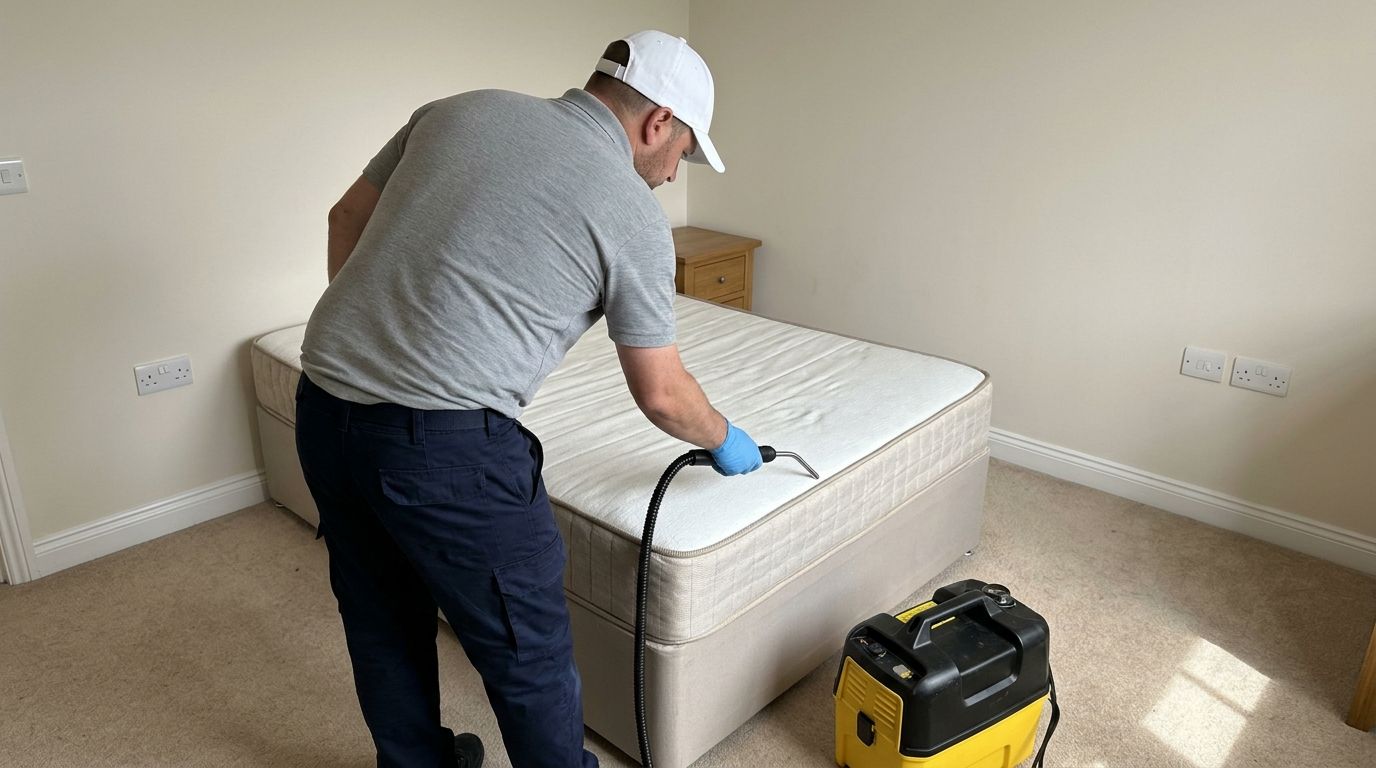
EnviroEx treats bed bugs in homes, rented flats, HMOs, student accommodation and hotels across Manchester and Greater Manchester. We inspect promptly to confirm and map the infestation, give written preparation guidance, treat beds, furniture and room edges, then return after two to three weeks for newly hatched bugs. Call or send an enquiry to book an inspection.
How can you tell if you have bed bugs?
Most people notice the bites first: itchy, raised marks on the face, neck, arms or shoulders, often in a line or a small cluster, appearing after a night’s sleep. Bites are a poor diagnostic on their own. Reactions vary from person to person and some people do not react at all, so in a shared flat one occupant may be covered in bites while another has none.
The physical evidence is more reliable, and it is usually found close to where people sleep or sit for long periods:
- Small dark spots of dried droppings along mattress seams, piping and labels, on bed slats and in the joints of the frame.
- Rusty or reddish smears on sheets and pillowcases where a bug has been crushed after feeding.
- Pale, papery shed skins left behind as young bed bugs grow.
- Eggs: pearly white, about a millimetre long and glued into crevices.
- Live insects: adults are flat, oval and reddish-brown, roughly the size of an apple seed, and swell and darken after a feed.
- A sweet, musty smell in heavier infestations.
Beyond the bed, check headboards fixed to the wall, bedside furniture, skirting boards, carpet edges, behind loose wallpaper and picture frames, and around sockets and switches. If someone regularly sleeps on a sofa, check its seams and the underside too.
Why are bed bugs so common in Manchester flats, student lets and hotels?
Bed bugs are not a sign of a dirty home. They travel on people and their belongings, in luggage, bags, coats and second-hand furniture, so the risk follows movement and turnover rather than hygiene.
Greater Manchester has a great deal of both. Large numbers of students move between halls, purpose-built blocks and shared houses every year, and the summer and September changeovers in student areas such as Fallowfield bring a wave of mattresses, sofas and suitcases changing hands at once. City-centre apartment blocks mix long tenancies with short lets and serviced apartments, and hotels serving conferences, concerts, football and the airport see a constant flow of guests and luggage.
The building stock helps bed bugs once they arrive. Victorian terraces and converted mills divided into flats and HMO rooms often share floor voids, pipe runs and party walls with gaps around them, which let bugs move from one room to the next. Second-hand mattresses and sofas bought online or picked up from the street are a common source in rented homes.
How does our bed bug treatment work?
Every job begins with an inspection to confirm bed bugs, map where they are living and judge how far they have spread. In HMOs, student houses and blocks of flats we will usually recommend checking the rooms either side of the affected one, because treating a single room in a connected building often moves the problem rather than solving it.
You then receive written preparation guidance, and following it closely affects the outcome. Moving belongings into another room before treatment is one of the most common ways a one-room problem becomes a whole-house problem.
Treatment itself combines methods rather than relying on one product. Residual insecticide goes into the cracks and joints where bed bugs shelter: bed frames and bases, headboards, skirting and furniture joints. Desiccant dusts are placed in voids such as bed bases and behind skirting, where they physically damage the insects’ waxy outer layer, so insecticide resistance gives little protection. Steam is used on mattress seams and upholstered furniture. Resistance to some common insecticides is widely reported in UK bed bug populations, so we choose and rotate products with that in mind. Every product is authorised for professional use in Great Britain and applied as its label directs.
Because many insecticides do not reliably kill eggs, the follow-up visit is part of the treatment, not an add-on.
Is bed bug treatment safe for children, pets, guests and staff?
Everyone, including pets, should stay out of treated rooms during treatment and until surfaces are dry, which is usually a few hours. We confirm the re-entry time for the products used and advise on ventilation. Fish tanks should be covered and air pumps switched off.
Tell us before the visit about babies, pregnancy, asthma or allergies in the household. Children’s mattresses, cots and soft toys are not treated in the same way as an adult’s bed frame; we favour steam, laundering and only those products whose label permits that use.
In hotels, serviced apartments and student accommodation we schedule treatment around occupancy, keep the room out of use until it is safe to re-enter, and brief housekeeping on which surfaces were treated. Product information is provided for your COSHH records.
How many visits does bed bug treatment take?
Most jobs need two treatment visits, two to three weeks apart. That interval follows the life cycle: eggs laid before the first visit hatch over the following week or two, and the second visit treats those nymphs before they can breed.
Heavier infestations, cluttered rooms, several affected rooms in one HMO, and flats with infested neighbours often need a third visit. We close a job when inspection finds no live activity, not on a fixed date.
Between visits, keep sleeping in your own bed. Avoid vacuuming or wiping skirting boards and other treated edges until we say it is fine, so the residual treatment stays in place.
How do you stop bed bugs coming back?
No proofing seals a building against bed bugs, because they arrive on people and belongings. Prevention means catching introductions early and making them harder to establish:
- After travel, unpack on a hard floor rather than the bed, check luggage seams and put clothes straight into a hot wash.
- Inspect second-hand beds and sofas closely before bringing them indoors, and avoid furniture left on the street.
- Fit zipped encasements to mattresses and divan bases; they trap any remaining bugs and make checks quick.
- Place interceptor monitors under bed legs so a new problem shows up early.
- In HMOs and converted flats, seal gaps around pipes, skirting and floorboards between rooms.
For hotels, serviced apartments and student accommodation, the most effective measures are procedural: housekeeping trained to recognise the signs at every room change, a written response plan for reports, and periodic inspections. Our commercial pest control service can build bed bug checks into a planned programme.
When does DIY stop being enough?
Laundering, decluttering and encasing a mattress are worthwhile. Shop-bought sprays and foggers are a different matter. They rarely reach the crevices where bed bugs hide, they do not kill eggs, and they can drive bugs out of the bed and into skirting, sockets and the next room.
It is time for professional treatment if bites continue after a full hot wash of bedding, if you find evidence in more than one place, if you live in an HMO or block where others are affected, or if you run any kind of accommodation. If bites are around the ankles and you have pets, consider fleas first; our flea treatment service covers that.
Who is responsible, and what should landlords and accommodation providers record?
For rented homes, responsibility depends on the facts. A home must be fit for human habitation at the start of a tenancy and throughout it under the Homes (Fitness for Human Habitation) Act 2018, and pests fall within the “domestic hygiene, pests and refuse” hazard assessed under the Housing Health and Safety Rating System (HHSRS). Where bed bugs were present at the start of a tenancy, or are spreading from another flat or shared parts, the landlord or managing agent is normally expected to act. Where disrepair such as gaps between rooms helps them spread, the repairing duty in section 11 of the Landlord and Tenant Act 1985 may also be relevant. Where a tenant introduces them into a self-contained home, the tenancy agreement may place responsibility on the tenant, so check it and take advice if it is disputed.
In HMOs, the Management of Houses in Multiple Occupation (England) Regulations 2006 require the manager to keep common parts and shared fixtures clean and in good repair, and to make sure each unit of accommodation, with any furniture supplied, is clean when a new occupier moves in. In practice, an infestation moving between rooms is the manager’s to coordinate. Councils also have powers under the Public Health Act 1936 to deal with verminous premises and articles.
Good records protect everyone. Keep the tenant’s report and the date you received it, inspection and treatment reports, the rooms treated, the preparation guidance given, access arrangements and the outcome of each follow-up. Hotels and accommodation providers should add an incident log showing room status and housekeeping checks. Our reports are written to sit in those files, and our pest control for landlords service covers tenanted homes, HMOs and managed blocks.
How bed bug treatment works with EnviroEx
- 1
Inspection and confirmation
We check mattress seams, bed bases, frame joints, headboards, skirting, sockets and nearby furniture to confirm bed bugs and map how far they have spread, including adjoining rooms where relevant.
- 2
Written preparation guidance
You receive a preparation sheet covering what to launder at 60°C, what to bag, what to leave in place and why furniture should not be moved to other rooms before treatment.
- 3
First treatment
We treat harbourage with a combination of residual insecticide, desiccant dust in voids and steam on mattresses and upholstery, choosing products to work around known insecticide resistance.
- 4
Follow-up treatment
We return after two to three weeks to treat nymphs that have hatched from eggs laid before the first visit, and re-inspect every treated area.
- 5
Final check and report
When no live activity is found we close the job with a written report covering rooms treated, products used and advice given, ready for landlord or accommodation records.
Typical visits: Usually two treatment visits two to three weeks apart; heavy infestations, cluttered rooms and connected HMO rooms or flats can need a third visit or more.
Safety: People and pets stay out of treated rooms until surfaces are dry, usually a few hours, and we confirm the re-entry time for the product used. On mattresses and children's furniture we favour steam and only products whose label permits that use.
Bed Bug Treatment: your questions answered
How do I know it is bed bugs and not fleas or mosquitoes?
Bed bug bites usually appear on skin exposed in bed, such as the face, neck, arms and shoulders, often in a line or small cluster. Flea bites tend to sit around the ankles and lower legs and usually point to a pet or a previous occupant's pet. The bites alone are not proof, though, because reactions vary and some people do not react at all. Look for evidence instead: small dark spots on mattress seams, rusty smears on sheets, pale shed skins or live insects. A clear photo or a specimen sealed in a bag lets us confirm before treatment.
Should I sleep in a different room if I have bed bugs?
In most cases, no. Bed bugs follow the person they feed on, so moving to the sofa or a spare room tends to spread the infestation into furniture that was clean. Keep sleeping in your own bed, with freshly laundered bedding and the bed pulled slightly away from the wall. Once treatment is in place, you sleeping there draws the bugs out across treated surfaces, which helps the treatment work. If you are in an HMO or a hotel, tell the landlord or manager rather than moving rooms yourself.
Do I need to throw my mattress away?
Usually not. Most mattresses can be treated, and fitting a zipped encasement afterwards traps any bugs left inside and makes future checks easier. Throwing a mattress out can make things worse if it is carried unwrapped through hallways and stairwells, shedding bugs and eggs on the way. If a mattress is badly damaged or heavily infested and you decide to replace it, wrap it fully in plastic before moving it, mark it as infested and arrange disposal promptly rather than leaving it in a shared bin store.
Is there a treatment that kills every bed bug in one visit?
No single product or visit can be relied on to do that, so treat any one-visit promise with caution. Bed bug eggs are glued deep into crevices and many insecticides do not reliably kill them, so nymphs keep hatching for a week or two after the first treatment. Resistance to some common insecticides is also widely reported in UK bed bug populations. That is why we combine methods, including residual products, desiccant dusts and steam, and build a second visit into the plan from the start.
How should I prepare my home for bed bug treatment?
Strip the beds and wash bedding, nightwear and clothing from around the bed on a 60°C wash, then tumble dry on a hot setting. Bag clean items in sealed bags so they are not reinfested. Clear the floor around beds and skirting so we can reach the edges, and empty bedside drawers. Do not move furniture or belongings into other rooms, and stop using shop-bought sprays, which can scatter bugs. Your written preparation sheet will set out anything specific to your property.
Is heat treatment better than chemical treatment for bed bugs?
Each has a place. Heat kills all life stages, eggs included, when the room and its contents are held at a lethal temperature for long enough, but it needs specialist equipment, careful preparation and good control to avoid cold spots or damage to heat-sensitive items. It also leaves no residual protection afterwards. Chemical and physical treatments with a planned follow-up work well in most homes and rented rooms. We explain the options after inspection, and if we think a property would be better suited to heat we will say so.
Who is responsible for bed bugs in a rented flat or student house?
It depends on how and when the bed bugs arrived and on the tenancy. If they were present at the start of the tenancy, or are spreading from another flat or a shared part of an HMO, the landlord or managing agent is normally expected to deal with it, because pests fall within the hazards assessed under HHSRS and a home must be fit for human habitation. If a tenant brings them into a self-contained home mid-tenancy, the agreement may place responsibility on them. Report it to your landlord in writing either way, and take advice if responsibility is disputed.
What should a hotel or serviced apartment do when a guest reports bed bugs?
Take the room out of service straight away and leave the bed and furniture in place, since stripping and moving items around the building can spread the problem. Record the date, the room and what was reported or found. If the guest moves rooms, offer to bag and launder their clothing and check their luggage first, so the bugs do not travel with them. We inspect the affected room and the rooms on either side, above and below, then treat and re-inspect before the room goes back into use.
Bed Bug Treatment by area
Local detail for the places we serve most often.
Last updated: