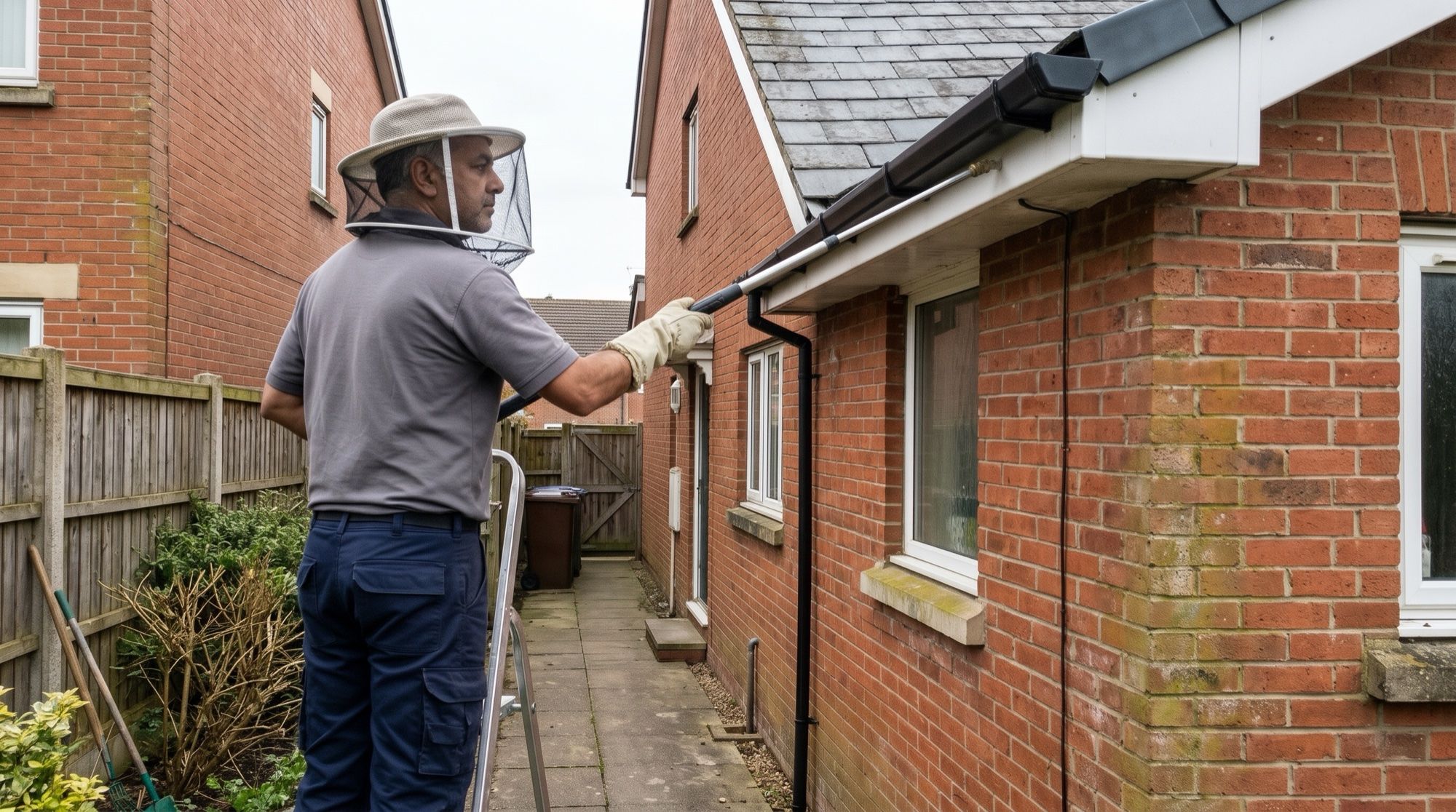
EnviroEx treats wasp nests at homes, food premises, offices and other business sites across Manchester and Greater Manchester. We find the nest entrance, apply a professional insecticide and leave clear safety advice; most nests are inactive within a day or two. We arrange prompt visits during the season. Call or send an enquiry to book.
How do you know it is a nest and not just a few wasps?
A handful of wasps around a bin or a table in late summer is normal. A nest gives itself away through a pattern: a steady stream of wasps flying in and out of the same point, usually in a straight line, for most of the day. Watch from a few metres away on a warm afternoon and the entrance usually shows itself quickly.
The signs facilities teams and householders should look for are:
- wasps going in and out of a gap under the slates, at the end of a soffit board or beside a fascia;
- a faint scratching or rustling in a ceiling or wall, which is workers enlarging the papery nest;
- wasps appearing indoors in numbers, often in a bedroom or landing below the loft, having found a way through a downlighter or around the hatch;
- a grey, papery globe in a shed, garage roof, bird box or compost bin;
- on business premises, repeated activity at the same corner of a flat roof, sign box, cladding joint or bin store.
Is it definitely wasps?
Identification comes first, because we treat wasp nests but do not treat bees. Common and German wasps are bright yellow and black, smooth-bodied and narrow-waisted. Bumblebees are rounder and furry. The tree bumblebee, now widespread across the region, likes bird boxes and gaps in soffits and is often mistaken for wasps because of the traffic around the entrance. Its colonies are small, fairly docile and finished by mid-summer, so leaving them alone is usually the right answer.
Honeybee swarms are best collected by a local beekeeper, and the British Beekeepers Association lists volunteer swarm collectors. Masonry bees boring into soft mortar on older brick walls are solitary and rarely a problem in themselves, though they signal that repointing is due.
The European hornet is a large native species, brown and yellow, and can be treated like a wasp nest where it is causing a problem in or on a building. The Asian, or yellow-legged, hornet is different. It is an invasive non-native species with a dark body, a single orange band and yellow-tipped legs, and sightings should be reported through the Asian Hornet Watch app or the online form on the Non-native Species Secretariat website rather than handled privately. If a photo suggests an Asian hornet, we will ask you to report it and leave the nest undisturbed.
Why do wasps choose buildings in Greater Manchester?
A queen starts a nest alone in spring, looking for somewhere dry, sheltered and close to a supply of wood fibre. By late summer that nest can hold several thousand workers. The building stock here gives her plenty of choice.
Victorian and Edwardian terraces offer slipped slates, gaps where the roof meets the party wall and worn pointing. Inter-war semis often have soffits and fascias that have shrunk away from the brickwork, plus small bay roofs with a void behind them. Newer houses and apartment blocks have weep vents at the base of cavity walls and gaps around service pipes, which let a queen into a cavity where the nest grows unseen until wasps start appearing indoors.
Commercial premises add their own entry points: flat roofs with failed flashing, gaps behind illuminated signage and rainscreen cladding, roller-shutter boxes and plant rooms. Bin stores with lids that do not close, and food businesses with outdoor seating, attract foraging workers late in the season, when the colony stops rearing larvae and workers go looking for sugar.
Wasps are most noticeable in August and September. In late summer the colony raises new queens and males; through autumn the workers die off as temperatures fall, and the nest is empty by winter. It is not reused, but next spring’s queens may pick similar spots on the same building, which is why proofing matters.
How do we treat a wasp nest?
We start by confirming the species and finding the entrance, which can be some distance from the nest itself. If the nest is in a bird box, we check that no birds are still nesting there, since an active bird’s nest is protected under the Wildlife and Countryside Act 1981.
The technician, wearing a protective suit and veil, applies a professional-use insecticide dust or foam directly into the entrance. Returning workers carry it into the nest, so the treatment reaches the colony without opening the structure. For entrances at roof height, we use an extension lance from the ground where we can and plan safe access where we cannot.
Expect a short burst of activity as disturbed wasps fly out, followed by a steady fall over the next few hours. Most nests are dead within a day or two. On commercial sites, we agree the treatment area with the site manager, can schedule the visit before opening or after close, and leave a written job record.
Is treatment safe for children, pets, staff and customers?
Because the product goes into the nest entrance rather than across rooms, lawns or seating areas, exposure is limited. Keep people and pets away from the treated spot for the rest of the day and do not touch it. If the nest is in a loft, keep the hatch closed. Wasps can be agitated for a short time, so shut windows on that side of the building.
Anyone with a known sting allergy should stay indoors and away from that elevation until activity stops; signs of anaphylaxis after a sting are a 999 emergency. On trading premises we may close off outdoor tables near the nest, put up temporary signage and choose a quieter time of day. In food premises, treatment is kept well away from open food and food-contact surfaces.
How many visits does a wasp nest take?
Usually one. A second visit is occasionally needed where the nest is very large, where two colonies are using the same building, or where the entrance was difficult to reach. If activity is still heavy two days after treatment, let us know.
How do you stop wasps nesting there again?
Since old nests are not reused, prevention means removing the spots queens like. Winter and early spring are the best time for the work: seal gaps around soffits and fascias, replace slipped slates, repoint open joints, and fit purpose-made insect-proof covers to weep vents rather than blocking them, because they let the cavity drain and ventilate. Keep shed and garage doors well fitted and bin lids closed.
For businesses, add these items to the planned maintenance list. In food rooms, windows that open to the outside should, where necessary, have removable insect-proof screens, and bins and drinks waste near seating should be covered. A spring check of eaves, signage and known nesting points catches small nests when treatment is simplest, and on a commercial pest control contract that check can be built into routine visits.
When does DIY stop being enough?
Shop-bought powders can deal with a small, exposed nest early in the season. They stop being enough when the nest is in a wall cavity, loft or roof; when the entrance is above head height, where being stung on a ladder is a real fall risk; when the nest is large and late in the season; when someone in the household has an allergy; when the nest is near a door, a play area or a customer area; or when you are not sure of the species.
Do not block the entrance. Trapped wasps can chew through plasterboard and emerge indoors. In any of those cases, our domestic pest control team can usually deal with it in one visit.
What should a business or landlord record?
For food businesses, Regulation (EC) No 852/2004, which still applies in England as assimilated law, requires adequate procedures to control pests, and the Food Safety Act 1990 and the Food Hygiene (England) Regulations 2013 give environmental health officers enforcement powers. An EHO is likely to expect wasp activity and treatment to appear in your pest-management records alongside your HACCP-based plan: date, location, findings, product used, who treated it and any follow-up. Our food premises pest control service covers how that file is kept.
For landlords, responsibility depends on the tenancy and on the cause. Where wasps got in through disrepair to the structure or exterior, the repairing duty under section 11 of the Landlord and Tenant Act 1985 may apply. Domestic hygiene, pests and refuse is also an HHSRS hazard, relevant to the fitness test under the Homes (Fitness for Human Habitation) Act 2018, though whether a seasonal nest meets that threshold depends on the circumstances. Keep a note of when the nest was reported, when it was treated and when the entry point was repaired. Our pest control for landlords service can manage this across a portfolio.
How wasp nest removal works with EnviroEx
- 1
Confirm the species
From your description or a photo, we check it is wasps rather than bees or an Asian hornet, which follow different routes.
- 2
Find the entrance
We trace the flight line to the point the wasps use, which may be some distance from the nest inside a cavity or roof void.
- 3
Treat at the entrance
A professional-use insecticide dust or foam goes directly into the entrance, using an extension lance from the ground where height allows.
- 4
Safety briefing and record
We explain what to expect over the next day, mark any area to keep clear and leave a job record suitable for a pest-management file.
- 5
Check the result
Activity normally falls within hours and stops within a day or two. If it does not, tell us and we will reassess the nest.
Typical visits: One visit treats most nests; a second is occasionally needed for very large, hard-to-reach or multiple nests.
Safety: Keep children, pets, staff and customers away from the treated entrance for the rest of the day, do not block the hole, and do not try to remove a nest while it is still active.
Wasp Nest Removal: your questions answered
Can I get a wasp nest removed for free in Greater Manchester?
Usually not. Wasps are not generally treated as a public-health pest. Check your council's website for current pest control services and charges. Council and housing association tenants should ask their landlord first, as some include it. Otherwise private treatment is the route, and we will tell you plainly if the nest can safely be left alone.
Do you treat bees as well as wasps?
No. We do not treat honeybee or bumblebee nests. If your description or photo suggests bees, we will say so and point you to the right route: a local beekeeper for a honeybee swarm, usually found through the British Beekeepers Association, or patience for a bumblebee nest, which dies out naturally within the season. Tree bumblebees in bird boxes and soffits are a common mix-up in late spring and early summer, and their colonies are usually finished by mid-summer.
Can I leave a wasp nest until the winter?
Often, yes, if it is away from doors, windows, play areas and customer seating and nobody using the building has a sting allergy. Colonies die off in autumn and the old nest is not reused, so by late October most colonies are dying out or already gone. Leaving it is a poor choice when the nest is beside an entrance, inside a loft above bedrooms, or on trading premises, where staff and customer safety come first.
What if I cannot see where the nest is?
That is common with cavity walls, flat roofs and lofts. The entrance is what matters, and it can sit some way from the nest itself. We look for the flight line, check eaves, weep vents, air bricks and roof edges, and listen at internal walls where needed. Treating the entrance is normally enough, because returning workers carry the insecticide inside, so we rarely need to open up plasterboard or brickwork.
Is treatment safe for my children and pets, and do I need to go out?
You do not need to leave the house. The treatment goes into the nest entrance rather than being sprayed around rooms or the garden. Keep children and pets away from that spot for the rest of the day, close windows on that side of the building while the wasps settle, and keep the loft hatch shut if the nest is in the roof space. Anyone with a known sting allergy should stay well away until activity stops.
What kills a wasp nest instantly?
Nothing safe does. Even a professional insecticide works over a few hours, because it relies on returning wasps carrying it into the nest, and most nests are dead within a day or two. Pouring water, petrol or boiling liquid on a nest, setting it alight or blocking the hole are all dangerous. They tend to send agitated wasps straight at you, or force them to chew their way into the house.
Will you take the nest away after treating it?
Usually there is no need. A treated nest stops being active and is not reused the following year, so leaving it in a roof void or cavity does no harm. Where a nest is easy to reach, such as in a shed, garage or bird box, it can be taken down once it is dead if you prefer. Opening up a roof or wall just to remove an old, empty nest is rarely worth the cost or disruption.
We run a café with outdoor seating. What should we record after a wasp treatment?
Treat it like any other pest activity on site. Your pest-management records should show the date, where the nest was, what was used, who treated it and any follow-up, so an environmental health officer can see the issue was identified and controlled. We leave a job record for that file. It also helps to note the housekeeping and proofing changes that reduce wasp pressure around food, such as covered bins and screened kitchen windows.
Is a wasp nest the landlord's or the tenant's responsibility?
It depends on the tenancy agreement and on how the wasps got in. A seasonal nest is often treated as the tenant's matter, but if the colony entered through disrepair, such as a broken soffit or slipped slates, the landlord's repairing duty under section 11 of the Landlord and Tenant Act 1985 may well be relevant. Either way, the entry point should be repaired once the nest is dead, and both the treatment and the repair recorded.
Wasp Nest Removal by area
Local detail for the places we serve most often.
Last updated: