EnviroEx provides pest control for restaurants, cafés, takeaways, bakeries and food producers across Manchester and Greater Manchester. We respond promptly to active sightings, treat with methods suited to food rooms, proof entry points and leave inspection-ready records for your EHO visit. Ongoing contracts are set by risk. Call or send an enquiry to arrange a site survey.
What are the signs of pests in a food business?
In most kitchens, staff are the first to see the signs, provided they know what to look for.
Mouse droppings are small, dark and spindle-shaped, about the size of a grain of rice. They collect along wall edges, behind fridges and on top of stacked packaging. Rat droppings are noticeably larger, closer to a sultana, and usually appear near drains, in cellars and around the bin store. Other signs include gnawed sacks and cartons, grease smears along skirting, shredded paper in voids and scratching in the ceiling once the extraction goes off.
German cockroaches are the species most often found in commercial kitchens. They are small, pale brown, with two dark stripes behind the head, and they shelter in warm cracks around dishwashers, ovens, fridge motor housings and door gaskets. Seeing one in daylight often means the hidden population is large. Look too for brown egg cases, shed skins and a musty smell in enclosed spaces. Oriental cockroaches are larger, darker and slower, and favour cooler cellars and drains.
Flies and stored-product insects are easier to overlook. Fruit flies around glass washers and floor drains, small moths or webbing in flour, rice and spices, and beetles in dry goods all point to a breeding source that needs finding, not just a fly killer on the wall.
Why do Manchester food premises attract pests?
Much of the city’s food trade operates from buildings that were never designed as kitchens. Restaurants, cafés and bars in the city centre, the Northern Quarter and Ancoats often occupy converted warehouses, mills and Victorian commercial buildings. Cellars, shared risers, suspended ceilings and old brick drainage connect one unit to the next. Treating a single kitchen rarely holds for long if the source is the unit next door, a shared basement or a communal bin yard.
The way food businesses trade adds to it. Late opening means kitchens stay warm and are rarely empty for long, which suits cockroaches. Frequent deliveries bring cardboard, sacks and crates through the back door, and insects can travel in with them. Rear yards and back entries shared by several takeaways collect trade waste between collections, which draws rats, gulls that tear bags open and pigeons that pick over the spillage.
Manchester’s canals, rivers and older sewers give brown rats long, sheltered routes through the city. A cracked drain, a missing rodding-eye cap or a floor gully that has dried out can open a direct path into a kitchen. From late autumn, as temperatures drop, mice push into heated buildings, and food rooms with gaps around service pipes are among the first places they settle.
How does food premises pest control work?
Every job starts with a survey. We identify the species, find out where it is living and how it is getting in, and look at the site the way an environmental health officer would.
Treatment is chosen for a room where food is prepared. For mice and rats inside, we rely mainly on traps and monitoring, placed where staff will not disturb them and food cannot be contaminated. Where rodenticide is justified, it is secured in locked, tamper-resistant stations, normally in external or non-food areas, and each one is numbered on a site plan. Under the CRRU code of best practice and the product labels, toxic bait is used for a defined treatment and removed afterwards; permanent baiting is lawful only where the label allows it. Glue traps are not part of our approach: since 31 July 2024 it has been an offence in England to set one for a rodent without a licence, and Natural England grants those only where public health or safety requires it.
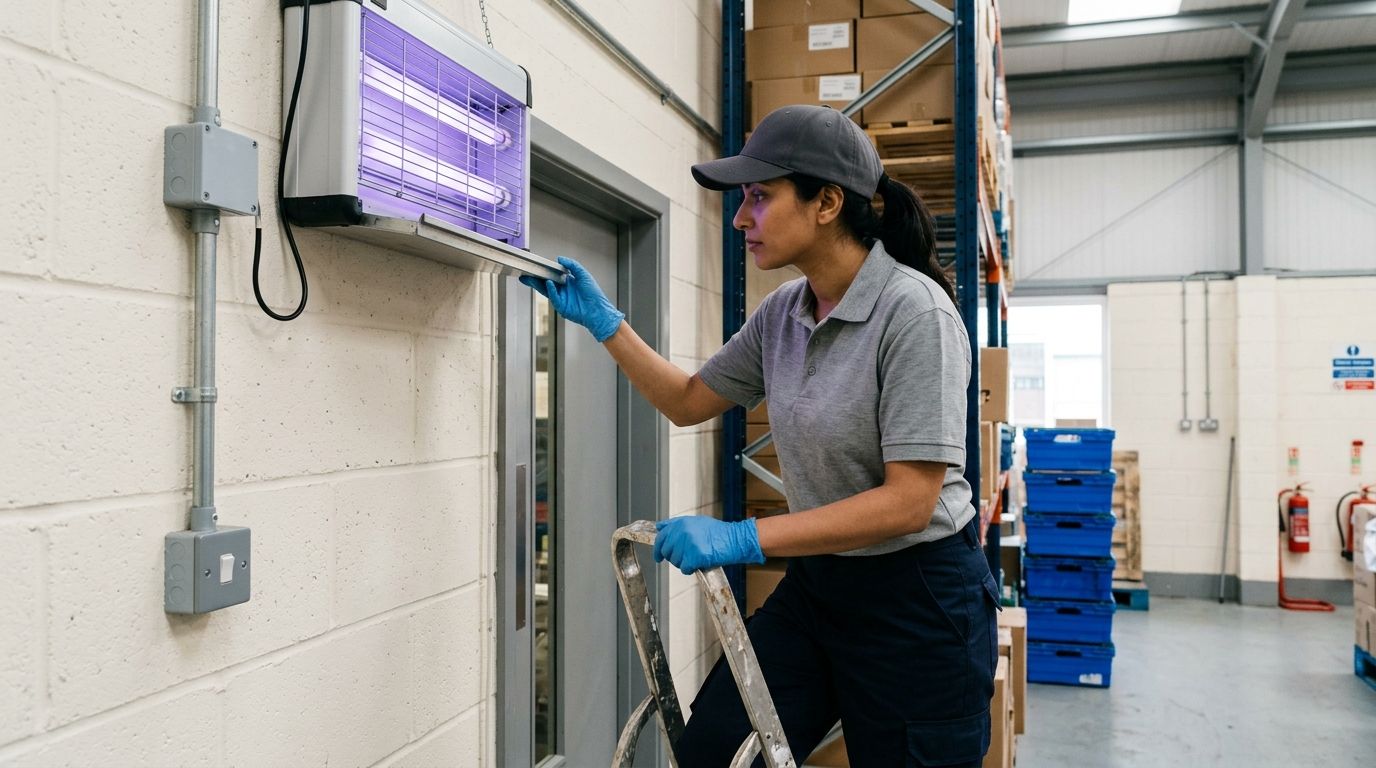
For cockroaches, gel baits placed into cracks and voids do most of the work, supported by sticky monitors that show whether numbers are falling. General sprays play a small part in a working kitchen because they can scatter cockroaches into new hiding places and leave residue where it is not wanted. Flies are tackled at the breeding source first, usually a drain, a waste area or a neglected corner under equipment, and then with insect light traps. In food rooms, sticky-board units are generally preferred to electric grid types, which can scatter fragments. You can read more about our approach to specific pests on our cockroach control and rodent control pages.
Is treatment safe for staff, customers and food?
It should be, and the planning is what makes it so. We schedule treatment before service or after close, food is covered or removed, and nothing is applied to food-contact surfaces. Stations are placed out of reach of customers, children and, in dog-friendly cafés, visiting pets. Staff are told what has been placed where, and the site plan shows every point so nobody moves a station during a deep clean without knowing.
You receive safety data sheets for any product we use, along with clear instructions on re-entry and cleaning, so your COSHH file stays current.
How many visits does it usually take?
A mouse problem in a kitchen typically needs two or three visits over two to three weeks: treatment, a check on activity, then sign-off once proofing is in place. Rats depend on where they are coming from; if the source is a defective drain, the drain needs repairing and we will say so in writing.
German cockroaches take longer. Their egg cases shield developing nymphs from many treatments, so follow-up visits at intervals over four to six weeks are normal until monitors show no new activity.
After that, most food businesses move onto routine inspection. The frequency is set by risk rather than a fixed rule; many sites sit at around eight inspections a year, with more for basement kitchens, premises with a history of activity and producers working to a customer audit. Multi-site operators can find more detail on our commercial pest control page.
How do you proof a kitchen against pests?
Proofing is what stops the same problem returning. A mouse can pass through a gap roughly the width of a pencil and a young rat through one about the width of a thumb. We seal gaps around pipes behind sinks and under cooking lines, fit bristle strips and kick plates to doors, mesh air bricks and vents, cap redundant drains and close gaps where boxing meets the floor. Fly screens on opening windows and strip curtains on back doors help in summer.
Housekeeping matters as much as hardware. Keep stock off the floor and away from walls so the area can be inspected, flatten cardboard and get it out of the kitchen quickly, keep trade bins lidded and the yard clear between collections, and move equipment regularly to clean behind it. Where gulls and pigeons are working the bin store or loading area, tighter waste control comes first, then netting or other proofing from our bird control service to keep them off ledges and canopies.
When does DIY stop being enough for a food business?
A shop-bought trap can deal with a single mouse, but it does not tell you where it came from or whether more are behind the panels. Call a contractor if you find droppings in more than one area, see cockroaches in daylight, notice activity coming back after a clean, or find damaged stock.
There is also the question of evidence. An inspector wants to see competent, documented pest management, and a box of supermarket traps with no records rarely demonstrates that.
What pest control records should a food business keep?
The food hygiene rules that apply in England, based on Regulation (EC) No 852/2004, require adequate procedures to control pests and food safety procedures based on HACCP principles. The Food Safety and Hygiene (England) Regulations 2013 let officers serve hygiene improvement notices and, where there is an imminent risk of injury to health, a hygiene emergency prohibition notice, which takes effect immediately and can close all or part of the premises. Pest control is also part of how the Food Hygiene Rating Scheme scores the condition of your premises.
A sound pest control file usually contains:
- your contract or written pest management arrangement
- a site plan showing every monitoring point and station
- visit reports with findings and recommendations
- a record of when each recommendation was actioned
- safety data sheets for products used on site
- a staff sightings log and notes of proofing or repair work
- service records for insect light traps
Records can support a due diligence defence under the Food Safety Act 1990, but they do not transfer responsibility. The food business operator stays accountable for food safety, which is why our reports set out each action with a priority, ready to file alongside your HACCP plan.
How food premises pest control works with EnviroEx
- 1
Site survey and risk review
We walk the kitchen, dry stores, cellar, bin area and service voids with you, identify the pest and its entry routes, and note what an inspector is likely to look at first.
- 2
Treatment designed for food rooms
Rodents are handled mainly with traps and monitoring, cockroaches with gel baits in cracks and voids, and any rodenticide is secured in tamper-resistant stations and recorded.
- 3
Proofing and housekeeping actions
We seal gaps around pipes, doors, drains and ducts, and give you a short, prioritised list of cleaning, storage and maintenance fixes with photographs.
- 4
Follow-up visits
Return visits check activity levels, adjust the treatment and confirm in writing when the infestation is under control.
- 5
Records and routine inspection
You receive a report after every visit and a site plan of monitoring points, and can move onto a routine inspection contract set by the risk on your site.
Typical visits: Most active infestations need two to four visits over two to six weeks; routine contracts for food businesses are set by risk and commonly run to around eight inspections a year or more.
Safety: In food rooms we favour traps, monitoring and gel baits placed away from food-contact surfaces; any rodenticide is locked in tamper-resistant stations, mapped and recorded in line with the CRRU code.
Food Premises Pest Control: your questions answered
Will one mouse sighting lower our food hygiene rating?
Not automatically. The inspector scores what they find on the day and how well you are managing it. A single sighting that was logged, reported to your contractor, treated and followed by proofing shows control. Droppings across the dry store, gnawed packaging and no records suggest the opposite, and can pull down the scores for the condition of the premises and for confidence in management. Where an officer judges there is an imminent risk of injury to health, they can serve a hygiene emergency prohibition notice, which takes effect at once and can shut all or part of the premises, so early action matters.
What will an environmental health officer ask to see about pest control?
Expect to be asked who manages pest control and how. In most inspections that means your contract or written arrangement, a site plan showing monitoring points and stations, recent visit reports, evidence that you acted on the recommendations, and safety data sheets for any products used on site. Officers also look at the building itself: gaps around pipes, door seals, fly screens, the bin area and dry stores. Our reports are laid out so they can be filed straight into your HACCP or Safer Food, Better Business records.
Do we have to close while you treat the kitchen?
Usually not. Most treatments are planned around service, early in the morning or after close, with food covered or removed and food-contact surfaces left clear. Traps and gel baits sit in voids and behind equipment, out of the way of staff. Closure becomes a question when an infestation is heavy enough to put food at risk. In that situation an officer may require it, or you may decide to close voluntarily while a deep clean and intensive treatment are carried out. We will tell you plainly if we think you are near that point.
Do you use poison in food preparation areas?
We avoid it wherever we can. Inside kitchens and stores we rely mainly on traps, monitoring and, for cockroaches, gel baits placed in cracks away from food-contact surfaces. Where rodenticide is justified it goes in locked, tamper-resistant stations, usually in external or non-food areas, each one numbered on the site plan. We follow the CRRU code of best practice and the product label, so toxic bait is used for a defined treatment and then removed; permanent baiting is lawful only where the label allows it. Glue traps are not part of our approach, because since July 2024 setting one for rodents in England has needed a licence, granted only in limited public health or safety cases.
How many routine pest inspections a year does a restaurant need?
There is no single legal number; it depends on risk. Around eight routine inspections a year is a common pattern for food businesses, with more for premises that have a history of activity, a basement kitchen, shared drainage or a busy rear yard, and for producers working to a customer or audit standard. A small café with sound proofing and no history may need fewer. We set the frequency after a survey and review it whenever the findings change, so you are not paying for visits the site does not need.
Does having a pest control contract make us compliant?
A contract does not move legal responsibility away from the food business operator. What it gives you is competent advice, regular inspection and a paper trail that can support a due diligence defence under the Food Safety Act 1990. The part officers examine closely is whether you acted on what the reports said: replacing the door seal, lifting stock off the floor, getting the drain repaired. We record each recommendation with a priority so you can show when it was raised and when it was closed.
We lease our unit. Who is responsible for proofing work?
That depends on the lease. Many commercial leases put internal repairs on the tenant and structural or common-part repairs on the landlord, sometimes recovered through a service charge, but the wording varies and is worth checking. Food safety responsibility stays with you as the operator whoever pays. In converted buildings with shared basements and risers, the entry point is often in an area you do not control, so we write findings with photographs in a form you can pass to your landlord or managing agent.
Do we have to tell the council if we find rats or mice?
Section 3 of the Prevention of Damage by Pests Act 1949 places a duty on an occupier who knows rats or mice are living on or visiting the land in substantial numbers to notify the local authority in writing, and section 4 lets the council serve notice requiring treatment or structural work. A single sighting dealt with promptly is unlikely to reach that threshold, but an established infestation may. Whether it applies depends on the circumstances, so we will give you our view after the survey and put the findings in writing.
Food Premises Pest Control by area
Local detail for the places we serve most often.
Last updated: