EnviroEx works with food businesses, shops, offices, landlords, industrial units and householders in Oldham, Chadderton, Royton and Failsworth. After a prompt survey we treat rats, mice, insects and nuisance pigeons using secured methods, seal the routes they use and put every visit in writing for your records. To book, phone or use the enquiry form.
Mill buildings, distribution units and business parks
Cotton made Oldham: at its height the town had more than 360 mills working day and night. Large brick buildings of that era share the same weak points for rodents: pipe and cable runs through thick walls, lift and stair cores that connect every floor, and goods doors left open while stock moves. Where a former mill is split between tenants, one occupier’s station plan rarely holds unless the shared corridors and risers are covered too.
In 2001 retail and wholesale and manufacturing were the borough’s two largest employment sectors, each taking about a fifth of employed residents. Royton has a business park at Salmon Fields, and Hollinwood Junction, beside Junction 22 of the M60, is a Langtree scheme of 13 distribution and manufacturing units delivered with the council. Pallets, wrapped stock and dock levellers give mice cover and a way in. A warehouse contract starts with a numbered plan covering dock doors, shutters, the fence line and the waste compound, with visit frequency set by risk and trend reports for any customer or auditor; our commercial pest control page sets out the detail.
Shops, food counters and venues in the town centre
The Spindles and Town Square together form one of the largest covered retail areas in Greater Manchester. Units in a covered centre usually share service corridors, risers and waste stores, so mice that start in one unit can work through to the next, and the station plan has to be agreed with centre management rather than stopping at the shop door. Public venues such as Gallery Oldham and the Odeon cinema in the Old Town Hall need the same discretion wherever food is served or stored, from a confectionery counter to a staff room, with visits timed around opening hours and stations placed where the public cannot see or reach them.
A Food Hygiene Rating Scheme inspection looks at the state of the building and how food safety is managed, not just at cleanliness on the day, so an unproofed gap under a back door or a missing pest record can pull a score down before any droppings appear. Our food premises pest control service gives cafés, takeaways and kitchens a written plan, a station map and a report after every visit for the food safety file, whether it is built on HACCP or on Safer Food, Better Business.
The council’s town-centre plans with its partner Muse include more than 2,000 new homes and a new park at Tommyfield. If groundwork starts next door, check drains, door seals and yard bins, because excavation can displace established rats.
Offices, hospitals, colleges and care homes
Royal Oldham Hospital sits on the town’s northern boundary with Royton, and University Campus Oldham and Oldham College add further and higher education sites. In offices the risk usually sits in tea points, desk-side food and ceiling voids shared with other tenants. In healthcare, education and care settings, methods are chosen around the people inside: enclosed traps in occupied rooms, any rodenticide kept to locked external stations or sealed voids, and visit times agreed with the estates or facilities team. Bin stores are often the weak point; on a council round reported in the local press, a single wheelie bin at a residential home in Failsworth held dozens of rats.
Canals, rivers and waterside premises
The town sits on high ground between the Irk and the Medlock, but several rivers and canals cross the wider borough. The Beal flows north along the town’s boundary with Royton and with Shaw and Crompton. The Medlock runs through the wooded gorge between Lees and Ashton-under-Lyne. The Rochdale Canal crosses the north-west corner of Failsworth, and the Huddersfield Narrow Canal runs through Saddleworth, with the Standedge tunnel at Diggle. Brown rats use banks, culverts and outfalls for cover, and one Saddleworth café had them arriving from the canal in search of food.
Water changes the method too. Product labels and CRRU UK guidance restrict how rodenticide can be used near watercourses, and the Rochdale Canal is one of the borough’s five Sites of Special Scientific Interest, where works on the protected land itself can need consent from Natural England. On waterside premises we rely on trapping, fixed stations set back from the bank and proofing of the building.
Pigeons on brick rooflines and retail roofs
Long sills, brick parapets and the flat roofs of shopping centres and industrial units offer feral pigeons roosting and nesting ledges, and the birds foul entrances, loading bays and rooftop plant below. The Wildlife and Countryside Act 1981 treats feral pigeons as wild birds, which makes it an offence to intentionally damage or destroy a nest that is in use or under construction. In England, feral pigeons may normally be killed only under a licence, in practice usually a general licence, whose conditions expect proofing and scaring to have been tried or ruled out as impractical first. Our bird control work is therefore built on exclusion, with netting over canopies and light wells, sprung wire or spikes along ledges, and cleaning of fouled areas, timed so that no active nest is disturbed.
Bins, fly-tipping and the council’s rat figures
Council technicians were called to 506 rat infestations in 2022, after 497 in 2021 and 475 in 2020, and they leave out calls to private landlords and housing associations, so the real total is likely higher. Since October 2016 general waste has gone out only every three weeks, so food put in the wrong bin waits longer, and in Werneth a technician saw a rat feeding on fly-tipped rubbish. The same technician said rodents try to come indoors as it turns cold in mid-September, which makes late summer the right moment for a business to check door sweeps, airbricks and the bin compound.
What does Oldham Council offer?
The council’s current page lists a dozen pests its team treats for homeowners and private renters, from rats and wasps to moles and two kinds of beetle, mostly as a paid service, with one free treatment a year possible for residents on Council Tax Reduction. Businesses can ask for an individually priced quote by email. Pigeons and gulls are not on the list, so bird proofing is likely to need a private contractor either way.
Homes and lettings: mill terraces and stone cottages
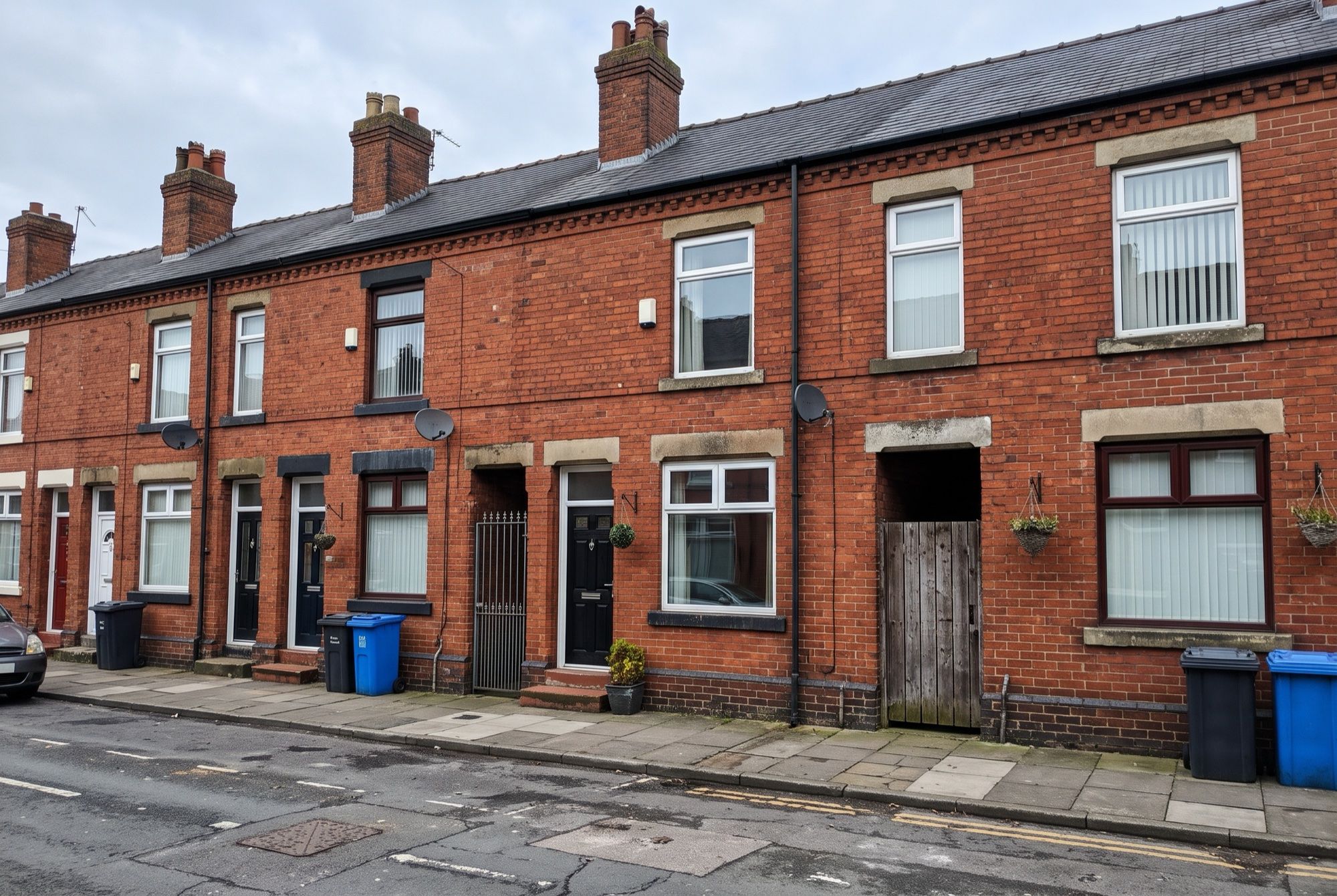
Much of Oldham’s housing is two-up-two-down terraces, built mostly between 1870 and 1920 for cotton mill workers. Rows of early-twentieth-century terraces built for factory workers are still common in Chadderton, while in Royton redevelopment has modernised many of the older Edwardian terraced streets. In a terraced row, mice often travel through roof spaces and wall voids, and rats use drain runs that serve several houses, so the house reporting the problem is not always where it started.
Saddleworth is different: broadly rural, with Yorkshire-style cottages in local millstone grit rather than the Accrington red brick found across most of the borough. There, mice and rats tend to come in from the surrounding land in autumn, through open joints in old pointing.
Home ownership fell from 64.9 per cent of households in 2011 to 60.4 per cent in 2021, so more of the borough’s homes are rented. Where rodents get in through defects, the repair is usually the landlord’s job under section 11 of the Landlord and Tenant Act 1985, which covers the structure, exterior and drains. The HHSRS also treats pests as one of the hazards it rates, so a dated note of findings and repairs protects both sides. The pest control for landlords service covers tenant access and the property file, and householders can book a domestic visit.
What does Oldham Council offer?
According to its current pest control page, Oldham Council's own team treats homes for owner-occupiers and private tenants, charging for most jobs and covering rats, mice, wasps, squirrels, bed bugs, cockroaches and several other pests, though bees are not on its list. Residents receiving Council Tax Reduction (not a Council Tax discount alone) may be eligible for one free treatment every 12 months for rats, mice, bed bugs, cockroaches or fleas, while social housing tenants are asked to report pests to their registered social landlord. Businesses can request an individually tailored commercial quote by email.
See the council's pest control page (checked 2026-10-24).
Local context that shapes pest problems in Oldham
- Oldham Council dealt with 506 rat infestations in 2022, compared with 497 in 2021 and 475 in 2020, and the totals do not include work for private landlords or housing associations. [The Oldham Times]
- On one council pest-control round, rats were seen eating fly-tipped rubbish in Werneth and crowding a wheelie bin, rodents were coming up from the canal to feed, and the technician said they try to get indoors once it turns cold around mid-September. [The Oldham Times]
- Since 3 October 2016 Oldham has collected general household waste every three weeks instead of fortnightly, while food and garden waste stayed on a weekly round. [letsrecycle.com]
- A large share of Oldham's homes are two-up-two-down terraces, put up mainly between 1870 and 1920 to house the town's cotton mill workers. [Wikipedia, Oldham]
- At the height of the cotton trade Oldham had more than 360 mills, running day and night. [Wikipedia, Oldham]
- The Spindles and Town Square, the town centre's two shopping centres, together make up one of the largest covered retail areas in Greater Manchester. [Wikipedia, Oldham]
- Hollinwood Junction, beside Junction 22 of the M60, is a Langtree scheme of 13 distribution and manufacturing units of roughly 5,000 to 42,000 sq ft, 192,000 sq ft in all, delivered in partnership with Oldham Council. [Oldham Chronicle]
- The Rochdale Canal, which crosses the north-west corner of Failsworth and once carried coal out of Chadderton, is one of five Sites of Special Scientific Interest in the borough. [Wikipedia, Failsworth; Chadderton; Metropolitan Borough of Oldham]
- Saddleworth is broadly rural, and its mills and Yorkshire-style cottages were built from local millstone grit rather than the Accrington red brick used across most of the borough. [Wikipedia, Saddleworth]
- The share of Oldham households owning their home dropped from 64.9 per cent at the 2011 census to 60.4 per cent in 2021. [Office for National Statistics]
Our services in Oldham
Rat & Mouse Control in Oldham
Council rat call-outs rose from 475 in 2020 to 506 in 2022 without counting calls to private landlords or housing associations, and three-weekly general bins and fly-tipping leave rats an easy food supply close to homes.
Commercial Pest Control in Oldham
Retail and wholesale and manufacturing each employed about a fifth of working residents in 2001, and distribution units like those in the Hollinwood Junction scheme by the M60 need dock-door proofing and monitoring records that stand up to an audit.
Food Premises Pest Control in Oldham
Food outlets in the Spindles and Town Square, one of the largest covered retail areas in Greater Manchester, usually share service routes with neighbouring units, so their own visit reports matter at inspection.
Bird Control & Proofing in Oldham
Older brick buildings with long sills and parapets, and the wide roofs of shopping centres and industrial units give feral pigeons roosting space, so proofing is planned around those features first.
Pest Control for Landlords in Oldham
Home ownership fell from 64.9 to 60.4 per cent of households between the last two censuses, and in tight mill terraces a rodent report in one let often traces to drains or voids shared along the row.
Domestic Pest Control in Oldham
Saddleworth's millstone grit cottages sit in rural country partly inside the Peak District, so mice and rats arriving from fields and canal banks in autumn are a different job from a town terrace.
Also available in Oldham:
Pest control in Oldham: your questions answered
Do you cover Chadderton, Royton, Failsworth and Saddleworth, or just Oldham town?
The whole borough. That means the town centre and its surrounding districts across OL1, OL4, OL8 and OL9, Royton, Heyside and Shaw in OL2, Saddleworth villages such as Uppermill, Delph and Greenfield in OL3, Failsworth in M35 and the Chadderton side of M24, which is shared with Rochdale borough. Postcode lines do not always follow the borough boundary, so a site on the edge with Tameside or Manchester is covered in the same way, since we work across all ten Greater Manchester boroughs.
What does Oldham Council offer, and is its pest control free?
For most residents it is a paid service. The council's current page lists treatments for homeowners and private renters covering pests such as rats, mice, wasps, bed bugs and squirrels, and does not list bees. If you receive Council Tax Reduction you may be eligible for one free treatment every 12 months for rats, mice, bed bugs, cockroaches or fleas, and you will need your Council Tax reference to book. A 2023 council announcement described a wider free service, so go by the current page rather than older news.
I rent from a housing association in Oldham. Who do I report pests to?
Start with your landlord. The council's pest control page asks social housing tenants to report pests to their registered social landlord, giving First Choice Homes as an example, rather than booking the council service. Your landlord then decides how treatment is arranged. Write down what you saw and the date you reported it. If you are a private landlord or letting agent with tenants in the borough, we can take instructions directly, arrange access with tenants and send the report to you.
Can Oldham Council handle pest control for our business?
It can quote. The council offers a commercial service that it prices individually for each business, with quotes requested by email. Businesses often compare that with a private contract when they need bird proofing, which is not among the pests the council's page lists, several sites on one plan, or reporting laid out for a retailer's audit or an environmental health visit. We start with a site survey and set the visit pattern by risk; our commercial pest control service explains what each visit report contains.
We are taking a new industrial unit near M60 Junction 22. When should pest monitoring start?
Before the stock arrives. New units, including those in the Hollinwood Junction scheme, are not rodent-proof by default: service entries, dock levellers and shutter seals can all leave gaps. A baseline survey and numbered monitoring plan, set up while the unit is empty, gives you a clean starting record and makes any later activity easy to spot. If you supply a retailer or are audited to a BRCGS standard, records that begin on day one also avoid gaps in your file.
Do the three-weekly bin collections bring more rats?
Collection frequency on its own does not create rats, but what happens around the bins does. Since October 2016, general household waste in Oldham has been collected every three weeks, while food and garden waste stay weekly. Trouble starts when food goes in the general bin, lids will not close, or bags are left beside the bin or dumped, like the fly-tipped rubbish rats were seen feeding on in Werneth. Using the weekly food caddy and keeping lids shut takes away an easy meal.
We have a stone cottage in Saddleworth. Are pests different out there?
Often, yes. Saddleworth is mostly rural, with millstone grit cottages, moorland and the Huddersfield Narrow Canal close by, and part of the borough lies inside the Peak District National Park. Mice and rats move in from fields and canal banks as the weather turns, and older stone walls can have open joints in the pointing and gaps around timbers that a mouse will use. We survey the outside of the building as carefully as the inside and proof with materials that suit traditional stonework.
Nearby areas we cover
Sources (9)
Last updated: