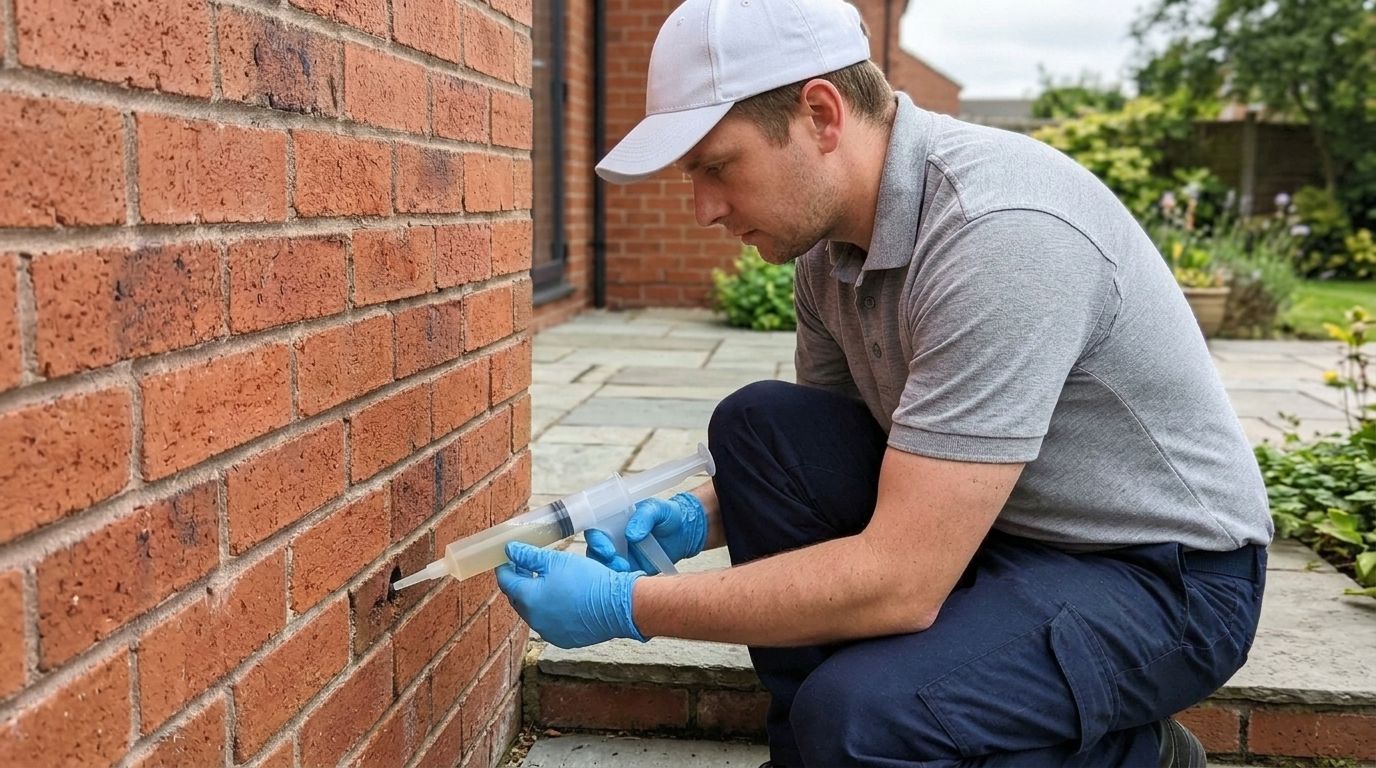
EnviroEx treats black garden ant and Pharaoh's ant problems in homes, food premises, rented properties and managed buildings across Manchester and Greater Manchester. We identify the species first, then target the nest with bait or residual treatment, proof entry points and follow up where trails persist. Call or send an enquiry to book a prompt visit.
What are the signs of an ant problem?
Most people notice the trail first: a steady line of small dark ants running along a skirting board, across a worktop or under the back door towards something sweet. Ants lay a scent trail as they forage, so once one worker finds food the rest follow the same route, often for days.
Other signs depend on the species and the building:
- Fine soil or sand pushed up between paving slabs, along the base of an outside wall or through gaps in a kitchen floor. This is spoil from the nest.
- Ants appearing from one fixed point, such as a gap behind a skirting, a crack in a tiled floor or the junction where an extension meets the original house.
- Winged ants indoors in late summer, particularly if they come from the floor or a wall rather than through an open window.
- Very small, pale ants around kettles, ovens, radiators and warm pipework at any time of year. That pattern points to Pharaoh’s ants, which behave very differently from garden ants.
In food premises, ants usually turn up first in dry stores, around drinks stations and anywhere sugar, syrup or fruit is kept. Any sighting there needs logging and acting on.
Why do ants get into Manchester homes and premises?
The ant behind most calls in Greater Manchester is the black garden ant. Its colonies live outdoors, under patios, flagged yards, paths and lawns, and in the soil against house walls. A queen can live for many years, so the nest that troubled you last summer is usually the one that is back this year. From spring to early autumn the workers forage widely, and a kitchen with crumbs, pet food or a sticky bin is an easy find.
The local building stock gives them plenty of ways in. Victorian and Edwardian terraces often have suspended timber floors, worn door thresholds and back yards laid tight against the house. Interwar semis commonly have patios and rear extensions where the joint with the original wall has opened up over time. In newer flats and commercial units, ants follow cable and pipe entries and the voids behind kitchen plinths.
Pharaoh’s ants are a different problem. They are a tropical species that, in Britain, survives only inside centrally heated buildings: apartment blocks, hospitals, care homes, hotels, bakeries and other premises with warm service runs. Large mixed-use buildings and converted mills with shared heating and risers give them continuous warm routes from one unit to the next. A colony can contain many queens, and when it is disturbed the workers carry brood away to start new nests. That is why spraying them so often makes the problem worse.
How does our ant treatment work?
We start by identifying the ant, because the right method for one species is the wrong method for another. We follow the trails back, check thresholds, plinths, service entries and outside paving, and look for the nest itself.
For black garden ants, treatment targets the nest and the route in. Where the nest is outside and accessible, we treat it and the entry points with a residual insecticide, applied in line with the product label. Indoors, we place gel or liquid bait on the trail so that workers carry it back and share it with the queen and brood. That is the part a shop-bought spray never reaches, so we may ask you to leave the trail alone for a few days while the bait works.
For Pharaoh’s ants, we do not spray. We survey the affected area and the rooms around it, map the activity and place non-repellent bait across the whole zone, so the colony feeds on it rather than splitting. In blocks and managed buildings this works best when neighbouring flats or units are treated at the same time, which we coordinate with the managing agent, landlord or facilities team.
Each visit ends with a short written report setting out what we found, the products used and where, and what you need to do next.
Is ant treatment safe for children, pets, staff and customers?
Bait is placed in cracks, behind plinths and inside enclosed stations, away from children, pets and food.
Where a residual product is applied to paving, thresholds or outside walls, people and pets should stay off the treated surfaces until they have dried, and we confirm the time for the product used. In food premises we treat outside service hours where possible, protect food and food-contact surfaces, and tell staff which areas were treated. In care homes and other healthcare settings, bait positions are agreed with the person responsible for the site so stations stay out of reach of residents and visitors.
How many visits does ant control take?
A garden-ant problem is usually dealt with in one treatment visit. Trails often get busier for a day or two as workers collect bait, then fall away over the following days. If ants are still trailing after a week or two, a follow-up visit checks the nest site and re-treats.
Pharaoh’s ants take longer. Bait has to reach every part of the colony, including the queens and brood, and in a large heated building the programme commonly runs for several weeks and can take a few months. We plan the visits in advance and sign the job off on monitoring results rather than on a fixed date.
How do you stop ants coming back?
Garden ant nests are normal in most outdoor spaces, so the aim is to keep foragers out and give them nothing to find inside:
- Sealing gaps at door thresholds, around waste pipes and cable entries, and along the joint between an extension and the main wall.
- Re-bedding or re-pointing paving that sits tight against the house, and keeping soil and planters below the damp-proof course.
- Storing sugar, syrup, honey and pet food in sealed containers, wiping worktops at the end of the day and rinsing recycling before it goes in the bin.
- In food premises, adding ant activity to opening checks and cleaning drinks stations, dry stores and the backs of shelving on a set schedule.
For Pharaoh’s ants, prevention is mostly about early reporting. Residents and staff who see tiny pale ants should report them before anyone reaches for a spray.
We can carry out basic proofing at the same visit, or set it out in the report so your maintenance contractor can complete it.
When does DIY stop being enough?
Shop-bought baits can deal with a small garden-ant trail that appears once and stays outdoors. It is time to bring in a professional when:
- ants return every year from the same point, or appear in several rooms at once;
- winged ants emerge from inside the house rather than drifting in from outside;
- the ants are tiny and pale, or active in winter inside a heated building;
- you run a food business, care setting or managed block and need a documented response;
- sprays have been tried and the activity has spread.
If you are also seeing cockroaches, which use the same warm service runs in blocks and commercial kitchens, our cockroach control page covers how we treat them. For a wider look at pests in a house, see domestic pest control.
What should a business or landlord record?
The council powers in Part I of the Prevention of Damage by Pests Act 1949 relate to rats and mice, so for ants the law that matters in a food business is food hygiene law. Every food business must have adequate procedures in place to control pests, enforced in England through the Food Safety Act 1990 and the Food Safety and Hygiene (England) Regulations 2013. An Environmental Health Officer will want to see that you spotted the problem, acted on it and can show it. Keep each visit report, a site plan with bait positions, your own sightings log, cleaning records and any proofing work, filed with your HACCP plan or Safer Food, Better Business pack. Our food premises pest control service is built around that file.
For landlords, responsibility depends on the cause. Seasonal foraging from a tenant’s own garden is often treated as housekeeping. Where ants get in through disrepair to the structure or exterior, in most residential tenancies the repair is the landlord’s under section 11 of the Landlord and Tenant Act 1985, and an infestation running through a block is usually for the landlord or managing agent to resolve. Pests fall within the domestic hygiene, pests and refuse hazard assessed under HHSRS, and the Homes (Fitness for Human Habitation) Act 2018 gives tenants in England a route to court action where a home is unfit. Keep the tenant’s report, the dates you responded, treatment reports and any repairs completed. Our pest control for landlords service covers access, tenant liaison and reporting.
How ant control works with EnviroEx
- 1
Inspection and identification
We follow the trails back towards the nest, check thresholds, kitchen plinths, service entries and outside paving, and confirm the species, because garden ants and Pharaoh's ants need opposite approaches.
- 2
Written treatment plan
You receive a short plan setting out where bait or residual product will go, what to avoid in the meantime, such as spraying or scrubbing trails, and the proofing that will stop ants getting back in.
- 3
Targeted treatment
Garden ants are treated at the nest and entry points, with bait indoors that workers carry back to the queen. Pharaoh's ants receive non-repellent bait only, placed across the whole affected zone so the colony does not split.
- 4
Follow-up and monitoring
We check bait uptake, top up or move placements and treat any new trails, returning on a planned schedule for Pharaoh's ants and for garden ants that keep trailing.
- 5
Proofing and sign-off
Gaps at thresholds, pipe entries and extension junctions are sealed or specified for your maintenance team, and the job closes with a written report for your records.
Typical visits: Garden ants: usually one treatment visit, with a follow-up if trails are still active after a week or two. Pharaoh's ants: a planned baiting programme over several weeks, which in a large heated building can run to a few months.
Safety: Bait is placed in cracks, behind units or in enclosed stations, out of reach of children, pets and food. Where a residual product is applied to paving, thresholds or outside walls, people and pets keep off it until it has dried, and we confirm the time for the product used.
Ant Control: your questions answered
Why do ants come back to my kitchen every summer?
Because the colony is usually still there. Black garden ants nest outdoors under paving, paths and lawns, and the queen can live for many years, so the same nest sends foragers in each season. Killing the ants you can see removes a small share of the workers and leaves the queen and brood untouched. The scent trail also lingers on surfaces and guides new foragers along the same route. Lasting control means bait that workers carry back to the nest, treatment of the nest where it can be reached, and sealing the gap they use to get in.
How can I tell garden ants from Pharaoh's ants?
Black garden ants are dark brown to black, around 3 to 5 mm long, and mostly appear from spring to early autumn, trailing in from outside. Pharaoh's ants are tiny, about 2 mm, pale yellow to light brown with a darker tip to the abdomen, and live inside centrally heated buildings, active at any time of year near kettles, ovens and warm pipework. The difference matters because Pharaoh's ant colonies tend to split into new colonies when sprayed or disturbed, so the treatment is completely different. A clear photo or a few ants sealed in a bag usually lets us confirm the species.
Should I spray the ants before you arrive?
Please don't. Sprays kill the foragers you can see but not the nest, and many repel ants so they simply find another route in. Residue on the trail can also stop ants taking professional bait, which is the part of the treatment that reaches the queen. With Pharaoh's ants, spraying can make the colony break up and spread to other rooms or flats. Scrubbing the trail with strong cleaners has a similar effect, so leave it until we have been. If you have already sprayed, tell us what you used and where.
What does it mean if flying ants appear indoors?
Flying ants are the winged males and new queens of a colony leaving on mating flights, usually on warm, humid days in mid to late summer. Seen outdoors, or drifting in through an open window, they are a short-lived nuisance that normally clears within a day or two. If they are emerging from inside the building, through a gap in the floor, behind a skirting board or from a wall, the nest is in or under the structure. That is worth having inspected, particularly in a kitchen or food business.
Can ants in our restaurant or café affect our food hygiene rating?
They can. Ants are pests for food hygiene purposes, and every food business must have adequate procedures in place to control pests. An inspector scoring you under the Food Hygiene Rating Scheme looks at the conditions found and at how well you manage them, so ants in a dry store or on a drinks station with no record of action are likely to count against you. Evidence that you spotted the activity, called in a contractor, acted on the recommendations and logged each step puts you in a far stronger position. Our reports are written to sit in your pest-management file.
Is my landlord responsible for ants in a rented home?
It depends on the cause. A few ants trailing in from the garden in summer is often treated as day-to-day housekeeping, and some tenancy agreements say so. Where ants get in through disrepair, such as failed pointing, gaps around frames or a broken threshold, the repair normally falls to the landlord under section 11 of the Landlord and Tenant Act 1985. An infestation running through a block, such as Pharaoh's ants, is usually for the landlord or managing agent to resolve. Pests also fall within one of the hazards assessed under HHSRS. Check the tenancy and take advice if responsibility is disputed.
Do we need to leave the house or close the business during ant treatment?
Usually not. Indoor treatment is mostly gel or liquid bait placed in cracks and behind units, and you can carry on as normal around it. Where we apply a residual product to paving, thresholds or outside walls, keep children and pets off those surfaces until they have dried; we confirm the time for the product used. In food premises we work outside service hours where possible, protect food and food-contact surfaces and tell staff which areas were treated. Leave bait undisturbed and avoid cleaning directly over it for the period we advise.
How long does it take to clear Pharaoh's ants from a block or care home?
Longer than garden ants, and it depends on how far the colonies have spread. Bait has to reach every queen and the brood, and colonies in a large heated building can be very large and spread across several floors through service risers and heating runs. A planned programme typically runs for several weeks and can take a few months. It works best when every affected flat or room is treated together, residents and staff stop using sprays, and activity is monitored between visits. We agree the schedule with the managing agent or site manager and sign off on monitoring results.
Ant Control by area
Local detail for the places we serve most often.
Last updated: