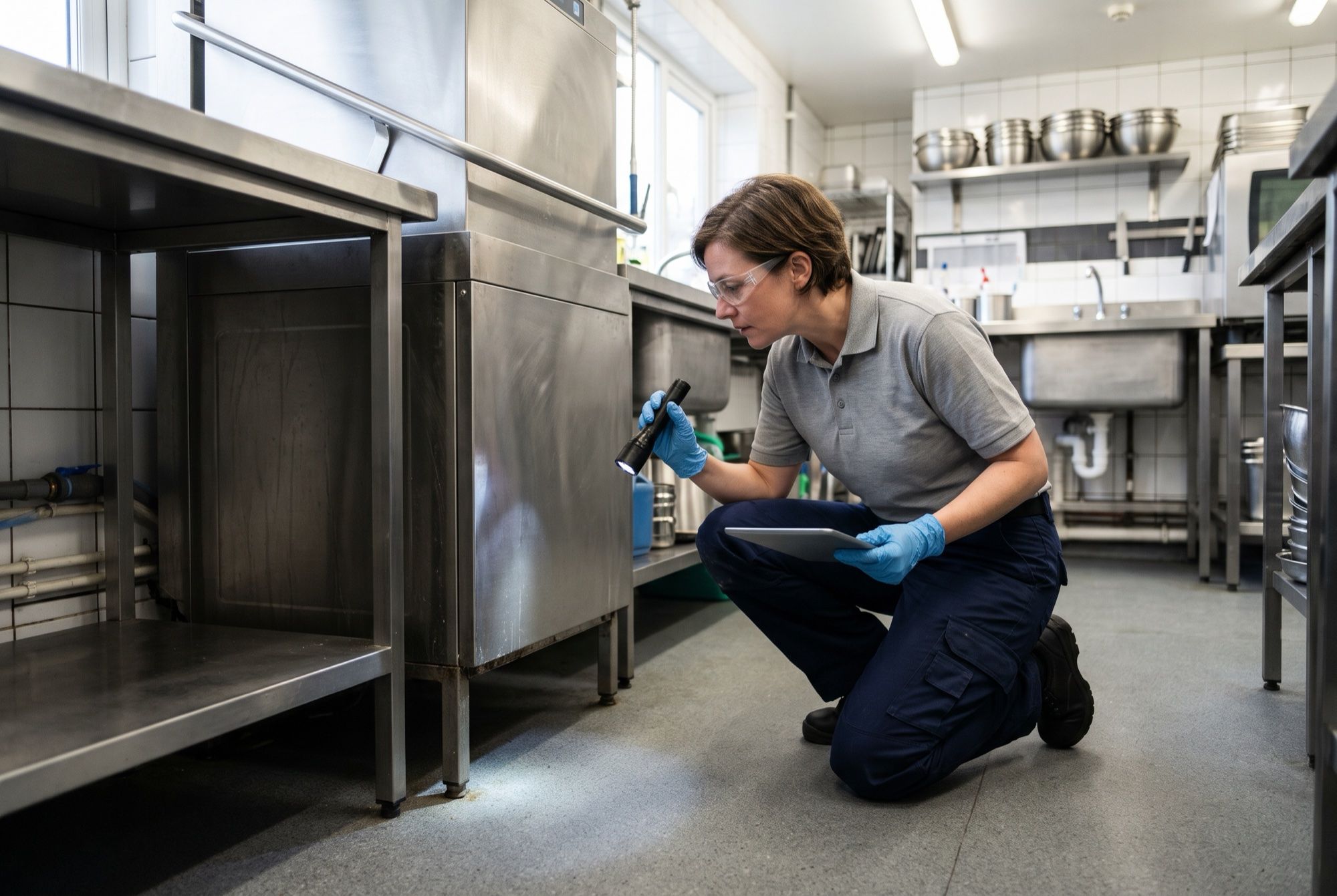
EnviroEx provides contracted and one-off commercial pest control for food businesses, offices, retail, landlords and industrial sites across Manchester and Greater Manchester. We survey the premises, agree a risk-based visit schedule, treat and proof promptly, and keep audit-ready records for EHO and client inspections. Call or request a site survey to book.
What are the signs of pests on commercial premises?
Staff usually find an infestation before an inspector does, if they know what to look for. In kitchens and stores, the early signs are droppings along wall and floor junctions and behind equipment, gnawed packaging, grease smears where rodents run along skirting or pipework, and shed cockroach skins or egg cases in the warm voids around fridge motors and dishwashers.
Offices and retail units show it differently: chewed cabling in floor voids, droppings in tea points, or a cleaner reporting movement in the bin store. In warehouses, look for spillage trails and damaged pallets near dock doors, and bird fouling on racking or beneath loading canopies.
One sign is easy to miss: a report that goes nowhere. If a sighting is mentioned on a shift and never written down, nobody can later show what was done about it.
Why do Manchester businesses get pests?
Many commercial buildings in Greater Manchester were built for a different purpose. Converted mills and warehouses in the city centre and Ancoats are full of shared service risers, old floor voids and party walls that let mice move between a restaurant, the flats above and the bar next door. Railway arches used as kitchens, breweries and workshops have open brickwork and ground-level drainage that rats exploit.
Older buildings in the city centre and borough town centres often connect to Victorian-era drains. Where a damaged or disused connection runs under a building, rats can come up into a basement or ground-floor kitchen without ever being seen outside.
Canal-side sites along the Rochdale and Bridgewater canals, and the large distribution buildings around Trafford Park and the motorway corridors, follow their own pattern: vegetation, water and constant deliveries, with dock doors open for long periods. On high-street parades in the boroughs, the problem is often a shared yard behind takeaways and shops, where one poorly managed bin store keeps activity going along the whole row.
How does a commercial pest control contract work?
Every contract starts with a survey. We walk the site with whoever knows it best, inside and out, including bin stores, drains, voids, goods-in and any areas shared with other tenants. We note what is present now, how pests could get in and what the operation itself attracts.
From that we write a proposal: pests covered, routine visits a year, where monitoring points go, methods by area, and exclusions. A numbered site plan lets anyone checking your file match a report to a location.
If there is activity at the start, we treat it first, with follow-up visits until it is resolved, then move to routine monitoring. Routine visits check every point, inspect the high-risk areas, record findings and set out actions. Where proofing is needed, we either carry it out or list it with photographs for your maintenance team or landlord.
Between visits, you report sightings and we attend, and those reactive visits go into the same file. At intervals we review trends with you: if one area keeps showing activity, the cause usually lies in the building rather than the bait.
Is treatment safe for staff, customers and stock?
It should be, and the programme is designed that way. Wherever people or non-target animals could reach bait, rodenticide goes only into tamper-resistant stations fixed in place. We follow the CRRU UK stewardship code, which expects proofing, hygiene and trapping to be considered before rodenticide. Permanent baiting is only lawful where the product label allows it and the site risk justifies it, so many stations hold non-toxic monitoring blocks until there is activity to treat.
In food areas we avoid anything that could contaminate food or contact surfaces, and time insecticide work for when areas are closed and stock is covered. In offices and shops open to the public, stations are placed so that customers, children and assistance dogs cannot reach the contents.
Rodent glue boards are no longer a routine tool. In England it is now an offence to set a glue trap to catch rodents, or where one could be caught, unless a pest controller is acting under a glue trap licence, granted only in exceptional cases to protect public health or safety. Insect monitoring boards are still used, sited or enclosed so rodents cannot be caught. You receive safety data sheets for any product used, for your COSHH assessments, and a record of what was applied, where and when.
How many visits a year does a business need?
A number quoted before anyone has seen the site is a guess. Frequency follows risk: what you handle, how the building is constructed, what surrounds it and what has happened before.
As a rough guide, low-risk offices and dry retail often sit at the lower end, around four to six routine visits a year. Restaurants, food stores and sites with a history of activity commonly need eight or more. Sites audited to standards such as BRCGS usually need documented trend analysis and periodic in-depth inspections as well, and we align the programme and reporting to the standard you are audited against.
An active infestation sits outside that pattern: treatment visits continue until it is resolved, then the routine schedule resumes. We set the frequency at survey, record why, and review it. If the evidence supports fewer visits, the plan should say so.
What proofing and housekeeping prevent repeat problems?
Treatment deals with today’s pests; proofing decides whether more arrive tomorrow. The same points come up on most commercial sites: gaps under external and fire doors, unsealed pipe and cable penetrations, open air bricks, damaged drain connections, and roller shutters that do not close to the floor.
We fit bristle strips, door sweeps, mesh and sealant, and recommend drain surveys and non-return valves where the evidence points underground. For flying insects in kitchens and food rooms, correctly placed and serviced electric fly killers support monitoring as well as control. Where pigeons or gulls roost on loading canopies or plant decks, our bird control service can proof the structure so fouling stops at source.
Housekeeping matters as much: lidded bins on hard standing, frequent waste collection, spillage cleaned each shift, stock off the floor and away from walls, and deliveries checked at goods-in.
When does DIY stop being enough for a business?
Shop-bought bait boxes look like a shortcut, but on commercial premises they rarely stand up to inspection. Amateur products come in limited pack sizes with tighter conditions of use, and most professional rodenticides can only be bought with proof of competence, such as an approved training certificate. Bait laid without a plan cannot be shown to an inspector, and loose bait in a food area is a contamination risk in its own right.
Call a professional when you see a second sign, when activity reaches a food room or stock, when the pest is in a shared part of the building you do not control, or when an inspection or audit is due. Cockroaches and stored-product insects rarely respond to DIY treatment, and nor do rats coming up from drains, which is often where our rodent control work begins.
What must a business record, and who is responsible?
The responsibility stays with you. A contract supports your compliance, but it does not transfer legal duties from the food business operator, employer or occupier to the contractor.
Food businesses must have adequate procedures to control pests under the general hygiene rules in Regulation (EC) No 852/2004, as it continues to apply in England, enforced through the Food Safety Act 1990 and the Food Safety and Hygiene (England) Regulations 2013. Pest control is one of the prerequisite programmes beneath your HACCP-based food safety management system or Safer Food, Better Business pack. Councils can serve hygiene improvement notices and, where there is an imminent risk to health, close premises using emergency prohibition powers. Our food premises pest control page covers this in more detail.
Every employer also has duties under the Health and Safety at Work etc. Act 1974 and the Workplace (Health, Safety and Welfare) Regulations 1992 to keep workplaces clean and safe. Under section 3 of the Prevention of Damage by Pests Act 1949, occupiers must notify the local authority in writing if they know rats or mice are living on or visiting their land in substantial numbers.
In multi-let buildings, responsibility depends on the lease. Common parts, roofs and drains often fall to the landlord or managing agent through the service charge, while the inside of a let unit usually falls to the tenant. Residential landlords have separate duties under section 11 of the Landlord and Tenant Act 1985 and the Homes (Fitness for Human Habitation) Act 2018, set out on our pest control for landlords page.
We keep your file ready to hand to an inspector, auditor or client: site plan, visit reports, product records, risk assessments and method statements, and a log of recommendations with their status.
How commercial pest control works with EnviroEx
- 1
Site survey and risk assessment
We walk the building inside and out, including bin stores, drains, voids, plant rooms and goods-in, and assess the pest risks your operation creates.
- 2
Written scope and site plan
You receive a proposal setting out pests covered, visit frequency, methods by area and exclusions, with a numbered site plan for your pest control file.
- 3
Initial treatment and proofing
Any active infestation is treated first. Entry points are proofed by us or listed with photographs for your maintenance team or landlord.
- 4
Routine inspections
Scheduled visits check every monitoring point and high-risk area, record findings and adjust the programme to what the evidence shows.
- 5
Reporting and review
Each visit produces a written report, and we review trends with you so the visit frequency and station layout stay proportionate to the risk.
Typical visits: A survey, then routine visits set by risk, commonly between four and twelve a year, plus reactive visits whenever activity is reported.
Safety: Wherever people or non-target animals could reach bait, rodenticide is used only in fixed, tamper-resistant stations in line with the product label and CRRU stewardship; insecticide work is timed to protect staff, customers and stock, and safety data sheets are supplied for your COSHH records.

Commercial Pest Control: your questions answered
What does a commercial pest control contract include?
A survey, a written scope and a numbered site plan, then routine inspections at the agreed frequency, checks of every monitoring point, treatment of the pests named in the contract and a written report after each visit. The scope also sets out how reactive callouts between routine visits are handled and what is excluded. Larger proofing works, drain repairs and pests not named in the contract are usually quoted separately, and we make that clear at the start rather than afterwards.
How many routine visits a year will our premises need?
It depends on risk rather than a standard package. We look at what you handle, how the building is put together, what surrounds it and any history of activity. Offices and dry retail commonly need fewer visits than kitchens, food stores or warehouses holding food, and audited sites may need more again, with periodic in-depth inspections. We set the frequency at survey, explain the reasoning in the proposal and review it as evidence builds up, so it can come down as well as go up.
What will an environmental health officer expect to see from our pest control?
Usually a pest control file that shows a working system: a site plan with numbered monitoring points, reports from each visit, records of sightings and what was done about them, product details and safety data sheets, and evidence that proofing or housekeeping recommendations were acted on. Officers also inspect the premises themselves, so a tidy folder will not cover gaps under doors or droppings behind equipment. We write our reports with that inspection in mind.
If we have a contract with you, are we still legally responsible for pests?
Yes. A contract helps you meet your duties, but it does not move them. The food business operator remains responsible under food hygiene law, the employer under health and safety law, and the occupier under the Prevention of Damage by Pests Act 1949. Our role is to provide competent advice, treatment and records. Yours is to report sightings promptly, give access and act on the recommendations that fall to you, such as repairs, waste management and cleaning.
Do we have to tell the council if we find rats on our site?
The Prevention of Damage by Pests Act 1949 requires occupiers to notify the local authority in writing if they know rats or mice are living on or visiting their land in substantial numbers. The Act does not define substantial precisely, so take advice if what you are seeing is more than an isolated sighting. Food businesses should also consider whether the activity affects food safety. We can help you document the problem and the steps taken, which is what the council will want to see.
Will one mouse sighting affect our food hygiene rating?
Not automatically. A rating reflects what the officer finds at inspection across food handling, the condition of the premises and how food safety is managed. A sighting that was logged, reported, treated and followed up with proofing shows the system working. Evidence of an active infestation, or a problem that was never recorded or dealt with, is far more serious and can lead to formal action. Report every sighting, keep the record and ask us to attend rather than waiting for the next routine visit.
Is it safe to use rodenticide in an office or shop open to the public?
Used properly, yes. Bait goes only into tamper-resistant stations fixed in position and marked on the site plan, so customers, children and animals cannot reach the contents. We follow CRRU stewardship guidance, which expects proofing, hygiene and trapping to be considered first, and we only bait permanently where the product label allows it and the site risk justifies it. In many customer-facing areas, traps or non-toxic monitoring are the better choice, and we will explain the reasoning in your report.
Can you visit outside our trading hours?
Usually, yes. Routine inspections in kitchens, shops and offices are often booked before opening, after close or at weekends, so that treatment does not disrupt customers or staff and insecticide work can be carried out while food is covered or removed. For sites that run around the clock, we agree access with the shift manager and work zone by zone. Tell us at survey what suits your operation and we build it into the visit schedule.
Can you work with our landlord, managing agent or facilities company?
Yes. In multi-let buildings the cause is often in a common area, roof void or drain that the tenant does not control. We can send findings to the tenant, the managing agent and the facilities provider at the same time, so each recommendation reaches whoever is responsible under the lease. We agree an access and escalation route at the start, including who authorises proofing works, which stops findings sitting in a report while activity continues.
Commercial Pest Control by area
Local detail for the places we serve most often.
Last updated: