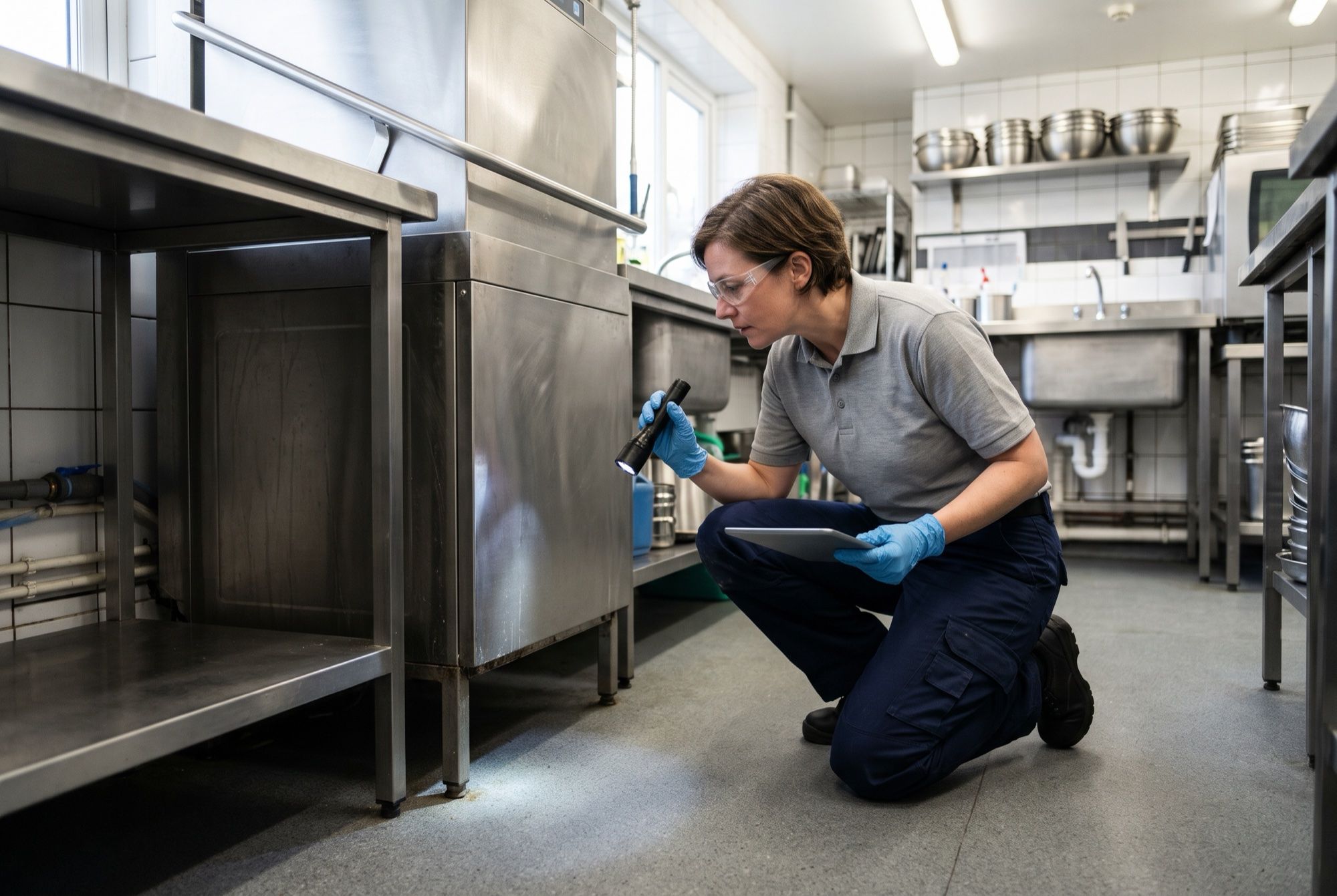
EnviroEx provides commercial pest control for factories, warehouses, food producers, offices, hotels and venues across Trafford Park and Old Trafford. We survey each building and its canal or rail boundary, agree a risk-based visit plan, treat and proof promptly, including bird proofing on large roofs, and keep audit-ready records. Call or request a site survey to book.
What does commercial pest control cover in Trafford Park and Old Trafford?
Trafford Park is widely described as the first planned industrial estate in the world, and it is still a working one: about 1,400 companies employing around 40,000 people across 4.7 square miles, on 2025 figures. A contract here might cover a food production line, a warehouse, a rail-linked depot or offices and trade units.
Food has a long history here. The Co-operative Wholesale Society set up a flour mill and food-packing works at Trafford Wharf in 1903, Kellogg’s arrived in the 1930s and Brooke Bond was a notable occupier. Rail freight uses the Euroterminal, opened in 1993.
Next door, Old Trafford brings hospitality and visitor work: the football stadium just off the north end of Warwick Road, Lancashire County Cricket Club’s ground and Hotel Football on Sir Matt Busby Way. Imperial War Museum North stands at Trafford Wharf, beside the Ship Canal.
Why do sites here attract rats, mice and birds?
Water is a large part of it. The estate is almost surrounded by canals, with the Bridgewater Canal to the south-east and south-west and the Manchester Ship Canal to the north-east and north-west. Brown rats burrow readily into banks and shelter in waterside vegetation, so a canal-side boundary is a monitoring priority.
Rail corridors add to it. Freight lines feed the Euroterminal, and in Old Trafford the stadium sits between the Bridgewater Canal and the railway, with Manchester United Football Ground station beside the Sir Bobby Charlton Stand. Lineside vegetation can give rodents cover right up to fences and yards.
Green space matters too. Trafford Ecology Park, 11 acres on the site of the old ornamental boating lake and a Local Nature Reserve since 2007, is valuable habitat inside an industrial area, so a unit bordering it needs monitoring on that side.
The buildings play their part. Roller shutters left open through a shift let rodents and birds walk in, high-bay racking and loading canopies give pigeons dry roosts, and flat roofs near water attract nesting gulls.
What do we typically find on these premises?
- Food production and ingredient stores. Mice in production voids and wall panelling; stored-product insects such as Indian meal moth and flour beetles in raw materials, spillage and returned stock.
- Warehousing and rail freight. Rats burrowing along fence lines and under dock levellers, pigeons in high bays, and pests arriving on damaged pallets at goods-in.
- Offices and trade counters. Mice moving through suspended ceilings, risers and service ducts shared between units.
- Matchday and hospitality. Bars, suites and cellars that stand empty between events. The 2025 inspection of the football ground recorded mouse evidence in seven areas, with droppings under a buffet bar, and the stadium kept a two-star food hygiene rating.
How does a contract run on a Trafford Park site?
The survey starts at the boundary (canal or rail edge, fences, drains, bin compounds and yard), then moves to the building, from dock doors to roof voids and canopies. You receive a written scope and a numbered site plan, with tamper-resistant stations along the perimeter and internal monitoring matched to the risk of each area. Rodenticide use follows CRRU stewardship guidance, so proofing, hygiene and trapping come first.
Where units run shifts around the clock, visits are agreed with shift managers and worked zone by zone; at event venues we inspect before the gates open. Each report records what was found, what was done and what falls to you, ready for an environmental health officer checking HACCP pest-management records or a BRCGS auditor reviewing trends. Where the cause sits in common parts, findings go to the landlord or estate manager as well.
Bird proofing for large roofs and canal-side buildings
Pigeons and gulls on warehouse roofs and canopies foul stock and walkways, and droppings near goods-in are a hygiene risk an auditor will note. Wild birds, their eggs and nests in use are protected under the Wildlife and Countryside Act 1981, so our bird control work starts with exclusion: netting under canopies and in high bays, post-and-wire or spikes on ledges, and mesh over gaps into roof voids. Removing an active nest, or any lethal control, must fall within a general or individual licence from Natural England, with conditions that differ by species, so we check before anything is touched.
Old Trafford homes, landlords and new development
Old Trafford has around 13,000 residents. Slum clearance in the 1960s and early 1970s took some of its Victorian housing, but residents preferred renovation, so many terraced streets survive. In those rows, mice move between houses through shared roof spaces and under-floor voids, and rats often trace back to old drains. On the park, 84 houses remain of Trafford Park Village, the workers’ housing completed in 1904.
What we see with commercial pest control in Trafford Park & Old Trafford
- Trafford Park is almost ringed by water, with the Bridgewater Canal on its south-eastern and south-western sides and the Manchester Ship Canal along its northern edges, so units on the edge of the estate often back onto a canal bank, and that is where we set external monitoring first.
- With around 1,400 companies on the estate as of 2025, activity at a neighbouring unit can easily reach yours, so our reports separate what starts inside your boundary from what arrives across it.
- Food manufacturing on the park goes back at least to 1903, when the Co-operative Wholesale Society set up a flour mill and food-packing works at Trafford Wharf, so on ingredient and food sites we check raw materials and spillage points for stored-product insects as well as rodents.
- Hospitality suites and bars at the football stadium and the cricket ground can sit unused between fixtures, and the 2025 inspection that found mouse evidence in seven areas of the football ground shows why those spaces need checking before each event.
- Rail freight lines into the Euroterminal and green edges such as the 11-acre Trafford Ecology Park give rodents and birds cover close to commercial buildings, so perimeter and roof checks carry as much weight as internal ones.
How the job runs
- 1
Site survey and risk assessment
We walk the building inside and out, including bin stores, drains, voids, plant rooms and goods-in, and assess the pest risks your operation creates.
- 2
Written scope and site plan
You receive a proposal setting out pests covered, visit frequency, methods by area and exclusions, with a numbered site plan for your pest control file.
- 3
Initial treatment and proofing
Any active infestation is treated first. Entry points are proofed by us or listed with photographs for your maintenance team or landlord.
- 4
Routine inspections
Scheduled visits check every monitoring point and high-risk area, record findings and adjust the programme to what the evidence shows.
- 5
Reporting and review
Each visit produces a written report, and we review trends with you so the visit frequency and station layout stay proportionate to the risk.
Typical visits: A survey, then routine visits set by risk, commonly between four and twelve a year, plus reactive visits whenever activity is reported.
Safety: Wherever people or non-target animals could reach bait, rodenticide is used only in fixed, tamper-resistant stations in line with the product label and CRRU stewardship; insecticide work is timed to protect staff, customers and stock, and safety data sheets are supplied for your COSHH records.
Commercial Pest Control in Trafford Park & Old Trafford: questions we get asked
Our Trafford Park unit has a canal on one boundary. How does that change the contract?
It puts as much weight on the external programme as on the internal one. Canal banks give rats soft ground to burrow into and plenty of cover, so we fix tamper-resistant stations along the water-side fence, look for burrows and runs at the foot of walls, and check drains, doors and shutters on that elevation closely. External findings are logged apart from internal ones, so an auditor or inspector can see whether rodents are being stopped at the perimeter. We work only on your side of the fence and note any activity on the bank in the report.
We store or make food on the park and are audited to BRCGS. Will your reports stand up to it?
They are written with that audit in mind. Tell us at survey which standard and issue you are audited against, and we match the scope, site plan and reporting to it. That usually means a visit frequency justified by risk, a record for every monitoring point, trend analysis reviewed with your technical team and a periodic in-depth inspection of the whole site. On ingredient and dry-goods sites we add goods-in checks and pheromone monitoring for stored-product moths and beetles, which auditors commonly ask about.
We run several bars and kiosks at Old Trafford on event days. Does each one need its own pest control records?
In most cases, yes. An environmental health officer can inspect any area where food is stored, prepared or served, and the 2025 inspection at the football ground recorded mouse evidence in hospitality suites as well as other areas. Each fixed bar, kiosk, suite and store should have numbered points on the site plan, its own entries in every report and a check shortly before it reopens after a quiet spell. Where several operators share a venue, the scope should state who covers which areas, so nothing falls between contracts.
Trafford Council's portal has a pests on public land form. When should a business use it?
Many councils run a pest control service for residents, but what is covered, who can book and the charges all vary and can change, so check the council's own pest control pages before you book. If you rent from a council or housing association, report the problem to your landlord first. If you would rather book a private firm, phone or use the enquiry form and we will arrange a survey.
What does a commercial pest control contract include?
A survey, a written scope and a numbered site plan, then routine inspections at the agreed frequency, checks of every monitoring point, treatment of the pests named in the contract and a written report after each visit. The scope also sets out how reactive callouts between routine visits are handled and what is excluded. Larger proofing works, drain repairs and pests not named in the contract are usually quoted separately, and we make that clear at the start rather than afterwards.
How many routine visits a year will our premises need?
It depends on risk rather than a standard package. We look at what you handle, how the building is put together, what surrounds it and any history of activity. Offices and dry retail commonly need fewer visits than kitchens, food stores or warehouses holding food, and audited sites may need more again, with periodic in-depth inspections. We set the frequency at survey, explain the reasoning in the proposal and review it as evidence builds up, so it can come down as well as go up.
What will an environmental health officer expect to see from our pest control?
Usually a pest control file that shows a working system: a site plan with numbered monitoring points, reports from each visit, records of sightings and what was done about them, product details and safety data sheets, and evidence that proofing or housekeeping recommendations were acted on. Officers also inspect the premises themselves, so a tidy folder will not cover gaps under doors or droppings behind equipment. We write our reports with that inspection in mind.
More in Trafford Park & Old Trafford
Last updated: