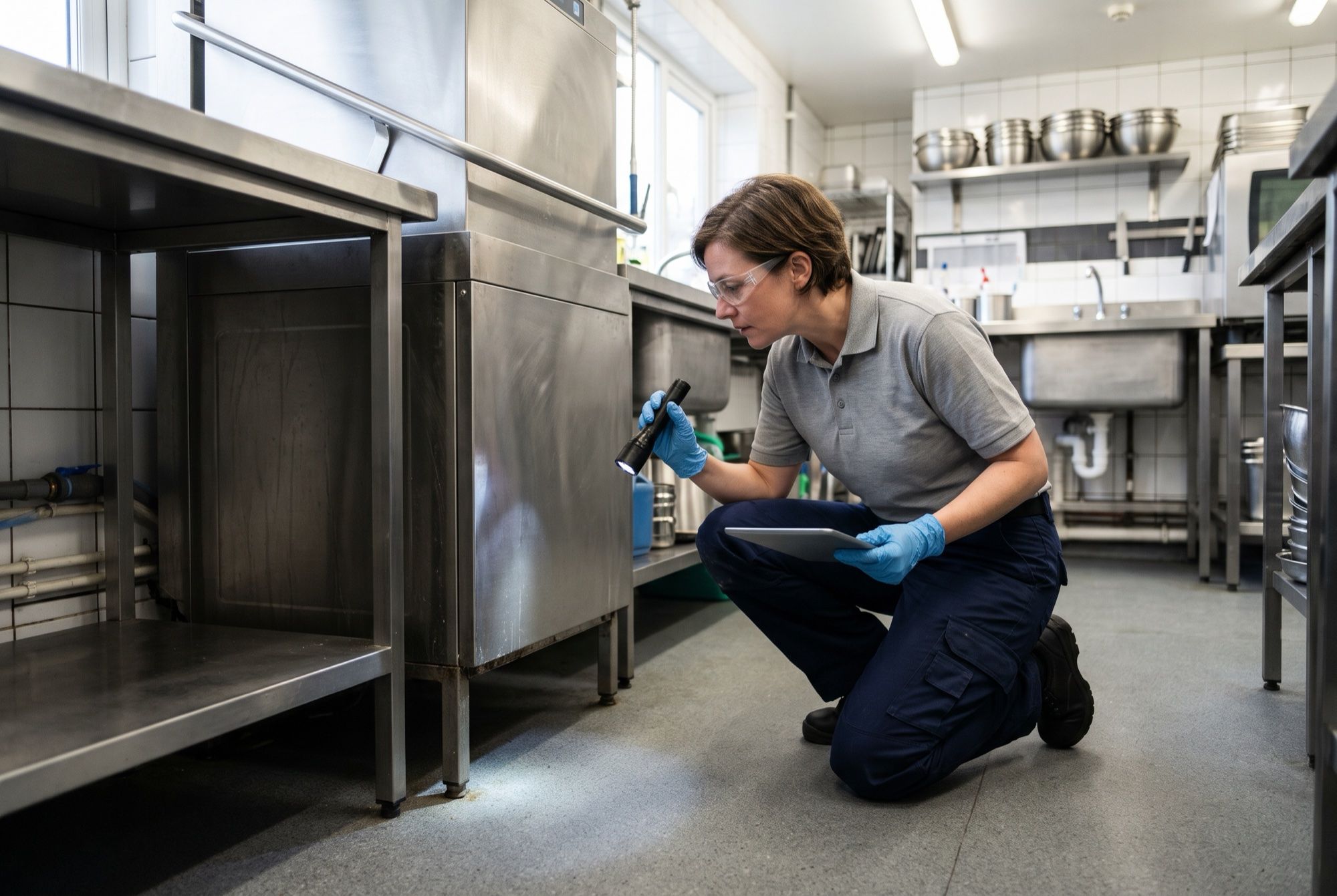
EnviroEx looks after offices, restaurants, hotels, shops, managed blocks and industrial units across Manchester. Every job begins with a survey of the building, its bin store and drains; we set a visit plan matched to the risk, treat and proof promptly and leave a written report for your EHO or audit file. Call or request a survey to book.
What does commercial pest control look like across Manchester?
The commercial core is ringed by Great Ancoats Street, Trinity Way and the Mancunian Way. It holds one of the largest concentrations of grade-A office space in any British city centre outside London, alongside a good stock of hotels, many nightclubs, the principal shopping streets of Deansgate and Market Street and the high-end shops of King Street. The centre also has 14 conservation areas, so proofing on many frontages has to suit the street as well as stop the pest.
Beyond the ring road, Cheetham Hill Road’s markets sell food and goods sourced worldwide, and for any food trader or wholesaler goods-in is the first place to check. The Rochdale Canal runs out through Ancoats and Newton Heath and the Ashton Canal through Holt Town, Clayton and Openshaw, so yards and units on either bank usually need external monitoring.
Why are rodents such a frequent problem for Manchester businesses?
The city council handled 469 rat reports in 2015 and 1,058 in 2019. The city centre showed the steepest increase in Greater Manchester, and the reporting pointed to litter, overfull bins, fly-tipping, empty buildings and open roadworks as conditions that suit rats. In October 2026, Press Association coverage of one national pest firm’s figures put Manchester top of the cities it listed for growth in rodent inquiries, up 26% between 2024 and 2025. Those are the firm’s own inquiry numbers, not an official count.
Stretches of two rivers run underground: the Irk passes into a brick tunnel under Victoria station at Ducie Bridge, and the Medlock is culverted under Hulme Street and tunnelled beneath the Castlefield basin. The city also averages about 140 rain days a year, and heavy rain can drive rats out of surcharged sewers and drains. For a basement kitchen or cellar bar, our rodent control surveys start below the floor.
What do we typically find on Manchester premises?
- Food and hospitality. Late trading leaves waste in yards and bin stores overnight, and kitchens that stay warm around the clock suit German cockroaches.
- Offices. Mice in floor voids, risers and tea points, often arriving from a neighbouring tenant.
- Retail. Stockrooms and rear service yards, where deliveries, cardboard and shared bins meet.
- Warehouses and industrial units. Roller doors left open, pallets stacked against walls and rough ground along the boundary give rats cover and a way in.
- Healthcare. Freedom of information figures from 2015 logged 5,618 vermin sightings in Greater Manchester hospitals over about five years, with ants and cockroaches the most common, and one trust said a contractor visited each of its sites every week. Sites like these need frequent, carefully documented programmes.
- Mixed-use buildings. Flats share risers, drains and bin stores with the business below, so a problem rarely stays in one unit.
How should Manchester buildings handle pigeons and gulls?
Local reporting in early 2026 described a pigeon cull at Manchester Victoria station that drew outrage well beyond the city; the train operator then said culls had stopped at all its stations, and police were investigating. The lesson for building owners is that pigeons are protected wild birds, and lethal control is generally only lawful under a general licence where proofing and other non-lethal options have been found ineffective or impractical. Gulls cause structural damage too: their pecking was blamed for weakening the station’s ETFE roof, part of which collapsed in 2016.
What does a Manchester commercial contract involve?
The survey covers the building and what surrounds it: bin store, shared yard, drains, roof and any common parts controlled by a landlord. City-centre kitchens and bars are usually visited before opening or once the last service has finished. Proofing owed by a landlord or managing agent is listed with photographs for them to act on. Reports are laid out to sit alongside your HACCP-based procedures in a file an environmental health officer can follow quickly, which matters for food businesses rated under the Food Hygiene Rating Scheme.
What about landlords, managing agents and homes?
At the 2021 census about 32% of Manchester households rented privately, nearly 30% rented from a social landlord and only 37% owned their home. More than a quarter live in purpose-built flats, where bin stores, risers and common parts usually sit with the managing agent rather than any one resident. Blocks and HMOs like these are what our pest control for landlords work is designed around.
What we see with commercial pest control in Manchester
- Stretches of the River Irk and River Medlock run in tunnels and culverts beneath Victoria station, Hulme Street and the Castlefield basin, one reason we check drains and disused connections in basement kitchens and cellar bars.
- The pigeon cull at Manchester Victoria, reported in early 2026 with police investigating, is a reminder that netting, spikes and wire come first on Manchester buildings and lethal control is a last resort under a general licence.
- At the 2021 census around 1,770 Manchester households had their home inside commercial premises, above shops, offices or hotels, so a pest problem in those premises can also be a problem in someone's home, and our reports address both.
- Manchester averages about 140 rain days a year, and heavy rain can push rats out of full sewers into yards and basements, so drainage checks belong in any survey of a ground-floor or basement site in the city.
How the job runs
- 1
Site survey and risk assessment
We walk the building inside and out, including bin stores, drains, voids, plant rooms and goods-in, and assess the pest risks your operation creates.
- 2
Written scope and site plan
You receive a proposal setting out pests covered, visit frequency, methods by area and exclusions, with a numbered site plan for your pest control file.
- 3
Initial treatment and proofing
Any active infestation is treated first. Entry points are proofed by us or listed with photographs for your maintenance team or landlord.
- 4
Routine inspections
Scheduled visits check every monitoring point and high-risk area, record findings and adjust the programme to what the evidence shows.
- 5
Reporting and review
Each visit produces a written report, and we review trends with you so the visit frequency and station layout stay proportionate to the risk.
Typical visits: A survey, then routine visits set by risk, commonly between four and twelve a year, plus reactive visits whenever activity is reported.
Safety: Wherever people or non-target animals could reach bait, rodenticide is used only in fixed, tamper-resistant stations in line with the product label and CRRU stewardship; insecticide work is timed to protect staff, customers and stock, and safety data sheets are supplied for your COSHH records.
Commercial Pest Control in Manchester: questions we get asked
Do pigeons on our Manchester building have to be culled, or can they be proofed out?
In most cases they can be proofed out, and proofing is where the law expects you to start. The Wildlife and Countryside Act 1981 protects every wild bird, feral pigeons among them, and killing them is generally lawful only under a general licence, after non-lethal options have been considered and judged ineffective or impractical. We survey the ledges, plant areas and canopies the birds use, then fit netting, spikes or post-and-wire and clear fouling where it creates a slip or hygiene risk. The criticism that followed the cull at Manchester Victoria shows why the order matters.
Our premises back onto a canal or river in Manchester. Does that change the programme?
Usually it adds external work. Sites beside the Rochdale, Ashton or Bridgewater canals, or close to the Irwell, Irk or Medlock, have water, cover and vegetation on the boundary. We place external monitoring along that edge, check boundary walls and drain runs for burrows and gaps, and look closely at how waste is stored outside. Visit frequency is then set by what those external checks show over the first few months, not by the waterside location alone.
Rodent inquiries in Manchester are reported to be rising. Should we add routine visits?
Not on the strength of a headline. Recent inquiry figures from one national firm, and older council figures in which rat reports more than doubled in four years, describe the city as a whole rather than your building. We base frequency on the evidence from your own site: monitoring results, the condition of proofing, waste handling and activity next door. If that evidence changes, we add reactive visits and review the schedule with you; if monitoring stays clear, the plan can stay as it is.
Who should deal with the shared bin store behind our restaurant and the flats above?
Many councils run a pest control service for residents, but what is covered, who can book and the charges all vary and can change, so check the council's own pest control pages before you book. If you rent from a council or housing association, report the problem to your landlord first. If you would rather book a private firm, phone or use the enquiry form and we will arrange a survey.
Can you run a pest contract for the common parts of a Manchester apartment block?
Yes. For managing agents and residents' management companies we cover the areas no single leaseholder controls, such as bin stores, car parks, plant rooms, risers, roof spaces and landscaping. Monitoring points are numbered on a block plan, a report goes to the agent after each visit, and residents get a clear route for reporting activity inside their own flats. Coordinated work matters in blocks, because mice and cockroaches travel along shared services and ignore flat boundaries.
What does a commercial pest control contract include?
A survey, a written scope and a numbered site plan, then routine inspections at the agreed frequency, checks of every monitoring point, treatment of the pests named in the contract and a written report after each visit. The scope also sets out how reactive callouts between routine visits are handled and what is excluded. Larger proofing works, drain repairs and pests not named in the contract are usually quoted separately, and we make that clear at the start rather than afterwards.
How many routine visits a year will our premises need?
It depends on risk rather than a standard package. We look at what you handle, how the building is put together, what surrounds it and any history of activity. Offices and dry retail commonly need fewer visits than kitchens, food stores or warehouses holding food, and audited sites may need more again, with periodic in-depth inspections. We set the frequency at survey, explain the reasoning in the proposal and review it as evidence builds up, so it can come down as well as go up.
What will an environmental health officer expect to see from our pest control?
Usually a pest control file that shows a working system: a site plan with numbered monitoring points, reports from each visit, records of sightings and what was done about them, product details and safety data sheets, and evidence that proofing or housekeeping recommendations were acted on. Officers also inspect the premises themselves, so a tidy folder will not cover gaps under doors or droppings behind equipment. We write our reports with that inspection in mind.
More in Manchester
Last updated: