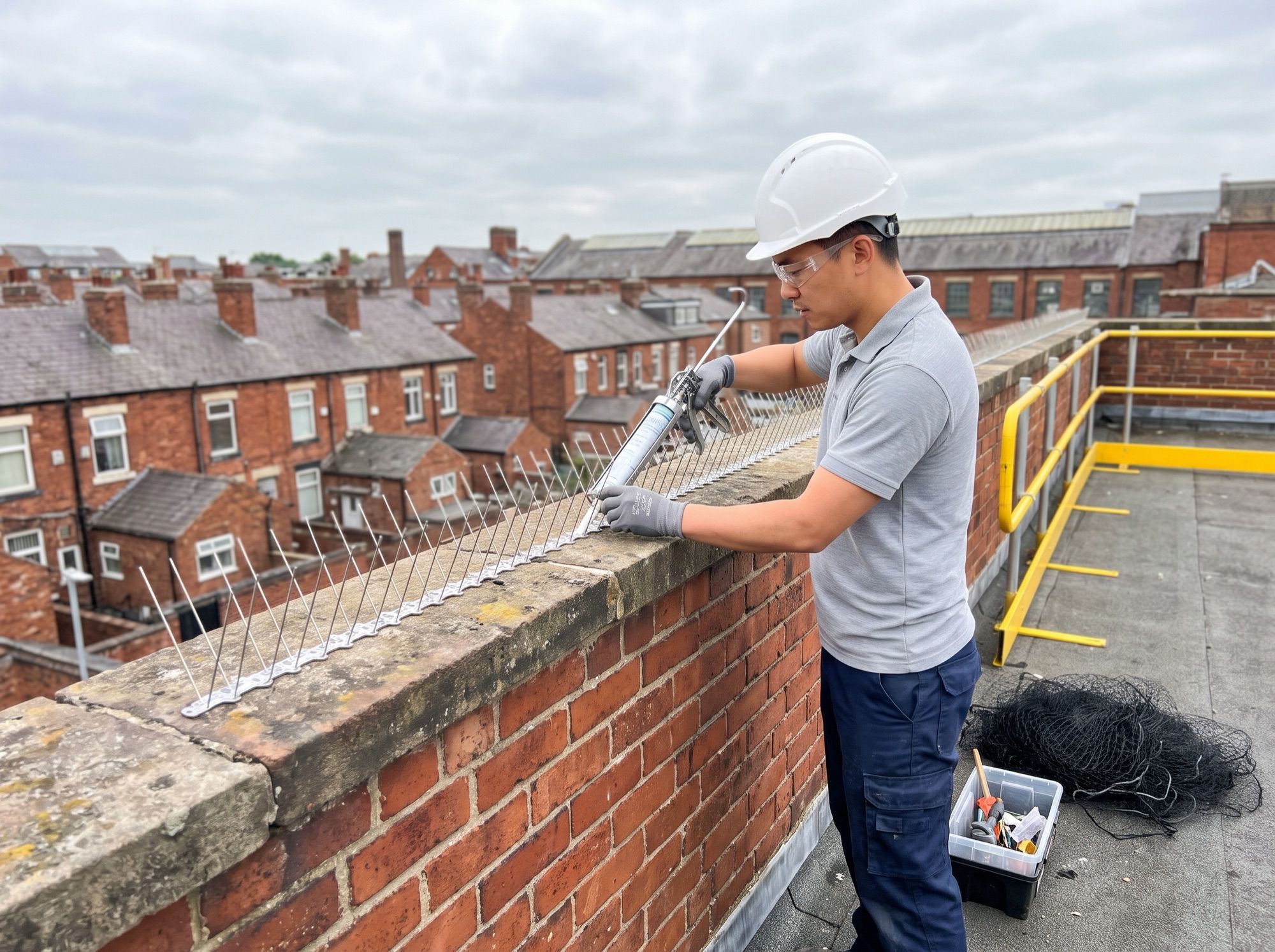
EnviroEx surveys and proofs Manchester buildings against pigeons and gulls, including city-centre offices, hotels, historic frontages, apartment blocks and industrial units. After confirming no nest is in use, we install exclusion matched to each ledge, roof and balcony, harm no birds, and document exactly what was fitted. A prompt survey can be booked by phone or through the enquiry form.
Why do pigeons and gulls settle on Manchester buildings?
The city centre packs an unusual amount of ledge into a small area. Fourteen conservation areas sit inside the inner ring road, alongside hotels, office buildings, nightclubs and the shopping frontages of the principal retail streets, Deansgate and Market Street among them. Railway buildings add large roofs of their own, from Piccadilly, the city’s largest terminus, to Victoria and its membrane roof. Pigeons roost and nest on the sheltered parts of that architecture, and gulls take to flat roofs and plant decks where they can nest undisturbed.
The residential stock matters too. Census 2021 placed 28.1 per cent of Manchester households in purpose-built flats and another 1.8 per cent in buildings converted from other uses, such as old warehouses, schools and churches. Balconies, recessed windows, light wells and redundant flues in those buildings give pigeons nest sites close to the street, and the work usually has to be agreed through a managing agent rather than with each resident.
What did the Victoria station cull change?
Manchester Mill’s account, published in February 2026, described pigeons being shot in the early hours at Manchester Victoria, with 29 birds recorded on the first night. Footage of injured birds, shared by a local pigeon rehabilitation group, drew outrage from well beyond the city. Culling was then halted across every station the operator runs, and Greater Manchester Police began investigating. The article pointed out that the law expects proofing and other non-lethal steps to be exhausted before birds are shot, and noted that the contractor’s own report conceded the benefit of a cull is short-lived.
For a Manchester business, the practical message is that lethal control now carries a reputational cost on top of its legal conditions. Proofing removes the roost itself, so there is no gap for new birds to fill, and it can be shown to staff, customers and the press without embarrassment.
How should gulls on Manchester roofs be handled?
Victoria station’s ETFE roof, finished in 2015, partly gave way in October 2016, and pecking by gulls was blamed for weakening the structure. That is a useful warning for owners of buildings with membrane roofs, rooflights or soft coverings. Herring and lesser black-backed gulls defend nest sites hard in spring and early summer, and an active nest generally cannot be removed without a licence, so the window for proofing a roof falls between breeding seasons. We survey in late summer and autumn, once young have fledged, and install netting or post-and-wire before birds return.
How does a city-centre installation run?
The steps match every EnviroEx bird job: a survey and species check, a written proposal backed by RAMS for your facilities team, clearance of nests and fouling, installation, a handover record and periodic inspection. In central Manchester, access is where most of the planning goes. Busy pavements, delivery bays and tall elevations can mean working from a mobile platform early in the morning, using rope access, or applying for a permit to occupy the highway. On hotels and offices we work around guests and staff; on residential blocks we coordinate notices and balcony access through the managing agent.
Historic frontages need a lighter touch. In the conservation areas we lean towards post-and-wire, clear gel and colour-matched netting that leave the facade looking unchanged, and we confirm listed status before drilling into stone or terracotta.
Keeping birds away once proofing is in
With rain on roughly 140 days in a typical year, nest debris in gutters and hoppers soon turns into overflowing water and damp, so clear gutters after proofing and check netting after storms. Keep bin stores closed and food waste off yards, because the same scraps that feed pigeons also feed rats. If your premises are on a scheduled commercial pest control contract, proofing checks can be added to routine visits, and our rat and mouse control team can deal with any rodent activity found at the same time.
What we see with bird control & proofing in Manchester
- After the pigeon shooting at Manchester Victoria, culling was halted across the operator's whole network and police began an inquiry, which leaves non-lethal proofing as the defensible route for city buildings.
- Gulls pecking at the panels were blamed for weakening Victoria station's ETFE roof before part of it failed in October 2016, so gull activity on membrane roofs and rooflights deserves early attention.
- The city centre contains 14 conservation areas, which is why discreet systems such as post-and-wire and clear gel are often the first choice on Manchester frontages.
- Purpose-built blocks housed 28.1 per cent of Manchester households in 2021, so balcony and roof proofing on apartment blocks is a common request and is usually arranged through a managing agent.
- Manchester sees rain on roughly 140 days a year, so gutters and hoppers blocked by nest debris quickly lead to overflowing water and damp inside buildings.
How the job runs
- 1
Survey and species check
We identify the species, how birds use each area, what the fixings will go into, how we will reach the work safely, and whether any nests are active or the building is listed.
- 2
Written proposal and method statement
You receive photographs, the system specified for each area, mesh sizes, access method and timing, with a risk assessment and method statement for your facilities team to approve.
- 3
Clearance and cleaning
Empty nests and fouling are removed, damped down and bagged, surfaces are disinfected, and we confirm no birds are inside any area that is about to be enclosed.
- 4
Installation
Netting, spikes, post-and-wire, gel, electric track or solar panel mesh is fitted to the agreed specification, timed around trading hours, deliveries or residents.
- 5
Handover and records
You get a record of what was installed and where, including the location of access zips and hatches in netting, plus the maintenance each system needs.
- 6
Inspection and upkeep
Netted areas and fixings are checked periodically and after storms, so a damaged panel is repaired before a bird gets in or becomes trapped.
Typical visits: Usually one survey visit and one installation visit. Large or phased sites, heavy fouling or an active nest that has to be left until it is empty can add visits, followed by periodic inspections.
Safety: Proofing excludes birds without harming them and uses no poisons. We check for live birds and active nests before enclosing an area, damp down and bag fouling rather than dry-sweeping it, and keep staff and the public out of the work zone.
Bird Control & Proofing in Manchester: questions we get asked
After the Victoria station cull, can a Manchester business still have pigeons culled?
In limited circumstances. Feral pigeons can be killed under GL41, the general licence Natural England issues for them, but only for the public health and safety purposes it lists and only if its conditions are met, including trying or ruling out non-lethal options first. The Victoria cull was halted after a national outcry and was reported to be under police investigation, which shows the reputational risk. Birds removed from a building that still offers a roost are soon replaced, so for almost every Manchester site we recommend proofing.
Our building is in a city-centre conservation area. Will proofing change how it looks?
It should not, if the system is chosen carefully. Fourteen conservation areas sit inside Manchester's inner ring road, and historic frontages typically carry ledges, cornices and carved detail that pigeons use. Post-and-wire and clear gel are hard to see from the street, netting can be matched to the masonry colour, and fixings can go into mortar joints rather than decorative stone. If the building is listed, works that affect its character can require listed building consent, and we check that before drilling.
Gulls are pecking at our roof membrane. Should we be worried?
Take it seriously. At Manchester Victoria, part of the ETFE roof failed in October 2016, and gull damage to the panels was blamed for weakening it. Damage to membranes, rooflights and seals lets water in, and nesting gulls defend the area aggressively in spring and early summer. An active nest usually has to be left until the young have fledged unless a licence is obtained. We survey the roof, record any damage for your roofer and install proofing between breeding seasons.
Pigeons are nesting on balconies in our apartment block. Who arranges the proofing?
Usually the managing agent or freeholder, because facades and roofs tend to fall under the lease as structure or common parts, although some leases make each balcony the flat owner's responsibility. Purpose-built blocks are home to just over a quarter of Manchester's households, so it is a common request. We survey the block, propose one consistent system such as balcony netting or spikes, and coordinate access and notices with residents so every affected balcony is done in a single programme.
How can I get rid of pigeons legally?
Proof the places they roost and nest. The Wildlife and Countryside Act 1981 protects all wild birds, their eggs and any nest in use or being built, but excluding birds with netting, spikes, wire or gel is lawful as long as no bird is harmed or trapped and no active nest is destroyed. Lethal control of feral pigeons is possible under Natural England's general licence GL41 for specific public health and safety purposes, but removed birds are soon replaced while the building still offers a roost, so exclusion is the lasting answer.
Am I allowed to shoot pigeons in my own garden?
Only in narrow circumstances. General licence GL41 lets an owner or occupier act against feral pigeons only for the purposes it lists, such as preventing slips and falls or the spread of disease to people, and you must meet its conditions, including humane killing, as well as firearms law and basic safety. Shooting to stop pigeons eating bird seed or sitting on a fence is unlikely to fit those purposes, and in built-up parts of Greater Manchester it is rarely safe or practical. Proofing the roof, removing the food source and covering solar panels is the realistic route.
Can you remove a gull nest from our roof?
Not while it is in use, unless a licence is in place. Herring gulls and lesser black-backed gulls are not listed on Natural England's public health and safety general licence (GL41), so removing a nest that is being built or holds eggs or chicks normally needs an individual licence. Expect Natural England to ask for evidence of a genuine public health or safety risk and of the non-lethal options considered, so it is not a quick fix. Once the young have fledged and the nest is empty, it can be cleared. The lasting fix is to proof the roof between breeding seasons so gulls cannot nest there next spring.
More in Manchester
Last updated: