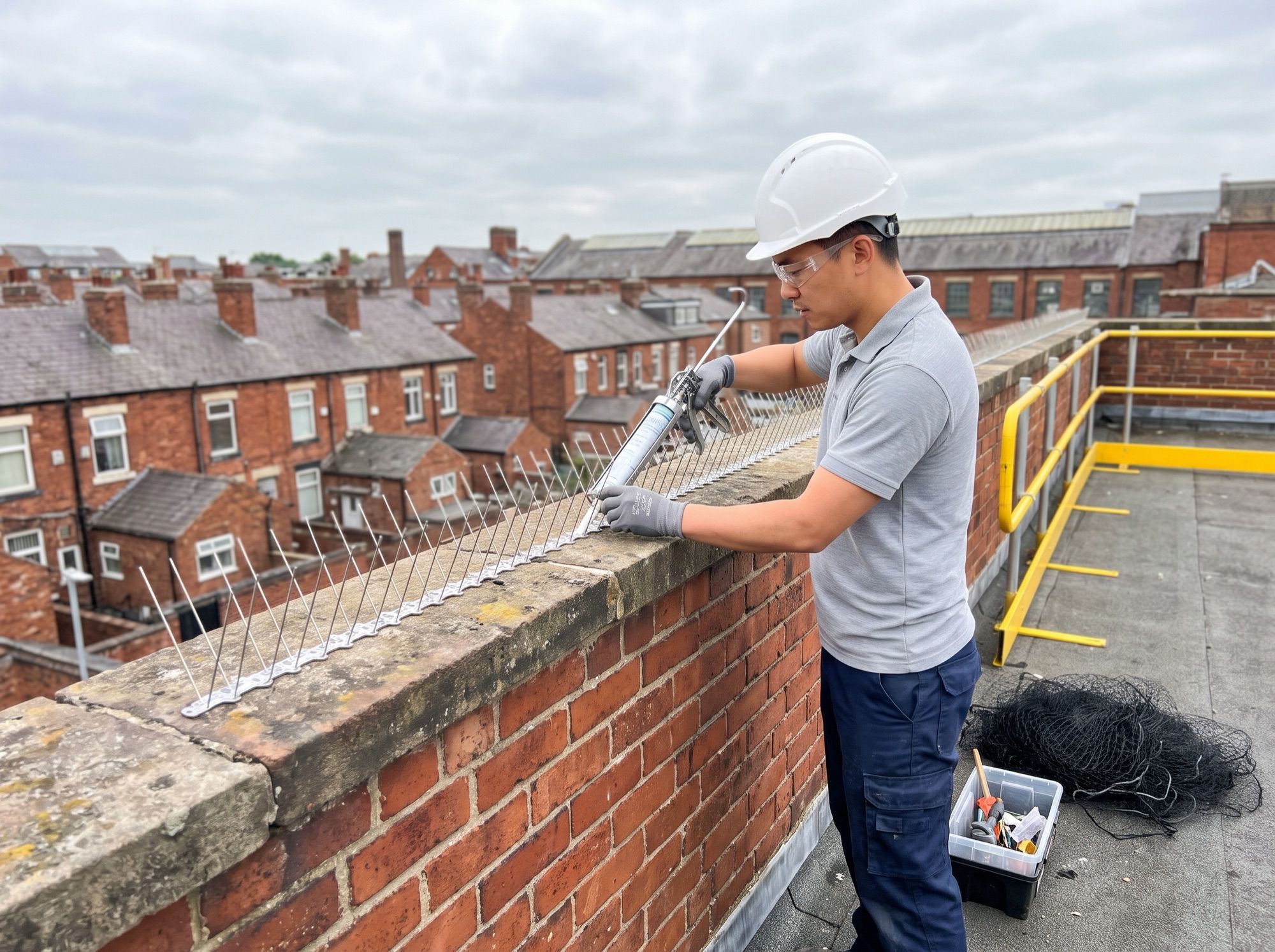
EnviroEx installs bird proofing on Salford buildings, including waterside offices, hotels and venues at Salford Quays, Pendleton retail units and residential blocks. Each elevation is surveyed and checked for nests in use before we specify netting, spikes, wire or gel, so pigeons and gulls are excluded lawfully. Phone us or send an enquiry to book the survey.
Why do pigeons settle on Salford’s waterside buildings?
Salford Quays is arranged around the old dock basins, so much of it looks onto open water. Its larger buildings, from offices at Soapworks and Quays Reach to the hotels, the outlet stores and The Lowry on Pier 8, offer what pigeons look for: ledges, canopies, signage and rooftop plant. To a pigeon, a tall elevation with sheltered ledges is a substitute sea cliff, the habitat its wild ancestors bred on, and the open space beside the water gives flocks somewhere to rest between feeds.
Away from the Quays, the picture shifts. Pendleton combines a shopping centre with high-rise flats, which gives birds both shelter and height. In the wider city, freight and warehouse sites such as Port Salford bring loading canopies and roller doors that, when left open, let birds roost directly above goods.
What does a survey usually find?
On Quays offices and hotels, the problems are usually on the underside of canopies over entrances, on ledges above doorways and terraces, and around roof plant where warm air rises. Fouling builds up on walkways and terraces first, and that is often what prompts the call.
On retail units and shopping centre service areas, birds use loading bays and the tops of signage, and they feed on spilled waste in yards. In residential blocks, balconies, window ledges and the gaps around rooftop equipment hold most of the nests. At warehouses and freight sites, pigeons perch on racking and roof steelwork just inside loading doors, which is the point where an auditor starts asking questions.
Every survey notes which species are present and whether they are roosting, loafing or nesting on each part of the building. It also covers the substrate fixings will go into, the access needed, and any nests still in use, since an active nest sets the earliest start date for that area.
Sick and dead birds: what Salford’s 2026 advice means on site
Since early August 2026 the council has logged a rise in reports of sick or dead wild birds in parks, on open ground and beside water. Residents have been told to leave them alone and, for now, to stop feeding birds in parks, because feeding draws them together. Reported birds are being picked up by specialist contractors.
On business premises, tell staff not to handle any bird they find, keep people away from it, and follow Defra’s current guidance on reporting. Stop any informal feeding by staff or visitors on your land. Proofing itself is unaffected, and arguably more useful now, because it keeps birds from gathering on your building at all. Our surveys record any carcasses found, and operatives wear protective equipment during clearance.
How does a bird proofing job run in Salford?
The survey turns into a proposal: annotated photographs, a system and mesh size for each problem area, how we will reach it and when, and the risk assessment and method statement your facilities team or managing agent will want to sign off. Waterside elevations at the Quays may need a mobile elevating work platform set on hard standing, or rope access where a façade rises straight from the water’s edge.
Installation starts with clearance. Droppings and old nest material are wetted to keep dust down, lifted into sealed bags and the area is disinfected, and every space due to be netted is checked for trapped birds before it is closed. The specified system then goes in, scheduled around trading, deliveries or events, and the handover record marks each installation and the position of any access zips for maintenance teams.
Keeping birds off once the proofing is in
Exclusion takes away the roost; the rest is about not giving birds a reason to hang around nearby. Lidded bins, yards swept of food waste, no feeding by staff and clear gutters all help. On food and hospitality sites, the waste that attracts pigeons also attracts rats, so bird checks sit well alongside our rodent control and commercial pest control visits in a single plan. Ask for netting to be looked at after high winds as well as on a routine schedule: a split near a fixing is a quick repair, while a pigeon caught behind the mesh becomes a welfare problem.
What we see with bird control & proofing in Salford
- Salford Quays is built around open dock basins, and the offices, hotels and venues beside them present ledges, canopies and roof plant to birds that feed and rest by the water.
- The council's own proofing offer is built around spikes on ledges and window sills; enclosed spaces such as loading bays, light wells and atria usually need netting instead.
- At freight and warehouse sites in the wider city, such as Port Salford on the Ship Canal at Barton-upon-Irwell, pigeons roosting over loading areas can foul stock, pallets and handling equipment.
- Pendleton's high-rise flats and the apartment towers at the Quays give pigeons height and shelter, so balconies and rooftop plant are where residential surveys here tend to focus.
How the job runs
- 1
Survey and species check
We identify the species, how birds use each area, what the fixings will go into, how we will reach the work safely, and whether any nests are active or the building is listed.
- 2
Written proposal and method statement
You receive photographs, the system specified for each area, mesh sizes, access method and timing, with a risk assessment and method statement for your facilities team to approve.
- 3
Clearance and cleaning
Empty nests and fouling are removed, damped down and bagged, surfaces are disinfected, and we confirm no birds are inside any area that is about to be enclosed.
- 4
Installation
Netting, spikes, post-and-wire, gel, electric track or solar panel mesh is fitted to the agreed specification, timed around trading hours, deliveries or residents.
- 5
Handover and records
You get a record of what was installed and where, including the location of access zips and hatches in netting, plus the maintenance each system needs.
- 6
Inspection and upkeep
Netted areas and fixings are checked periodically and after storms, so a damaged panel is repaired before a bird gets in or becomes trapped.
Typical visits: Usually one survey visit and one installation visit. Large or phased sites, heavy fouling or an active nest that has to be left until it is empty can add visits, followed by periodic inspections.
Safety: Proofing excludes birds without harming them and uses no poisons. We check for live birds and active nests before enclosing an area, damp down and bag fouling rather than dry-sweeping it, and keep staff and the public out of the work zone.
Bird Control & Proofing in Salford: questions we get asked
We already have council spike strips on our Salford building. Can you add to them?
Many councils run a pest control service for residents, but what is covered, who can book and the charges all vary and can change, so check the council's own pest control pages before you book. If you rent, report the problem to your landlord first. If you would rather book a private firm, phone or use the enquiry form and we will arrange a survey.
Our building is in a Salford conservation area. Do we need consent for bird proofing?
It depends on the building and the system. In a conservation area such as The Cliff in Broughton, discreet, reversible proofing on an unlisted building often needs no planning permission, but check with the council's planning team before work starts. If the building is listed, anything fixed into its historic fabric could require listed building consent. We favour low-visibility systems in these cases, such as post-and-wire, gel or colour-matched netting fixed into mortar joints rather than stone, and supply photographs and a specification for the planning officer to review.
Can you proof balconies and roof plant on Salford apartment blocks?
Yes, normally through the managing agent or management company rather than flat by flat. Pigeons nest on balconies and around rooftop plant in tall blocks, and droppings on one balcony soon become a complaint from the flat below. Balcony netting usually needs approval under the lease and consent from the building's management, so we supply photographs, a specification and a method statement for that process, then fit balconies in batches to keep access visits to a minimum.
Do audited warehouses and freight sites in Salford need bird control in their pest plan?
In most cases, yes. Third-party standards for storage and distribution, such as BRCGS Storage and Distribution, expect a pest-control programme that covers the risks to the site, and auditors generally treat birds roosting near stored goods as one of those risks. They are likely to look for proofing and inspection records as well as rodent monitoring. Loading canopies, dock doors and racking near open shutters are the usual targets. We specify netting or bird curtains for those areas and add bird checks to routine visits, so one report covers rodents, insects and birds.
How can I get rid of pigeons legally?
Proof the places they roost and nest. The Wildlife and Countryside Act 1981 protects all wild birds, their eggs and any nest in use or being built, but excluding birds with netting, spikes, wire or gel is lawful as long as no bird is harmed or trapped and no active nest is destroyed. Lethal control of feral pigeons is possible under Natural England's general licence GL41 for specific public health and safety purposes, but removed birds are soon replaced while the building still offers a roost, so exclusion is the lasting answer.
Am I allowed to shoot pigeons in my own garden?
Only in narrow circumstances. General licence GL41 lets an owner or occupier act against feral pigeons only for the purposes it lists, such as preventing slips and falls or the spread of disease to people, and you must meet its conditions, including humane killing, as well as firearms law and basic safety. Shooting to stop pigeons eating bird seed or sitting on a fence is unlikely to fit those purposes, and in built-up parts of Greater Manchester it is rarely safe or practical. Proofing the roof, removing the food source and covering solar panels is the realistic route.
Can you remove a gull nest from our roof?
Not while it is in use, unless a licence is in place. Herring gulls and lesser black-backed gulls are not listed on Natural England's public health and safety general licence (GL41), so removing a nest that is being built or holds eggs or chicks normally needs an individual licence. Expect Natural England to ask for evidence of a genuine public health or safety risk and of the non-lethal options considered, so it is not a quick fix. Once the young have fledged and the nest is empty, it can be cleared. The lasting fix is to proof the roof between breeding seasons so gulls cannot nest there next spring.
More in Salford
Last updated: