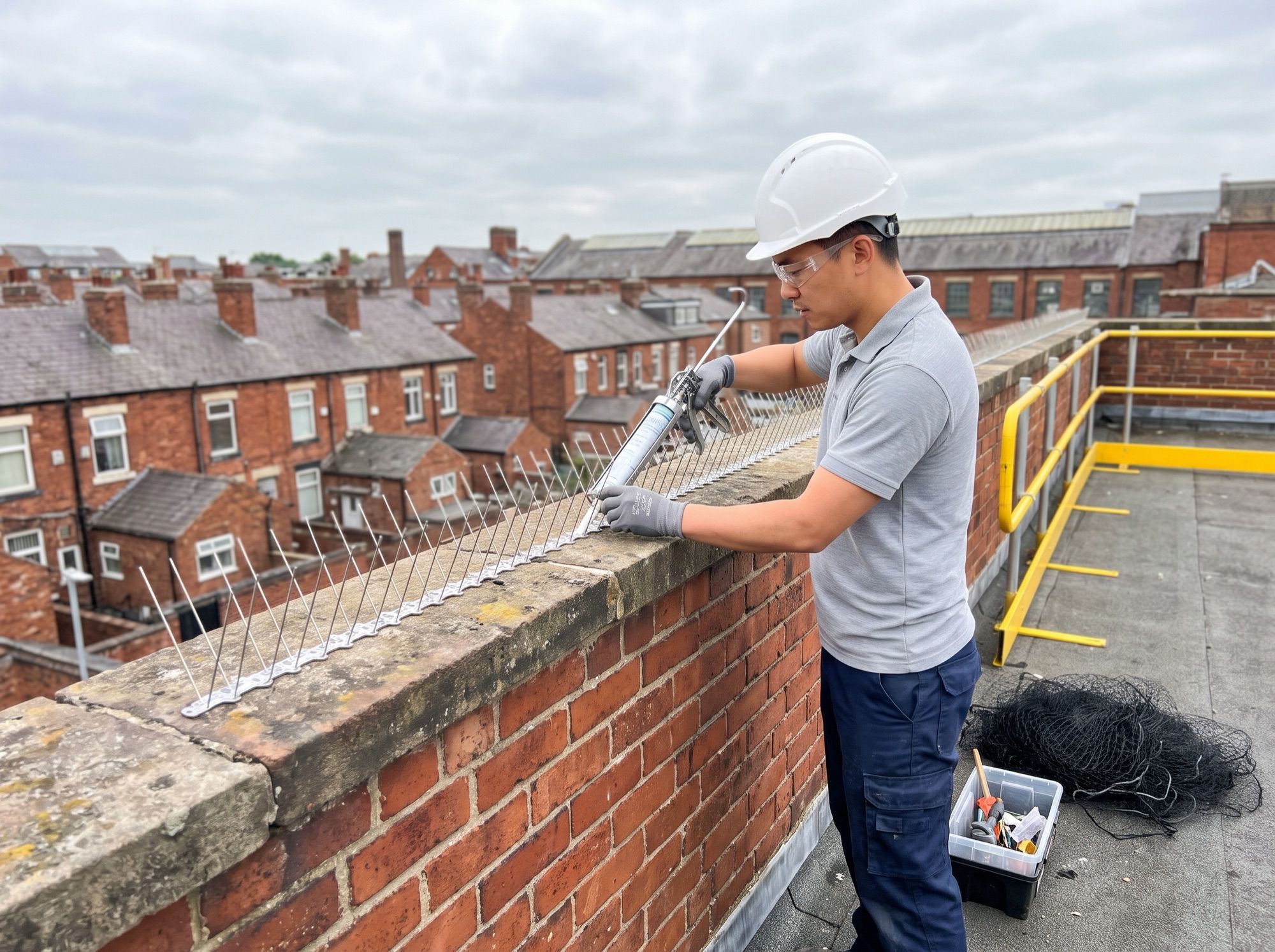
EnviroEx surveys and proofs buildings against pigeons and gulls across Trafford Park and Old Trafford, from warehouse canopies and roof plant to hotel frontages near Sir Matt Busby Way. We check for active nests, clear fouling, then fit netting, spikes, wire or gel within wildlife law. To arrange a prompt survey, phone us or use the enquiry form.
Why do pigeons favour Trafford Park buildings?
Feral pigeons look for two things: a dry, sheltered ledge to roost and nest on, and food within easy reach. Trafford Park provides both on an unusual scale. Its 4.7 square miles hold factories, warehouses and freight buildings, many with deep loading canopies, roof plant and exposed steelwork, and goods are handled in open yards, at docks and around the Euroterminal rail freight terminal. Where grain, flour or food packaging is moved, even small spills give birds a reason to stay.
The canals add open water and long sightlines on almost every side of the estate. Gulls increasingly nest on flat and shallow-pitched roofs well inland, and large roofs close to water can make attractive nesting platforms, defended noisily from spring into summer.
What do we find on warehouse, freight and food sites?
Most surveys on the estate turn up the same few problem areas:
- pigeons roosting on the steelwork inside loading canopies, fouling dock doors, vehicles and walkways below
- nests on roof plant, in box gutters and behind high-level signage
- birds flying in through open roller doors, then roosting on racking and roof beams above stock
- heavy fouling on ledges over pedestrian routes and fire exits, which becomes a slip hazard when wet
For a food business, a bird inside the building or droppings in a goods-in bay is a food-safety finding rather than a cleaning task. Food operators on the estate need proofing specifications and inspection reports filed with their HACCP pest-management records, next to rodent and insect monitoring, so an auditor can see the problem was found, fixed and checked.
How is proofing handled around the stadium and hotels?
Hotel Football faces the football stadium from Sir Matt Busby Way, on the far side of the Bridgewater Canal. Large venues and hotels can offer pigeons ledges on stands, canopies and signage, and their entrances carry heavy footfall on event days, so fouling becomes both a slip risk and a very public hygiene problem.
Appearance matters as much as performance here. Typical specifications are low-profile post-and-wire on frontages, clear or colour-matched spikes on signage, gel on narrow architectural features and netting over service yards and plant areas out of public view. Installation is booked around fixture and event calendars, so no work happens while crowds are arriving or leaving.
How does a bird-proofing job run on a working site?
The steps match our standard bird control process, scaled for big sheds and busy yards:
- Survey and species check, covering nests, the material each fixing goes into (steel, cladding or brick) and safe access.
- Written proposal with photographs, a specification for each area, and RAMS documents your facilities or safety team can sign off.
- Clearance of empty nests and fouling, damped down, bagged and followed by disinfection.
- Installation by mobile elevating work platform, scaffold tower or rope access, timed around shifts, deliveries and loading.
- Handover record showing what was fitted, where the netting access points are and how often it should be inspected.
On large sheds the access plan often sets the schedule, because a work platform needs clear floor space under canopies and in yards. We agree exclusion zones and timings with your site manager so docks keep working. Under the Wildlife and Countryside Act 1981, damaging or destroying a wild bird’s nest while it is being built or in use is an offence, so any area holding an active nest waits until the young have gone unless a licence covers the work.
What about homes in Old Trafford and The Village?
Domestic work here is smaller in scale. On Old Trafford’s Victorian terraces and in Trafford Park Village, the usual jobs are pigeons settling on chimney stacks, blocking gutters or nesting under rooftop solar panels. Spikes on stacks, gutter guards and mesh around solar arrays normally deal with it in a single visit once any nest is confirmed empty.
How do you keep birds off once the proofing is in?
Proofing removes the roost; site habits remove the reason to come back:
- keep dock and roller doors closed between loads, or fit strip curtains
- clear spilled food, grain and packaging from yards every shift
- ask staff not to feed birds in smoking shelters and break areas
- report torn netting quickly, because one open panel lets birds back in
- check gutters and fixings after storms, and book a periodic inspection
The same spilled food that draws pigeons also feeds rats, which is why many estate sites run bird proofing and rodent control through a single pest-management plan.
What we see with bird control & proofing in Trafford Park & Old Trafford
- Trafford Park's factories and warehouses spread across 4.7 square miles, and their open loading canopies and roof plant are typically where pigeons roost and nest.
- With canals on almost every side of the estate, broad canal-side roofs give gulls and pigeons open water and long sightlines close to the yards where goods are handled.
- Food production on the estate goes back at least to 1903 and the Co-operative Wholesale Society's flour mill at Trafford Wharf, and wherever flour, grain or food packaging is handled, a bird in a goods-in bay becomes a food-safety finding for the HACCP file.
- With the stadium on one bank of the Bridgewater Canal and Hotel Football opposite on Sir Matt Busby Way, proofing near the ground has to keep fouling off entrances that carry large crowds while staying discreet on visible frontages.
- On Old Trafford's Victorian terraces and the houses of Trafford Park Village, bird work is usually domestic in scale: chimney stacks, gutters and rooftop solar panels.
How the job runs
- 1
Survey and species check
We identify the species, how birds use each area, what the fixings will go into, how we will reach the work safely, and whether any nests are active or the building is listed.
- 2
Written proposal and method statement
You receive photographs, the system specified for each area, mesh sizes, access method and timing, with a risk assessment and method statement for your facilities team to approve.
- 3
Clearance and cleaning
Empty nests and fouling are removed, damped down and bagged, surfaces are disinfected, and we confirm no birds are inside any area that is about to be enclosed.
- 4
Installation
Netting, spikes, post-and-wire, gel, electric track or solar panel mesh is fitted to the agreed specification, timed around trading hours, deliveries or residents.
- 5
Handover and records
You get a record of what was installed and where, including the location of access zips and hatches in netting, plus the maintenance each system needs.
- 6
Inspection and upkeep
Netted areas and fixings are checked periodically and after storms, so a damaged panel is repaired before a bird gets in or becomes trapped.
Typical visits: Usually one survey visit and one installation visit. Large or phased sites, heavy fouling or an active nest that has to be left until it is empty can add visits, followed by periodic inspections.
Safety: Proofing excludes birds without harming them and uses no poisons. We check for live birds and active nests before enclosing an area, damp down and bag fouling rather than dry-sweeping it, and keep staff and the public out of the work zone.
Bird Control & Proofing in Trafford Park & Old Trafford: questions we get asked
Pigeons keep getting inside our warehouse through the roller doors. What can be done?
First, get the birds out safely: open a high door, switch off internal lights so the opening is the brightest exit, and avoid chasing them deeper into the racking. Then close the routes in. Options include faster-closing doors or PVC strip curtains at dock openings, netting above the high-level beams where birds roost, and sealing gaps at the ridge, eaves and cladding joints. We check racking and beams for nests before anything is enclosed and record the work for your HACCP or site safety file.
When is the best time to gull-proof a large roof on the estate?
Outside the breeding season, which for herring and lesser black-backed gulls usually runs from about April to August. Once a pair is building, sitting on eggs or rearing chicks, the nest is protected and work in that part of the roof normally has to wait. A survey in late summer, once the young have fledged, leaves autumn and winter for installation, which matters on big sheds where access platforms, roof-edge protection and crane or hoist bookings take time to arrange. Large shallow roofs near the canals may need wire grids or netting over the areas birds favour, with a check before the following spring.
On a multi-let estate building, is bird proofing the landlord's job or the tenant's?
It depends on the lease. On multi-let buildings the roof, gutters and structure are often kept by the landlord and recovered through the service charge, so proofing at roof level usually sits with them or their managing agent. Single-let units on full repairing leases tend to put it on the tenant. Either way, if you handle food, controlling pests inside your own unit remains your duty. We can report to both parties and set out each area separately in the proposal where responsibility is split.
Do we need the canal owner's agreement to proof a canal-side elevation?
Sometimes. If the work can be done safely from your own land, you normally need nothing beyond your landlord's consent, if you lease the building. If the only safe access is from the towpath or over the water, or fixings would touch a wall or structure belonging to the canal, its owner usually has to agree first and may set conditions on timing and access. We identify this at the survey, so the method statement and any approach to the owner are settled before installation is booked.
How can I get rid of pigeons legally?
Proof the places they roost and nest. The Wildlife and Countryside Act 1981 protects all wild birds, their eggs and any nest in use or being built, but excluding birds with netting, spikes, wire or gel is lawful as long as no bird is harmed or trapped and no active nest is destroyed. Lethal control of feral pigeons is possible under Natural England's general licence GL41 for specific public health and safety purposes, but removed birds are soon replaced while the building still offers a roost, so exclusion is the lasting answer.
Am I allowed to shoot pigeons in my own garden?
Only in narrow circumstances. General licence GL41 lets an owner or occupier act against feral pigeons only for the purposes it lists, such as preventing slips and falls or the spread of disease to people, and you must meet its conditions, including humane killing, as well as firearms law and basic safety. Shooting to stop pigeons eating bird seed or sitting on a fence is unlikely to fit those purposes, and in built-up parts of Greater Manchester it is rarely safe or practical. Proofing the roof, removing the food source and covering solar panels is the realistic route.
Can you remove a gull nest from our roof?
Not while it is in use, unless a licence is in place. Herring gulls and lesser black-backed gulls are not listed on Natural England's public health and safety general licence (GL41), so removing a nest that is being built or holds eggs or chicks normally needs an individual licence. Expect Natural England to ask for evidence of a genuine public health or safety risk and of the non-lethal options considered, so it is not a quick fix. Once the young have fledged and the nest is empty, it can be cleared. The lasting fix is to proof the roof between breeding seasons so gulls cannot nest there next spring.
More in Trafford Park & Old Trafford
Last updated: