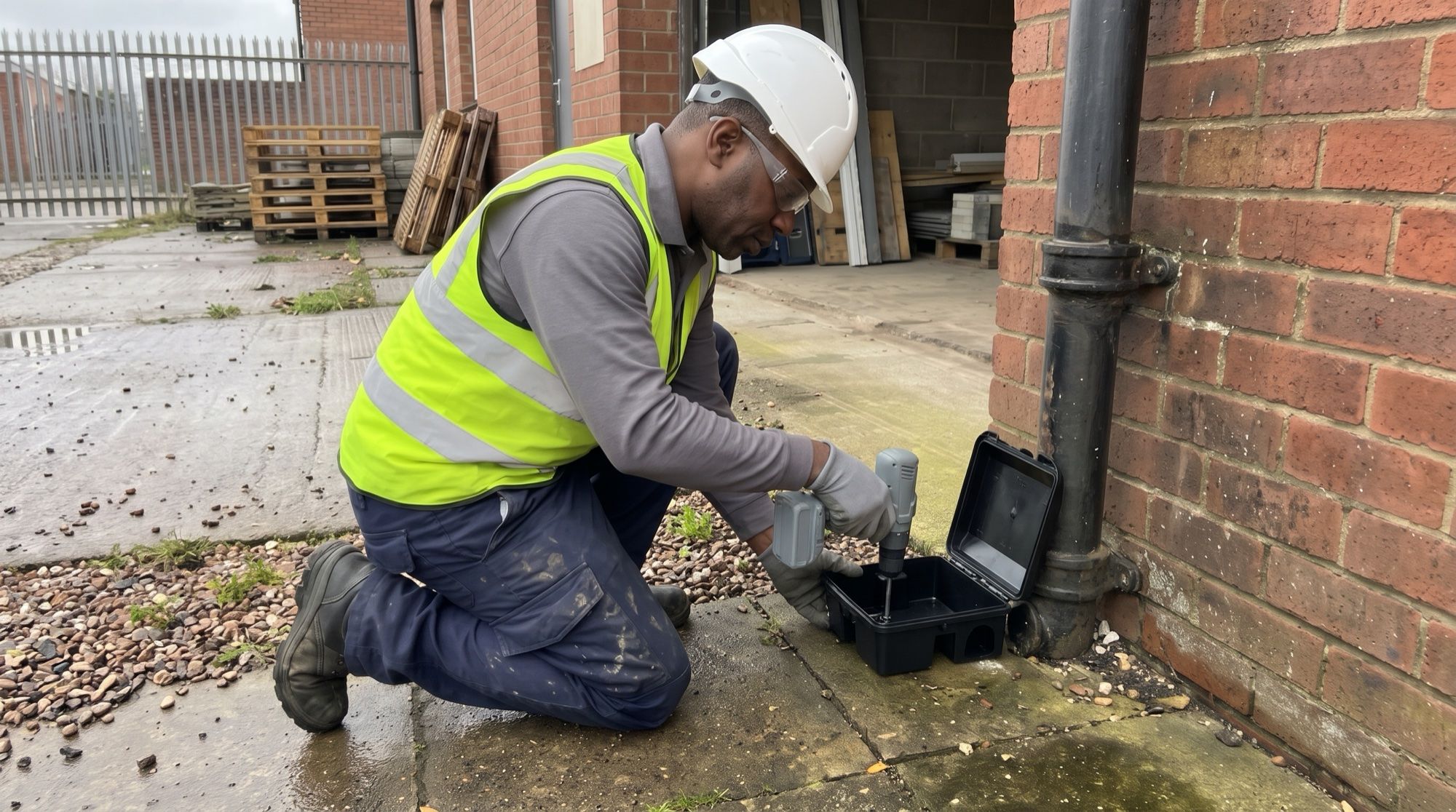
EnviroEx treats rats and mice in Salford offices, hotels, shops, rented blocks and homes, including Salford Quays, Pendleton and Lower Broughton. We survey first, trace the entry route through drains and service gaps, set secured stations or traps, proof the building and report in writing after each visit. Phone or send an enquiry to book a survey.
Why do rats and mice find their way into Salford buildings?
Water runs along most of Salford’s edges. The Irwell forms its eastern boundary, the Ship Canal and the Quays dock basins lie to the south, and the Bridgewater Canal and the Manchester, Bolton & Bury Canal pass through the wider city. Brown rats do well along riverbanks, culverts and outfalls, and the drains that connect to those waterways give them a steady route towards buildings. A waterside site can have rats living just beyond its fence line long before anyone sees one.
The building stock adds its own weak points. Victorian terraces were packed tightly during industrialisation, with shared drain runs and party walls that rodents pass along. The tower blocks that replaced many of those streets, and the newer apartment towers at the Quays, often link flats through bin chutes, service ducts and risers. Large offices, hotels and the shopping centre in Pendleton bring commercial waste, loading bays and back doors that stand open during deliveries.
What do we usually find in Salford premises?
The pattern changes with the type of building.
- Quays offices and hotels: mice in ceiling voids, raised floors and risers, often first noticed around tea points and hotel stores; rats around bin compounds and loading bays close to the basins.
- Shopping centre and high-street units in Pendleton: activity travelling along shared service corridors and yards, with gaps under roller shutters and around pipework into stockrooms.
- Terraced streets such as those in Seedley and Langworthy: cracked or disconnected clay drains beneath floors, redundant pipe connections never capped when a room was altered, and gaps around waste pipes into the void under the kitchen.
- Tower blocks and managed estates: bin rooms and chutes, and ducts that let rodents move between flats.
- Riverside streets in Lower Broughton and Kersal: drains that may have been damaged or silted by past flooding, and burrows along boundaries.
- Warehouses and freight sites, for example around Port Salford: roller doors open for long periods, pallets against walls and rats nesting under stored materials.
How does a rodent job run at a Salford site?
The first visit is a survey. Droppings, smears and gnawing tell us which rodent is present and how far it ranges, and the job is not planned until we know how it is getting in. Where the evidence points below ground, we lift inspection covers and look for defects, and advise a camera survey of the drains when a break seems likely. A short written plan follows, showing station and trap positions, the proofing required, and what staff, tenants or building management need to do.
Treatment follows a site risk assessment. Stations are fixed in place and locked, any rodenticide is used to the label and CRRU stewardship guidance, and every point is numbered on a plan. In hospital settings, halls of residence, nurseries and food rooms, occupied areas usually get enclosed traps, with bait kept to secured stations in plant and service spaces. Gaps we can close on the day are proofed with steel mesh, brush strips or cement-based filler; larger repairs are photographed for the landlord or maintenance team.
Expect two to four visits in most cases, spaced about a week to ten days apart. When a check shows the stations untouched and no fresh droppings, any rodenticide comes out and the closing report records what was found, treated and proofed. Food businesses, hotels and multi-let offices often move onto scheduled monitoring afterwards through our commercial pest control contracts, and block owners can use our pest control for landlords service to cover common parts.
Keeping rats out once the job is closed
For gardens and yards, the council’s own advice holds good: look in the dry spaces under decking, sheds and trampolines, bag food waste before it goes out, close bin lids and feed birds sparingly. The same rules scale up on commercial sites. Keep bin compounds closed and away from doors, fit and maintain door sweeps, cap rodding points, and clear pallets and cardboard from boundary walls.
Two local habits help as well. Tell the council about rats spotted in public places, because those reports help it decide where to bait the sewers. And after high water on the Irwell, have drains and low-level entry points looked at before the first cold spell sends rats looking for shelter.
What we see with rat & mouse control in Salford
- The Irwell marks Salford's boundary with Manchester city centre and the Ship Canal runs along its southern edge, so waterside offices and apartment blocks are surveyed along banks, outfalls and drainage as well as indoors.
- Hundreds of homes in Lower Broughton and Kersal flooded on Boxing Day 2015, so premises in those streets are worth a drain and entry-point check after any spell of high water, because floodwater disturbs burrows and can damage pipe runs.
- On the terraced streets of Seedley and Langworthy, shared drain runs and linked roof spaces can let rats and mice pass along a row, so landlords often need several houses surveyed rather than one.
- Bin rooms in managed blocks are a recurring weak point: residents of one Lower Broughton block reported rats and cockroaches over four years, with cockroaches in the bin rooms, and the landlord's response was baiting across the estate and sealing the gaps it found.
How the job runs
- 1
Survey and identification
We confirm whether it is rats or mice, map droppings, runs and gnawing, and trace the entry route through walls, voids, service ducts and drains.
- 2
Written treatment plan
You get a short plan setting out the method, where stations or traps will go, any proofing needed and what we need from you, your staff or your tenants.
- 3
Secure treatment
After a site risk assessment, tamper-resistant stations or traps go on active runs, with any rodenticide used in line with the product label and CRRU UK stewardship guidance.
- 4
Proofing and exclusion
Gaps around pipes, under doors, at airbricks and in drainage are sealed, screened or photographed and flagged for repair so the problem is not simply reset.
- 5
Follow-up and close-out
Return visits check activity, adjust placement and remove bait and bodies, finishing with a written report you can keep with your records.
Typical visits: Usually two to four visits: a survey and first treatment, then checks roughly every seven to ten days until activity stops. Food premises and larger sites often move onto a scheduled contract afterwards.
Safety: Rodenticide only goes inside locked, fixed, tamper-resistant stations or into voids children and animals cannot reach, and every station is marked on a plan. Where pets or young children share the space, we often use enclosed traps in those areas instead.
Rat & Mouse Control in Salford: questions we get asked
Can you take over from the council's pest contract at our Salford premises?
Many councils run a pest control service for residents, but what is covered, who can book and the charges all vary and can change, so check the council's own pest control pages before you book. If you rent, report the problem to your landlord first. If you would rather book a private firm, phone or use the enquiry form and we will arrange a survey.
Mice are coming through from a neighbouring unit at our Pendleton shop. What can we do?
Tell the landlord or centre management in writing first, because shared service corridors, ceiling voids and bin areas are often their responsibility under the lease rather than yours. Treating one unit while the next stays active rarely lasts. We survey your unit and its shared boundaries, proof gaps around pipes, cable entries and shutters on your side, place stations where the evidence points, and give you a report to pass to management so the source can be traced. For a food business, keep that report with your pest records for the next inspection.
Do you treat student houses and HMOs near the University of Salford?
Yes, usually on the landlord's instruction. Check Salford City Council's website for current pest control services and charges. We survey the house and its drainage, fix stations where tenants cannot disturb them, proof gaps around pipes and under kitchen units, and give the landlord a report plus a short list of what tenants can do. Bins are often the deciding factor.
Do mice in a Quays office mean the whole building needs treating?
Not always, but usually more than one floor. Mice in modern office blocks travel through ceiling voids, raised floors, risers and cable routes, so activity in one tenancy normally means a route through the shared core. We check the floors above and below and the risers, then agree with building management where stations go in common parts and where each tenant needs them. One plan for the building, with each tenancy's findings reported separately, stops mice simply moving to the next floor.
Will one mouse sighting affect our food hygiene rating?
Not automatically. The inspector scores what they find on the day across food hygiene and safety, the condition of the structure and confidence in management. A sighting that was reported, treated, proofed and recorded shows your controls working. Live activity, droppings near food, gaps left open or missing pest records count against you, and where there is an imminent risk to health the council can close premises with a hygiene emergency prohibition notice. Early action and a clear paper trail make the difference.
Who pays for rat control in a rented property, the landlord or the tenant?
It depends on the cause and the tenancy. In most tenancies, section 11 of the Landlord and Tenant Act 1985 makes the landlord responsible for keeping the structure, exterior and drains in repair, so rodents getting in through defects usually fall to the landlord. The Homes (Fitness for Human Habitation) Act 2018 also requires the home to be fit to live in. Where an infestation comes from how a tenant stores food or rubbish, the tenancy agreement may put the cost on them. We can report directly to the landlord or managing agent.
Do I have to report rats to the council?
The Prevention of Damage by Pests Act 1949 requires the occupier of land, other than agricultural land, to tell the local authority in writing if they know rats or mice are living on or visiting it in substantial numbers. The council can then require treatment or structural work. Whether your situation meets that threshold depends on the circumstances: a few droppings in a store room is not the same as an established colony. A treatment plan backed by written visit records shows the problem is being dealt with.
More in Salford
Last updated: