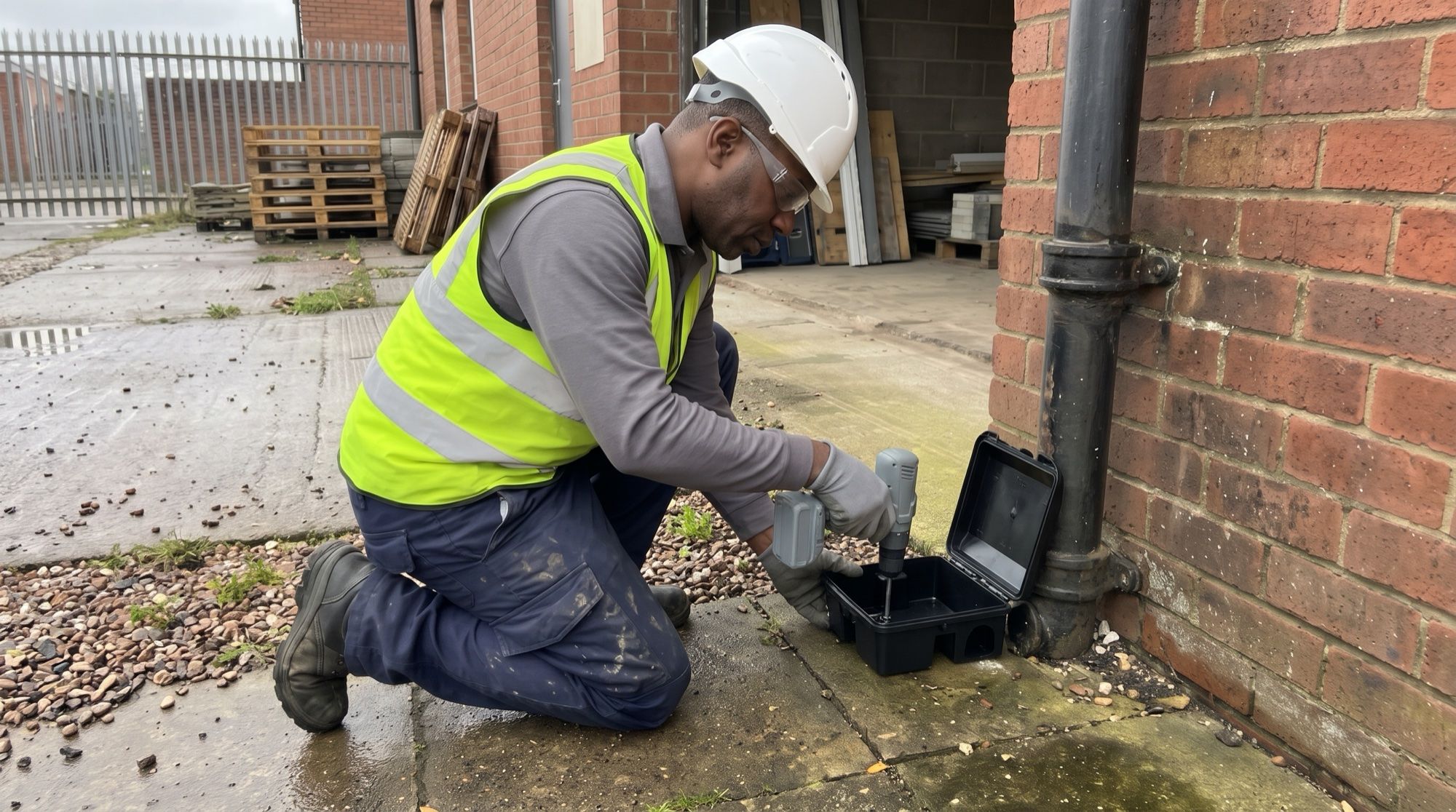
EnviroEx controls rats and mice in Manchester restaurants, offices, flats and rented homes, including Cheetham Hill terraces and Fallowfield student lets. Every job starts with a prompt survey that traces drains and shared voids, then secured baiting or trapping, proofing and a report on every visit. Ring us or send an enquiry to set it up.
Why does rodent work in Manchester start below ground?
Parts of Manchester sit over water nobody sees. Culverts carry the River Medlock under the car park of the City of Manchester Stadium, the old UMIST site and Hulme Street, and a tunnel takes it beneath the Castlefield basin. The Irk vanishes into brickwork at Ducie Bridge before running beneath Victoria station. Old sewers, culverts and canal walls give brown rats long, protected runs between food sources, which is why a city-centre treatment that ignores drains and service entries so often has to be repeated.
The weather adds pressure. Average annual rainfall in Manchester is just over 800 mm, and the Irwell has flooded repeatedly in recent decades, including in 2015 and 2020. Heavy rain and rising water push rats out of burrows and low sewers into basements, yards and drain runs, and a wet summer was one of the explanations given for a rise in rat and mouse problems across the city in 2015.
What do we typically find in Manchester premises?
City-centre kitchens and bars. The centre saw the sharpest late-2010s rise in council rat reports anywhere in Greater Manchester. In restaurants and bars, the common pattern is rats working a shared yard or commercial bin store after dark, while mice nest in warm voids under plinths, behind bar fridges and inside boxed-in pipework.
Offices and hotels. Mice move through suspended ceilings, floor boxes and risers, following food left at desks or on room-service trays. A single tenant’s booking rarely clears a multi-occupied building unless the managing agent brings the common parts into the plan.
Apartment blocks. When the council agreed in 2016 to replace 240-litre grey bins with 140-litre ones, blocks of flats served by shared bins and recycling containers were left out, so flats still rely on a bin store. A bin room door that does not close, or bags left on the floor, can feed rats for an entire block.
Terraces and student houses. Cheetham Hill still has terraces from its textile processing years, and terraced rows commonly share drainage, so broken or disconnected pipes under floors are a frequent way in. Mouse reports stand out in student areas: Moss Side and Fallowfield between them once produced over a thousand to the council in a year. Many of Withington’s larger houses were sold off as student flats, and that kind of letting brings shared kitchens, frequent changes of occupant and more household waste.
What happens on a Manchester rodent job?
The method is the same one every EnviroEx rodent job follows, adapted to the building. A survey establishes which rodent is present and traces the route, including drains, culvert walls and party voids, and you then get a short written plan. After a site risk assessment, bait boxes or traps are set where the survey found movement, with any rodenticide held in locked, fixed boxes and well back from canal and river edges. We return at intervals of a week or so to log what has been taken and move equipment, and sign the job off with a written report once activity has ceased.
In the city centre, timing matters as much as technique. We schedule kitchen visits before service or after close, arrange access to risers and basements through building managers, and flag defects that belong to a neighbour, a landlord or the sewerage company so the right person can act. If a CCTV drain survey is needed, the first report says so.
What keeps rats out of a Manchester building afterwards?
Prevention here comes down to four things:
- Waste. Bin store doors that shut fully, lids kept closed, nothing on the floor, and commercial collections frequent enough that containers never overflow. Under section 34 of the Environmental Protection Act 1990, businesses have a duty of care to store their waste so it cannot escape.
- Drains. Capped rodding points, sound junctions and, where a survey shows rats coming up through the system, a non-return valve on that run.
- Fabric. Steel mesh over airbricks and vents, sealed service entries, and brush strips on roller shutters and back doors.
- Timing. Proofing student lets over the summer, and checking waterside and basement premises after heavy rain or flooding.
For sites with an ongoing risk, a scheduled contract through our commercial pest control service keeps monitoring in place and the records current. Landlords with several properties will find access, tenant reports and HMO common parts covered in our landlord service.
What we see with rat & mouse control in Manchester
- Between 2015 and 2019 the number of rat infestations reported to the council went from 469 to 1,058, and the city centre's rise outpaced every other part of Greater Manchester.
- The River Medlock is buried below Hulme Street and passes under the Castlefield canal basin, so parts of the centre sit above long, sheltered water corridors that rats can use.
- Blocks of flats that share communal bins were excluded from the council's 2016 move to 140-litre household bins, so apartments still depend on shared bin stores that need to be kept closed and clean.
- Moss Side and Fallowfield together generated over a thousand of the council's roughly 6,000 mouse reports in a single year, and the autumn arrival of students was among the reasons given.
- Rain falls on around 140 days in an average Manchester year, and a wet summer was one of the reasons given for a rise in local rodent problems in 2015.
How the job runs
- 1
Survey and identification
We confirm whether it is rats or mice, map droppings, runs and gnawing, and trace the entry route through walls, voids, service ducts and drains.
- 2
Written treatment plan
You get a short plan setting out the method, where stations or traps will go, any proofing needed and what we need from you, your staff or your tenants.
- 3
Secure treatment
After a site risk assessment, tamper-resistant stations or traps go on active runs, with any rodenticide used in line with the product label and CRRU UK stewardship guidance.
- 4
Proofing and exclusion
Gaps around pipes, under doors, at airbricks and in drainage are sealed, screened or photographed and flagged for repair so the problem is not simply reset.
- 5
Follow-up and close-out
Return visits check activity, adjust placement and remove bait and bodies, finishing with a written report you can keep with your records.
Typical visits: Usually two to four visits: a survey and first treatment, then checks roughly every seven to ten days until activity stops. Food premises and larger sites often move onto a scheduled contract afterwards.
Safety: Rodenticide only goes inside locked, fixed, tamper-resistant stations or into voids children and animals cannot reach, and every station is marked on a plan. Where pets or young children share the space, we often use enclosed traps in those areas instead.
Rat & Mouse Control in Manchester: questions we get asked
I'm a Manchester council tenant with mice. Should I call you or the council?
Start with the council. Its tenants can have rats and mice, along with a few insect pests such as bed bugs and cockroaches, dealt with at no charge, so mention your council tenancy when you first make contact. Our rodent work in the city is mainly for businesses, private landlords, managing agents and owner-occupiers. If you rent privately, tell your landlord or letting agent, who will usually arrange treatment and any repairs.
Why do rats keep appearing around city-centre bin stores?
Waste is the most dependable food in the centre, and overflowing bins, litter and fly-tipping were among the conditions cited when council rat reports more than doubled in the late 2010s. A store with a gap under the door, split bags or waste left between collections will feed rats every night. We place secured stations around the store, proof doors and drains, and set out in writing what the waste contractor, landlord or neighbouring businesses need to change.
Our premises back onto the Rochdale Canal. Can you put bait near the water?
Only with care. Rodenticide labels and stewardship guidance restrict baiting where product could reach water or wildlife, and the canal, its towpath and walls are normally the Canal & River Trust's responsibility rather than yours. We concentrate stations on your side of the boundary, use traps where the risk to water is higher, and proof vents, drains and service entries that face the canal. If burrows sit on the canal side, we record them so the owner can be told.
When should student landlords in Fallowfield and Withington book rodent checks?
Before the academic year starts rather than after. In one year Moss Side and Fallowfield together accounted for more than a thousand of the council's mouse reports, and the September arrival of students was one of the factors cited. Many of Withington's bigger houses have been sold off as student flats, and that kind of letting usually means shared kitchens and a lot of waste. A summer inspection lets us proof pipe entries, kitchen plinths and bin areas while houses are empty, then leave a report for your tenancy file.
Will one mouse sighting affect our food hygiene rating?
Not automatically. The inspector scores what they find on the day across food hygiene and safety, the condition of the structure and confidence in management. A sighting that was reported, treated, proofed and recorded shows your controls working. Live activity, droppings near food, gaps left open or missing pest records count against you, and where there is an imminent risk to health the council can close premises with a hygiene emergency prohibition notice. Early action and a clear paper trail make the difference.
Who pays for rat control in a rented property, the landlord or the tenant?
It depends on the cause and the tenancy. In most tenancies, section 11 of the Landlord and Tenant Act 1985 makes the landlord responsible for keeping the structure, exterior and drains in repair, so rodents getting in through defects usually fall to the landlord. The Homes (Fitness for Human Habitation) Act 2018 also requires the home to be fit to live in. Where an infestation comes from how a tenant stores food or rubbish, the tenancy agreement may put the cost on them. We can report directly to the landlord or managing agent.
Do I have to report rats to the council?
The Prevention of Damage by Pests Act 1949 requires the occupier of land, other than agricultural land, to tell the local authority in writing if they know rats or mice are living on or visiting it in substantial numbers. The council can then require treatment or structural work. Whether your situation meets that threshold depends on the circumstances: a few droppings in a store room is not the same as an established colony. A treatment plan backed by written visit records shows the problem is being dealt with.
More in Manchester
Last updated: