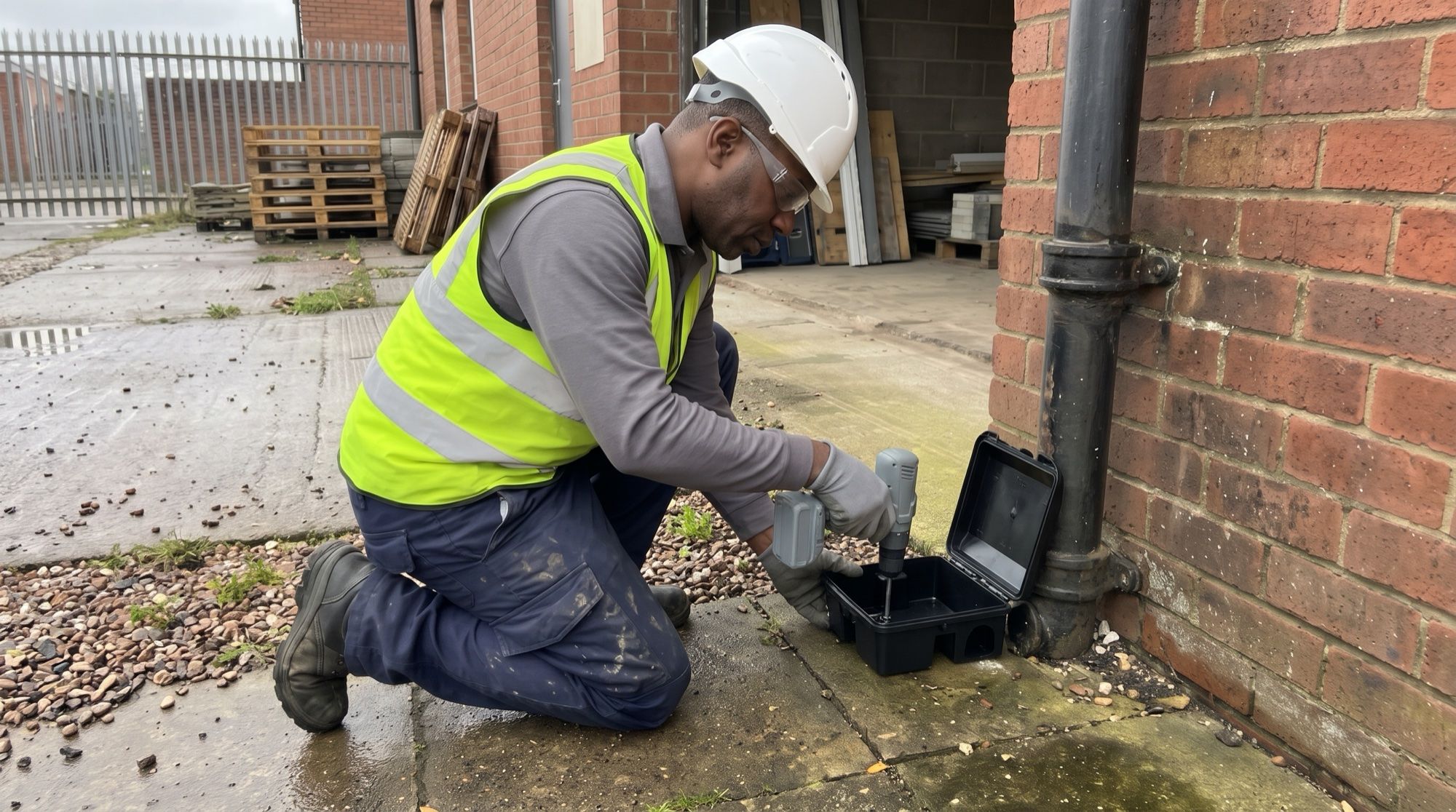
EnviroEx deals with rats and mice in Stockport food businesses, shops, pubs, industrial units and rented homes, including the town centre, Bredbury and Edgeley. We survey promptly, trace routes through drains, culverts and service gaps, fit secured stations or traps, proof entry points and report every visit in writing. Call or send an enquiry to book.
Why rats find so many routes into Stockport premises
Water shapes the rodent picture in Stockport. The Goyt and the Tame meet in the town to form the Mersey, which runs in a culvert under Merseyway in the centre, and the Lower Peak Forest Canal passes through Woodley, Bredbury and Romiley in the east of the borough. Brown rats live comfortably along banks, culverts and sewers. What links them to a building is most often drainage: a cracked clay pipe, a junction left open after a refit, an uncapped rodding eye in a back yard.
Age adds to it in the centre. Market Place holds a concentration of listed buildings, among them several 18th- and 19th-century commercial premises, and buildings of that age have usually been extended, divided and re-plumbed many times. Cellars, party walls and old ceiling voids give rats and mice a hidden network between neighbouring businesses, so a problem in one unit is often a shared one.
The wider trend points the same way. Stockport Council’s rat advice says numbers are rising in the UK and connects that to a warming climate and growing resistance to rodenticides. Figures reported by the Press Association in October 2026 put rat sightings over June to August 15% up on the year, with Manchester recording the sharpest rise in rodent enquiries of five UK cities between 2024 and 2025. Those are regional figures rather than Stockport counts, but they match the autumn pattern we plan around.
What we typically find in Stockport buildings
The type of premises sets the pattern:
- Town-centre kitchens and cafés: mice in dry stores, behind ranges and under counters, and rats around shared bin stores and yard gullies.
- Pubs: activity around cellar drops, beer-garden decking and outbuildings, where spilt food and cover sit side by side.
- Market and retail units: mice travelling through ceiling voids and stockrooms shared with the unit next door.
- Bredbury industrial and trade units: rats burrowing along external walls and fence lines, and mice coming in through dock doors and pallet stacks.
- Rented homes: rats rising from defective drainage beneath the floors of Edgeley’s Victorian terraces, mice in the roof spaces and wall cavities of Heaton Moor’s larger houses, and activity around shared refuse areas and service ducts in high-rise blocks such as Brinnington’s.
How a rodent job runs on a Stockport site
The method is the same as our standard rat and mouse service. We survey, confirm the species and trace the route in, then set out a written plan covering station positions, proofing and anything we need from staff or tenants. Tamper-resistant stations or enclosed traps go on active runs, with return visits roughly every seven to ten days until activity stops and a close-out report at the end.
Two local factors shape the detail. The first is the restriction on outdoor rodenticide, which the council’s advice highlights: work on yards, beer gardens and industrial perimeters leans on trapping, monitoring and proofing, with bait used outside only where product labels and stewardship rules allow. The second is flooding. The council’s Section 19 investigation into the floods of December 2024 to January 2025 covers locations from Bramhall Green to Offerton Green, and high water flushes rats from banks and burrows and can unsettle drain runs, so premises near a watercourse that flooded get a closer look at drains and external walls.
If the evidence points to a broken or open drain, the answer is a CCTV survey and a repair; topping up bait in the same building month after month only treats the symptom. Under the Prevention of Damage by Pests Act 1949, which the council’s advice also points to, owners and occupiers are responsible for dealing with rats on their land, so a written record of what was found and fixed matters as much as the treatment itself.
Keeping rodents out of Stockport premises
The council’s advice says a rat can get through a gap of 25mm. We proof well below that, because young rats and mice manage much less. Typical work here includes sealing pipe and cable entries, fitting brush strips to roller shutters and back doors, replacing broken airbrick covers and capping redundant drain connections in older buildings.
Housekeeping has to keep pace. With fortnightly blue-bin collections starting in December, landlords and managing agents should make sure tenants know the new days, check bin stores, keep lids shut and stop bags being left beside bins. Gardens and yards backing onto the borough’s parks and nature reserves need decking, sheds and compost bins kept in order, and our pest control for landlords service can build those checks into routine inspections.
For food businesses and larger sites, a scheduled commercial pest control contract keeps stations monitored between problems, so each autumn starts from a known position rather than from scratch.
What we see with rat & mouse control in Stockport
- The Mersey runs in a culvert beneath Merseyway, so rodent surveys of nearby shops and food outlets begin with drains, gullies and service entries rather than the sales floor.
- In Edgeley's Victorian terraces around Alexandra Park, shared walls and older drainage mean one house's rodents can soon become a neighbour's, so landlords may need adjoining properties checked.
- Bredbury's industrial land shares the east of the borough with the Peak Forest Canal, and on those sites loading doors, pallet stacks and fence lines are usually where rats show first.
How the job runs
- 1
Survey and identification
We confirm whether it is rats or mice, map droppings, runs and gnawing, and trace the entry route through walls, voids, service ducts and drains.
- 2
Written treatment plan
You get a short plan setting out the method, where stations or traps will go, any proofing needed and what we need from you, your staff or your tenants.
- 3
Secure treatment
After a site risk assessment, tamper-resistant stations or traps go on active runs, with any rodenticide used in line with the product label and CRRU UK stewardship guidance.
- 4
Proofing and exclusion
Gaps around pipes, under doors, at airbricks and in drainage are sealed, screened or photographed and flagged for repair so the problem is not simply reset.
- 5
Follow-up and close-out
Return visits check activity, adjust placement and remove bait and bodies, finishing with a written report you can keep with your records.
Typical visits: Usually two to four visits: a survey and first treatment, then checks roughly every seven to ten days until activity stops. Food premises and larger sites often move onto a scheduled contract afterwards.
Safety: Rodenticide only goes inside locked, fixed, tamper-resistant stations or into voids children and animals cannot reach, and every station is marked on a plan. Where pets or young children share the space, we often use enclosed traps in those areas instead.
Rat & Mouse Control in Stockport: questions we get asked
Could the culverted Mersey under Merseyway be where the rats in our shop are coming from?
It is possible, but it is rarely the direct route. Rats use rivers, culverts and sewers as corridors, yet they reach a shop through something more ordinary: a defective drain connection, an open gully, a gap around a service pipe or a void shared with the unit next door. Our survey traces that link, and where the evidence points below ground we recommend a CCTV drain survey so whoever is responsible can repair the defect. Treating the shop without closing the route only resets the problem.
We already use the council's commercial pest service. Can you take over, or work alongside it?
Many councils run a pest control service for residents, but what is covered, who can book and the charges all vary and can change, so check the council's own pest control pages before you book. If you rent, report the problem to your landlord first. If you would rather book a private firm, phone or use the enquiry form and we will arrange a survey.
Our premises flooded in the winter of 2024 to 2025. Should we expect more rodents?
It is worth checking. The council's flood investigation for December 2024 to January 2025 covered locations including Gatley Brook, Heald Green and the River Mersey. Floodwater drives rats out of riverbank and garden burrows, and saturated ground can shift or crack old drain runs, opening new routes into buildings. We look for fresh burrows along external walls, lift drain covers and check rodding points, and inspect below-floor voids where the building allows. If nothing turns up, you still have a dated record showing the site was checked.
Why are you trapping outside our Stockport premises rather than laying poison?
Because outdoor rodenticide use is restricted, a point Stockport Council's own advice also makes. The stewardship rules for professional products limit where and how bait can be used away from buildings and discourage leaving it down permanently. Outside, traps, monitoring points and proofing do most of the work, while rodenticide, where it is justified, goes into secured stations close to or inside the building. That protects wildlife and pets in yards and gardens, and it reduces the risk of encouraging resistance in the local rat population.
Will one mouse sighting affect our food hygiene rating?
Not automatically. The inspector scores what they find on the day across food hygiene and safety, the condition of the structure and confidence in management. A sighting that was reported, treated, proofed and recorded shows your controls working. Live activity, droppings near food, gaps left open or missing pest records count against you, and where there is an imminent risk to health the council can close premises with a hygiene emergency prohibition notice. Early action and a clear paper trail make the difference.
Who pays for rat control in a rented property, the landlord or the tenant?
It depends on the cause and the tenancy. In most tenancies, section 11 of the Landlord and Tenant Act 1985 makes the landlord responsible for keeping the structure, exterior and drains in repair, so rodents getting in through defects usually fall to the landlord. The Homes (Fitness for Human Habitation) Act 2018 also requires the home to be fit to live in. Where an infestation comes from how a tenant stores food or rubbish, the tenancy agreement may put the cost on them. We can report directly to the landlord or managing agent.
Do I have to report rats to the council?
The Prevention of Damage by Pests Act 1949 requires the occupier of land, other than agricultural land, to tell the local authority in writing if they know rats or mice are living on or visiting it in substantial numbers. The council can then require treatment or structural work. Whether your situation meets that threshold depends on the circumstances: a few droppings in a store room is not the same as an established colony. A treatment plan backed by written visit records shows the problem is being dealt with.
More in Stockport
Last updated: