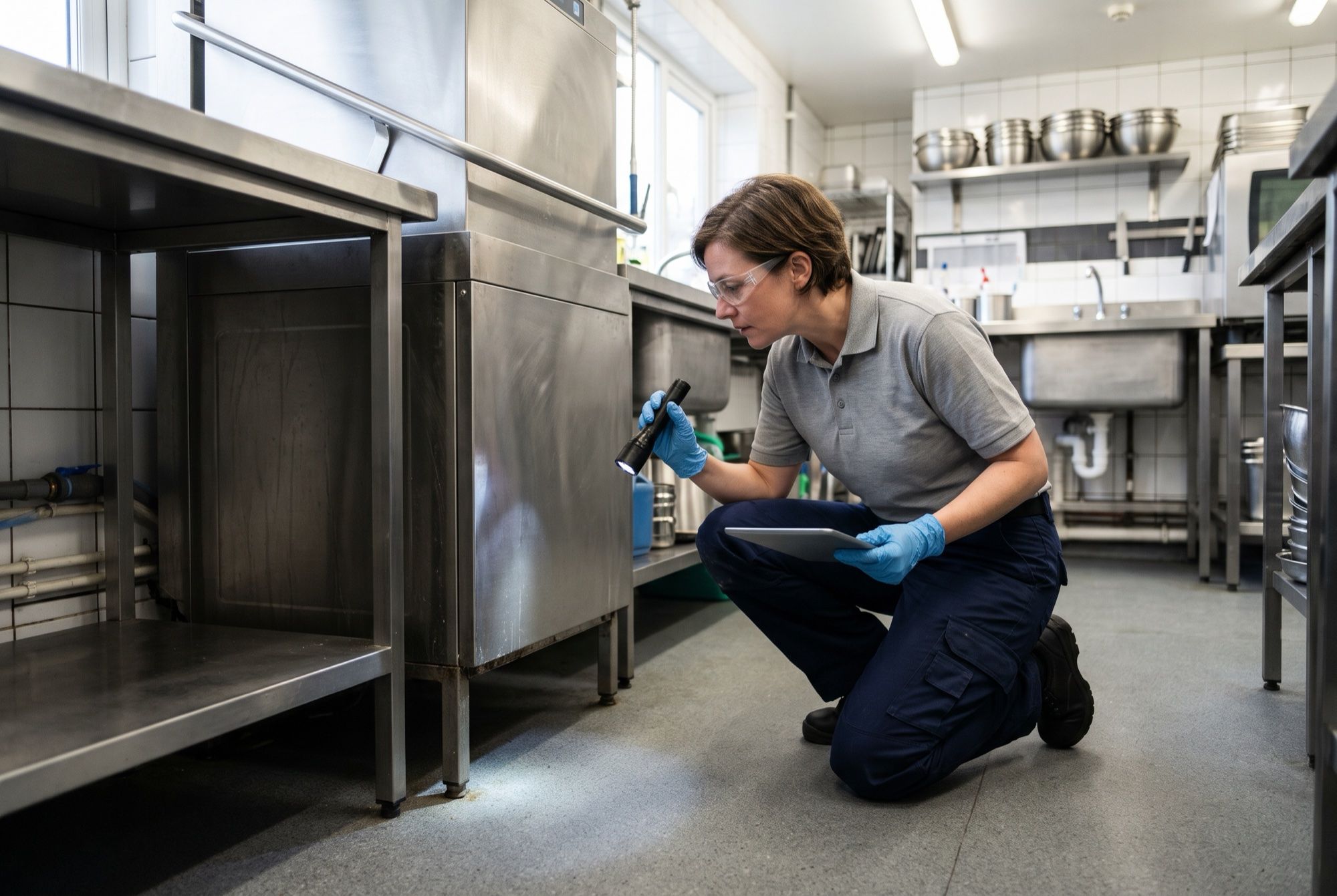
Across Stockport, EnviroEx handles commercial pest control for shops, food and leisure venues, offices, landlords' blocks and industrial units, from Merseyway and Market Place to Bredbury. Work starts with a walk-round survey, then a written scope, prompt treatment and proofing, and a report from each visit for your inspection file. Ring or send an enquiry to set up the survey.
Which Stockport premises need a commercial pest programme?
The town centre is Stockport’s main commercial district. Most high-street chains sit in Merseyway or The Peel Centre, while Market Place, the town’s focal point since the Middle Ages, still has its covered Market Hall, restored in 2008, among a dense group of listed buildings, 18th- and 19th-century trading premises among them. Redrock, opened in 2018, added a twelve-screen cinema alongside bars, restaurants and a gym, and the Pyramid beside the M60 reopened as an Indian and Pakistani restaurant in April 2025.
Elsewhere in the borough, Stockport NHS Foundation Trust runs Stepping Hill, a district general hospital with 778 beds, and Bredbury has industrial land developed in the 1960s on levelled colliery spoil; brewing at Robinsons’ Unicorn Brewery on Lower Hillgate moved there in 2024. The Interchange, officially opened in March 2024, combines a bus station, the Viaduct Park rooftop and a building that mixes homes with commercial space, so one structure can have several occupiers with different duties.
Why do Stockport premises see rats, mice and insects?
Part of the answer can lie below street level. The Mersey begins here, where the Goyt and the Tame join, and through the town centre it is culverted, with the Merseyway shopping street on top. Opened in 1797, the Ashton Canal’s Stockport branch stayed in use until the 1930s, and a good part of its line is now filled in. Mill-power tunnels were cut beneath the town from the Goyt, and wartime air-raid shelter tunnels run under the centre. Old drain runs and below-ground voids can link neighbouring properties, so our town-centre surveys look hard at drains, basements and service entries.
Flooding plays a part too. The council’s Section 19 report on the flooding that ran from December 2024 into January 2025 has appendices for locations including the River Mersey, Meadow Mill and Offerton Green. High water can push rats out of burrows and sewers, so drain covers, gullies and wall bases deserve a check after a flood.
The council’s advice on rats ties the rise in numbers to climate change and to rats becoming resistant to rodenticides, and points out that rodenticide use outdoors is restricted. Both point commercial programmes towards proofing, trapping and monitoring rather than bait alone.
What do we typically find on Stockport sites?
- Town-centre retail. Mice in stockrooms, service corridors and ceiling voids shared between units, often linked to waste areas at the rear.
- Food and leisure. Mice and cockroaches in warm kitchen voids, flies around waste, and wasps at outside tables in late summer, in bars, restaurants, pubs and food stalls.
- Healthcare, care and offices. Catering areas, stores, plant rooms and tea points that need frequent visits and careful records.
- Bredbury and other industrial units. Long perimeters, shutters open during deliveries, pigeons under canopies and stored-product insects arriving with incoming goods.
- Mixed-use and managed blocks. Bin rooms, service risers and car parks shared by residents and commercial tenants.
How is a Stockport contract set up and run?
The survey covers the building and its boundary, including yards, drain runs, roof edges and shared parts a landlord or agent maintains. The proposal sets out pests covered, visit frequency, methods and exclusions, and each monitoring point is numbered on a plan so every report entry traces to a spot on site. Live activity is cleared before routine monitoring begins, and entry points are either proofed by us or photographed for whoever holds the repair obligation.
Visits are booked around trade: before market stalls open, after a restaurant’s last sitting, or zone by zone on hospital and care sites that never close. Callouts between visits go into the same file.
Bird proofing for town-centre buildings
Pigeon fouling on shopfronts, signs, canopies and plant decks soon becomes a slip and hygiene problem at entrances. Because wild birds have legal protection, exclusion comes first in our bird control work, with netting, spikes or post-and-wire chosen for each elevation and fitted after a check for active nests. Around Market Place, with its concentration of listed buildings, we favour reversible fixings into mortar joints and flag anything that may need listed building consent before the work is booked.
What records will an inspector expect?
Whether it is a restaurant kitchen at Redrock or a pub cellar, Regulation (EC) No 852/2004, retained in England and enforced under the Food Safety Act 1990 and the Food Safety and Hygiene (England) Regulations 2013, expects the operator to keep pests under adequate control. The detail is on our food premises pest control page. Your file should hold the site plan, visit reports, safety data sheets and a log of which recommendations were acted on.
Landlords, managed blocks and homes
Private renting grew in Stockport between the last two censuses, from 11.4% of households in 2011 to 14.4% in 2021, with another 13.3% in social rented homes. Blocks and HMOs need one programme for bin stores, risers and voids, which is the job our pest control for landlords team plans for each building. Check Stockport Council’s website for current pest control services and charges.
What we see with commercial pest control in Stockport
- Most high-street chains in Stockport trade from Merseyway Shopping Centre or The Peel Centre, so retail programmes here concentrate on stockrooms, goods-in, service corridors and the waste areas behind each unit.
- Merseyway is built over the culverted River Mersey, and Market Place keeps a cluster of listed buildings that includes 18th- and 19th-century commercial premises, so town-centre surveys look closely at drainage, below-ground voids and fixings that suit historic fabric.
- Redrock's cinema, bars, restaurants and gym, along with the Pyramid's restaurant beside the M60, add evening food and leisure trade where waste areas and deliveries are best inspected before opening or after close.
- Some of Bredbury's industrial land dates from the 1960s, when old colliery spoil at Ashton Road and Stockport Road East was flattened for new industry, and the Peak Forest Canal also passes through, so units there need perimeter monitoring, shutter proofing and checks of incoming goods.
How the job runs
- 1
Site survey and risk assessment
We walk the building inside and out, including bin stores, drains, voids, plant rooms and goods-in, and assess the pest risks your operation creates.
- 2
Written scope and site plan
You receive a proposal setting out pests covered, visit frequency, methods by area and exclusions, with a numbered site plan for your pest control file.
- 3
Initial treatment and proofing
Any active infestation is treated first. Entry points are proofed by us or listed with photographs for your maintenance team or landlord.
- 4
Routine inspections
Scheduled visits check every monitoring point and high-risk area, record findings and adjust the programme to what the evidence shows.
- 5
Reporting and review
Each visit produces a written report, and we review trends with you so the visit frequency and station layout stay proportionate to the risk.
Typical visits: A survey, then routine visits set by risk, commonly between four and twelve a year, plus reactive visits whenever activity is reported.
Safety: Wherever people or non-target animals could reach bait, rodenticide is used only in fixed, tamper-resistant stations in line with the product label and CRRU stewardship; insecticide work is timed to protect staff, customers and stock, and safety data sheets are supplied for your COSHH records.
Commercial Pest Control in Stockport: questions we get asked
Stockport Council also offers commercial pest control. How do we choose between the council and a private contract?
Many councils run a pest control service for residents, but what is covered, who can book and the charges all vary and can change, so check the council's own pest control pages before you book. If you rent, report the problem to your landlord first. If you would rather book a private firm, phone or use the enquiry form and we will arrange a survey.
We trade from a stall in Stockport's Market Hall. Do we need our own pest control?
In most cases, yes, for your own pitch and stock. In a shared covered market the operator usually looks after the structure, drains and common areas, but if you sell food you are a food business operator in your own right and must show adequate pest control procedures for your stall. Ask the operator what its arrangements cover and how sightings should be reported, then keep your own record of checks, sealed storage, any gaps proofed under counters and any treatment. We work to the operator's access times and house rules, and copy findings that affect the wider building to the operator.
We lease a unit on a Bredbury industrial estate. What does a pest programme there usually cover?
Mainly the boundary and the loading areas. Expect external monitoring along fences and walls, checks of shutters, dock doors and levellers, inspection of incoming pallets and goods for stored-product insects, and a look at canopies and high bays for roosting pigeons. Older cotton mills in Bredbury were sited beside the Peak Forest Canal and the river head-streams, and where water and vegetation run close to a unit we mark on the plan where the external line needs extra points. If a customer audits your warehouse against a storage and distribution standard, mention it at the survey so the report layout and trend reviews follow it.
Rats are coming from a shared yard or drains behind our Stockport unit. Who has to deal with it?
It depends where the source is. Stockport Council's rat advice reminds landowners and householders that the Prevention of Damage by Pests Act 1949 makes rat control on their own property their responsibility, and points out that a gap of 25mm is enough for a rat. Inside your unit that usually means you as occupier, subject to your lease, while a shared yard, bin store or private drain run is often the landlord's or managing agent's to maintain. We trace the route, proof what sits within your control and send the rest in writing, with photographs, to whoever holds the repair obligation.
Can pigeon proofing on Stockport shopfronts and canopies be part of the same contract?
Yes. Pigeons and gulls are protected wild birds under the Wildlife and Countryside Act 1981, and killing them is in most cases allowed only under a licence, and then only where non-lethal options have failed or are impractical, so proofing comes first. That means spikes or post-and-wire on ledges and signs, netting under canopies and over plant, and cleaning fouling where it affects walkways or food areas. Every roost is checked for active nests before it is sealed, and the installation and later inspections are logged in the same site file.
What does a commercial pest control contract include?
A survey, a written scope and a numbered site plan, then routine inspections at the agreed frequency, checks of every monitoring point, treatment of the pests named in the contract and a written report after each visit. The scope also sets out how reactive callouts between routine visits are handled and what is excluded. Larger proofing works, drain repairs and pests not named in the contract are usually quoted separately, and we make that clear at the start rather than afterwards.
How many routine visits a year will our premises need?
It depends on risk rather than a standard package. We look at what you handle, how the building is put together, what surrounds it and any history of activity. Offices and dry retail commonly need fewer visits than kitchens, food stores or warehouses holding food, and audited sites may need more again, with periodic in-depth inspections. We set the frequency at survey, explain the reasoning in the proposal and review it as evidence builds up, so it can come down as well as go up.
What will an environmental health officer expect to see from our pest control?
Usually a pest control file that shows a working system: a site plan with numbered monitoring points, reports from each visit, records of sightings and what was done about them, product details and safety data sheets, and evidence that proofing or housekeeping recommendations were acted on. Officers also inspect the premises themselves, so a tidy folder will not cover gaps under doors or droppings behind equipment. We write our reports with that inspection in mind.
More in Stockport
Last updated: