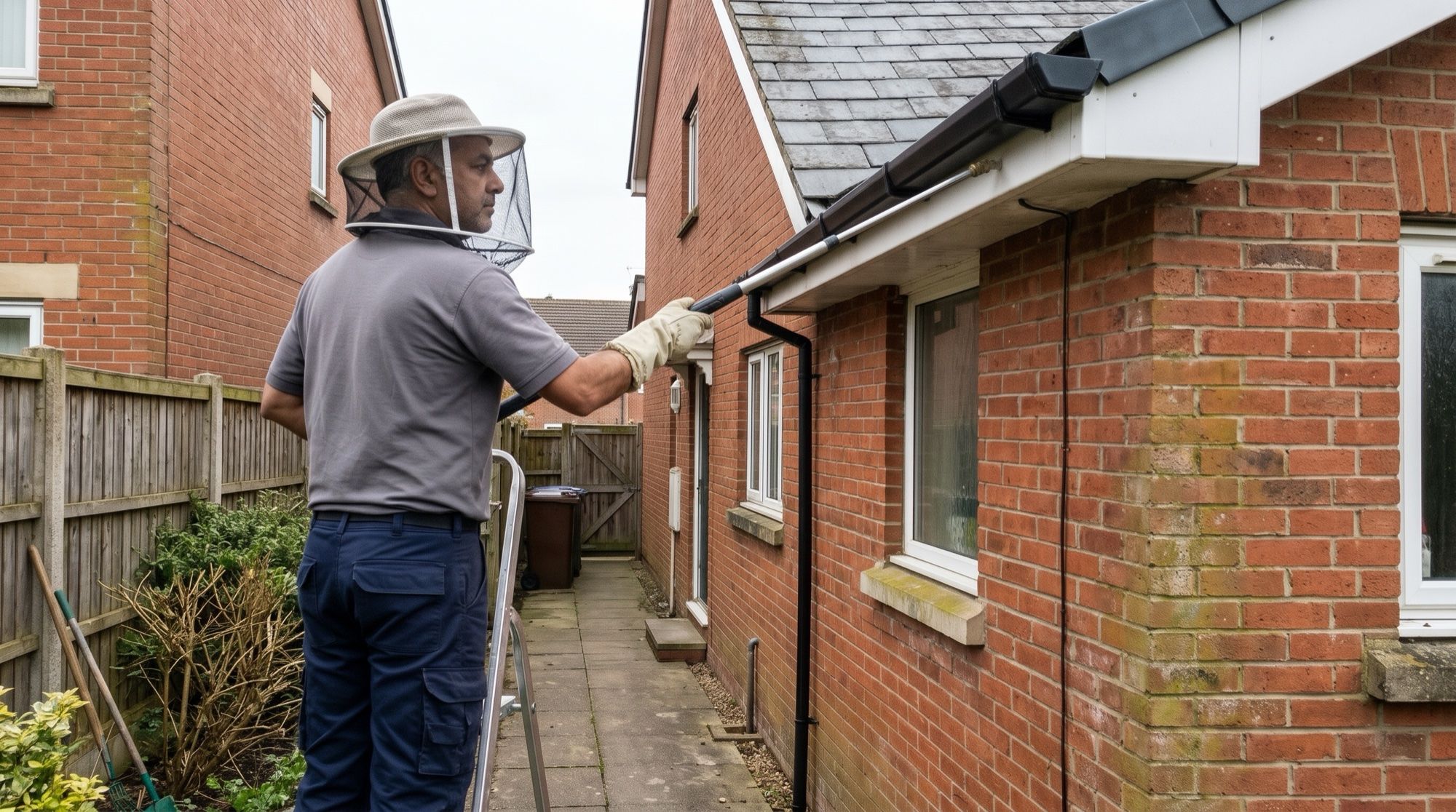
EnviroEx treats wasp nests on business premises, rented property and homes across Stockport, from town-centre bars and shops to Bredbury units and Edgeley terraces. We confirm it is wasps rather than bees, treat the nest entrance with a professional-use insecticide and leave safety advice and a job record. Ring us, or use the enquiry form, to book a prompt visit.
Where do wasps cause problems for Stockport businesses?
Food and drink trade feels it first. Market Place still has a working covered Market Hall, and Redrock brings bars and restaurants into the town centre. Late in the season, once a colony stops raising larvae, its workers go looking for sugar, and open drinks, fruit and waste bins become the target. A nest close to a doorway or outside seating then becomes a staff and customer safety matter rather than a nuisance.
Other premises have their own risks. Shopfront signs and canopies can hide hollow voids that suit a nest. Healthcare and care sites, Stepping Hill’s 778-bed district general hospital among them, serve people who may be frail or allergic, so a nest near an entrance needs prompt attention. In Bredbury, where colliery spoil was levelled for industrial development in the 1960s, units offer cladding joints, shutter boxes and canopy voids, and loading doors stay open for much of the day.
Why do wasps nest on Stockport buildings?
Each nest begins with a single queen in spring. She chews weathered wood into paper and wants a dry, hidden cavity close to food. Stockport supplies the raw materials. Nearly half the borough is green space, and its 14 local nature reserves take in Reddish Vale, Woodbank Park and Etherow Country Park, which means timber to strip and insects to feed the growing brood.
The building stock adds the cavities. Market Place has a dense cluster of listed buildings, several of them 18th- and 19th-century trading premises. Edgeley’s Victorian terraces cluster around Alexandra Park, while Heaton Moor’s Victorian houses went up between 1852 and 1892 along tree-lined streets, with infill continuing into Edwardian times. Slates, soffits and pointing on property of that age can give queens easy access. Newer homes, such as those made from Stockport College’s old Buckingham Road campus, are more often entered through vents and gaps around service pipes.
Colonies peak in August and September, and by late October most are failing as temperatures drop. An old nest is not reused, although new queens may well choose the same building the following spring.
What happens on a wasp visit to Stockport premises?
Identification comes first. Stockport Council’s service excludes bees and points people towards a beekeeper’s advice, and we do not treat bees either, so a photo of the insects at the entrance saves a wasted visit. If the picture points to an Asian hornet, log the sighting on the Asian Hornet Watch app and leave the nest undisturbed.
For wasps, the technician works back along the flight path to the entrance, which is not always beside the nest itself, and treats it with an insecticide dust or foam made for professional use. Wasps carry it into the nest as they come and go, so roofs and walls stay closed. On business premises we agree the visit time with the site manager, keep the area around the entrance clear until evening and leave a written job record. Activity normally drops within hours, and one visit is usually enough.
What should a business record?
A wasp nest on food premises is pest activity like any other, and an environmental health officer may expect to see it in your pest-management records: when it was found, where, what was applied, by whom and what followed. How we keep that file is set out on our food premises pest control page. Sites on a commercial pest control contract can have known nesting points looked at during spring visits, when any new nest is still small.
How do you stop wasps returning to the same building?
Proofing is best done over winter. Close gaps where soffits and fascias have pulled away, have loose slates refixed and open joints repointed, and put insect mesh over weep vents instead of filling them, since the cavity still needs to drain. On listed buildings, check whether consent is needed first. Where pigeons use the same ledges and roof edges, our bird control team can deal with both in one programme.
Wasps at home in Stockport
Householders have a choice. Check Stockport Council’s website for current pest control services and charges. A nest well away from doors and windows can often be left to die off by itself. One in a loft above a bedroom, beside a back door or in a busy garden is better treated, and our domestic pest control service normally handles it in one visit.
What we see with wasp nest removal in Stockport
- Edgeley's Victorian terraces around Alexandra Park and Heaton Moor's houses of 1852 to 1892 are old enough that slipped slates, loose soffits and open pointing can give queens a way in each spring.
- Green space makes up 45% of the borough, including 14 local nature reserves such as Reddish Vale and Etherow Country Park, which keeps colonies supplied with weathered timber for nest paper and insect prey for their larvae.
- Food and drink premises, from Redrock's bars and restaurants to any pub or café with outdoor tables, see the most foraging workers in late summer, when colonies turn to sugar.
How the job runs
- 1
Confirm the species
From your description or a photo, we check it is wasps rather than bees or an Asian hornet, which follow different routes.
- 2
Find the entrance
We trace the flight line to the point the wasps use, which may be some distance from the nest inside a cavity or roof void.
- 3
Treat at the entrance
A professional-use insecticide dust or foam goes directly into the entrance, using an extension lance from the ground where height allows.
- 4
Safety briefing and record
We explain what to expect over the next day, mark any area to keep clear and leave a job record suitable for a pest-management file.
- 5
Check the result
Activity normally falls within hours and stops within a day or two. If it does not, tell us and we will reassess the nest.
Typical visits: One visit treats most nests; a second is occasionally needed for very large, hard-to-reach or multiple nests.
Safety: Keep children, pets, staff and customers away from the treated entrance for the rest of the day, do not block the hole, and do not try to remove a nest while it is still active.
Wasp Nest Removal in Stockport: questions we get asked
Will Stockport Council treat a wasp nest, and when does a business need a private visit instead?
Many councils run a pest control service for residents, but what is covered, who can book and the charges all vary and can change, so check the council's own pest control pages before you book. If you rent, report the problem to your landlord first. If you would rather book a private firm, phone or use the enquiry form and we will arrange a survey.
There is a nest above our shop or pub entrance in Stockport. Can you treat it while we are open?
We would rather not. Treatment can stir the colony for a short time, so on trading premises we prefer to visit before opening, after close or in a quiet spell, and to keep the doorway or tables nearest the entrance out of use until the evening. If the entrance is high on an older frontage, we plan safe access with the building manager in line with the Work at Height Regulations 2005, treating from pavement level with an extension pole wherever it will reach.
We manage several rented properties around Stockport. Can one call cover nests at more than one address?
Yes. Give us each address and where the wasps are entering, and we will group visits where we can. Every property gets its own job record showing the nest location, the product used and any repair needed at the entry point, such as a gap at a soffit or a slipped slate. That record lets you show a tenant or letting agent that the report was dealt with and the cause addressed, and a spring roofline check can be added to your planned maintenance as part of our pest control for landlords service.
Our Bredbury unit has wasps around the loading bay. Is there a nest?
Very likely, if the traffic is steady and heads to one point. On industrial units that point is often a gap in cladding, a roller-shutter box, a gutter end or a void in a canopy. We trace the flight line, treat at the entrance and record the job for your file. If the colony is inside a shutter box, we may ask your team to keep that door closed for the rest of the day so drivers and warehouse staff are not caught by agitated wasps.
The nest is in the roof of a listed building near Market Place. Does that change anything?
The treatment itself usually does not, because the insecticide goes into the entrance and nothing has to be opened up. The difference comes afterwards. Repairs to the entry point on a listed building, such as repointing or refixing slates, may need listed building consent if they would affect its character, so we note the entry point in the job record and suggest you ask the council, as local planning authority, before the work is booked.
Can I get a wasp nest removed for free in Greater Manchester?
Usually not. Wasps are not generally treated as a public-health pest. Check your council's website for current pest control services and charges. Council and housing association tenants should ask their landlord first, as some include it. Otherwise private treatment is the route, and we will tell you plainly if the nest can safely be left alone.
Do you treat bees as well as wasps?
No. We do not treat honeybee or bumblebee nests. If your description or photo suggests bees, we will say so and point you to the right route: a local beekeeper for a honeybee swarm, usually found through the British Beekeepers Association, or patience for a bumblebee nest, which dies out naturally within the season. Tree bumblebees in bird boxes and soffits are a common mix-up in late spring and early summer, and their colonies are usually finished by mid-summer.
Can I leave a wasp nest until the winter?
Often, yes, if it is away from doors, windows, play areas and customer seating and nobody using the building has a sting allergy. Colonies die off in autumn and the old nest is not reused, so by late October most colonies are dying out or already gone. Leaving it is a poor choice when the nest is beside an entrance, inside a loft above bedrooms, or on trading premises, where staff and customer safety come first.
More in Stockport
Last updated: