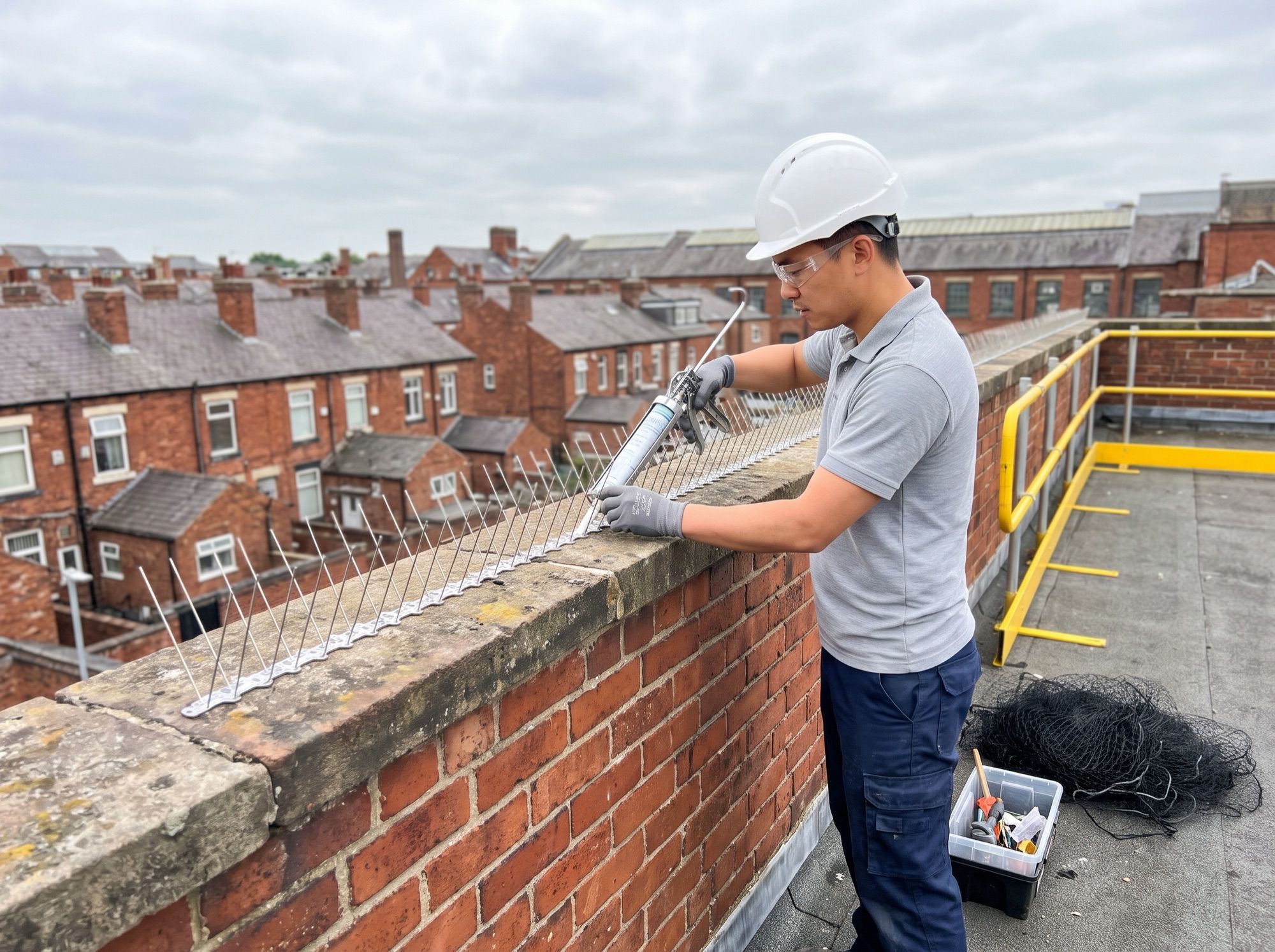
EnviroEx surveys and proofs Stockport buildings against pigeons and gulls, including listed premises around Market Place, town-centre retail units and industrial roofs in Bredbury. We check for active nests, specify netting, spikes, post-and-wire or gel for each area and fit it within wildlife law. Call or send an enquiry to arrange a prompt survey.
Where pigeons settle on Stockport buildings
The centre’s oldest commercial buildings are the first place to look. Market Place has been the core of the town since medieval times, and its listed buildings include several 18th- and 19th-century commercial premises, an age of building that typically brings cornices, deep window reveals, chimney stacks and signage brackets: good pigeon perches. The covered Market Hall, restored in 2008, still trades, and in any covered market a bird that gets inside can end up roosting above food for sale, so roof lights, vents and doors deserve a check.
Around the Merseyway Shopping Centre and The Peel Centre, the risk points tend to be modern ones: shopfront canopies, signage, service yards, roof plant and outdoor seating where people eat. Stockport Viaduct, a Grade II* listed structure of about 11 million bricks, carries the West Coast Main Line across the Mersey valley, and brickwork on that scale, along with the buildings close to it, offers plenty of ledges and recesses for a roost.
Newer schemes need attention too. Stockport Interchange, opened officially in March 2024 between Wellington Road and the viaduct, added a mixed-use residential and commercial building and a rooftop park, Viaduct Park. Balconies, canopies and public seating on new buildings are far easier to proof before birds have settled than after.
Gulls and large roofs in the east
Bredbury’s industrial land was levelled from colliery spoil in the 1960s, and industrial and trade units on land like this tend to have large roofs and loading canopies. Herring gulls and lesser black-backed gulls nest on flat roofs far from the sea and defend them noisily through spring and summer, while pigeons move into loading bays and onto racking just inside roller doors.
Because a gull nest that is in use or being built cannot lawfully be removed or destroyed without a licence, roof proofing is planned for the months when the roofs are empty.
Proofing historic and listed frontages
Listed buildings are not confined to Market Place. Staircase House, a Grade II* listed medieval townhouse that holds the Stockport Story Museum, and The Plaza, a Grade II* listed cinema and variety theatre built in 1932, are two of the town’s better-known examples.
On buildings like these the work is about restraint: systems that can come out later without leaving a mark, fixings kept off decorative faces, and fouling cleaned from stone and brick by methods that will not etch or stain it. Where consent may be needed, we build the time for it into the programme rather than fitting first and asking later.
How a Stockport bird job is planned
The survey records the species, how birds use each area, what fixings will go into, how we will reach the work and whether any nest is active, since the Wildlife and Countryside Act 1981 protects wild birds and nests in use. On busy shopping streets we usually install early in the morning or after closing, inside a cordoned zone, using a tower scaffold, a mobile elevating work platform or rope access as the building demands. Centre managers and landlords receive a risk assessment and method statement to approve beforehand.
Before any fixing goes in, we wet down the droppings, bag them as waste and disinfect the ledge. Most jobs take two visits, survey then installation, though an area with an active nest is left for a later visit once the birds have gone.
Homes, solar panels and rented roofs
Where a suburban house in Bramhall or Cheadle Hulme has rooftop solar panels, pigeons may nest in the dry gap beneath them; clip-on mesh around the edge of the array closes it without drilling into the roof or the panels. In older terraces, birds use gutters, chimney stacks and gaps under the eaves. For landlords, a blocked gutter or a nest in the roof can become a repair question under section 11 of the Landlord and Tenant Act 1985, so keep a record of what was found and fixed.
Keeping the proofing effective
Netting and wire need checking at set intervals and after any spell of high wind, because a loose fixing found early is a small repair. Around the town centre’s bin stores and beer gardens, closed lids and staff who do not feed birds make as much difference as the hardware.
Food sites gain most from treating birds and rodents together. A yard that feeds pigeons is usually feeding rats as well, so bird checks can be added to routine rodent visits and reported in the same file as your Food Hygiene Rating Scheme evidence.
What we see with bird control & proofing in Stockport
- Market Place holds a concentration of listed buildings, so proofing on historic shopfronts there is specified with discreet, reversible systems and fixings that may need listed building consent.
- Premises close to Stockport Viaduct stand beside one of the largest brick structures in the UK, and ledges facing brickwork on that scale are worth surveying for roosting pigeons.
- Bredbury's industrial units, on land levelled for industry in the 1960s, are surveyed for pigeons in loading bays and for gulls on roofs, with roof proofing timed outside the breeding season.
- New town-centre schemes such as the Interchange, opened in 2024 with a rooftop park and a residential and commercial building, are easiest to proof before birds have settled on them.
How the job runs
- 1
Survey and species check
We identify the species, how birds use each area, what the fixings will go into, how we will reach the work safely, and whether any nests are active or the building is listed.
- 2
Written proposal and method statement
You receive photographs, the system specified for each area, mesh sizes, access method and timing, with a risk assessment and method statement for your facilities team to approve.
- 3
Clearance and cleaning
Empty nests and fouling are removed, damped down and bagged, surfaces are disinfected, and we confirm no birds are inside any area that is about to be enclosed.
- 4
Installation
Netting, spikes, post-and-wire, gel, electric track or solar panel mesh is fitted to the agreed specification, timed around trading hours, deliveries or residents.
- 5
Handover and records
You get a record of what was installed and where, including the location of access zips and hatches in netting, plus the maintenance each system needs.
- 6
Inspection and upkeep
Netted areas and fixings are checked periodically and after storms, so a damaged panel is repaired before a bird gets in or becomes trapped.
Typical visits: Usually one survey visit and one installation visit. Large or phased sites, heavy fouling or an active nest that has to be left until it is empty can add visits, followed by periodic inspections.
Safety: Proofing excludes birds without harming them and uses no poisons. We check for live birds and active nests before enclosing an area, damp down and bag fouling rather than dry-sweeping it, and keep staff and the public out of the work zone.
Bird Control & Proofing in Stockport: questions we get asked
What bird proofing suits a listed shopfront around Market Place?
Usually the least visible system that does the job. Post-and-wire suits stone ledges and cornices, gel works on narrow mouldings, and low-profile spikes can sit behind parapets out of sight from the street. Fixings go into mortar joints rather than stone or brick faces, so they can come out later without damage. Because Market Place has a concentration of listed buildings, check with the council's planning team whether listed building consent is needed; our survey photographs and specification can support that conversation.
Pigeons roost on railway brickwork beside our building. What can you do?
We cannot fix anything to a structure you do not own, and the railway's own infrastructure is a matter for its owner. What we can do is make your building the less attractive option: proof the ledges, signage, canopies and roof plant that face the brickwork, net any light well or yard where birds drop down to feed, and clear and disinfect the fouling. We also record what we find, with photographs, so you have evidence if you raise the roost with the structure's owner.
When should a Bredbury warehouse have gull proofing fitted?
Between breeding seasons. Gulls usually return to nest sites in spring, and once a nest is being built or holds eggs or chicks it is protected, so work on that part of the roof has to wait. A survey in late autumn or winter lets us specify wire or netting for the roof areas gulls use, plan safe access and install while the roof is empty. Pigeon proofing in loading bays and canopies can usually go ahead at any time of year, after a check for active nests.
Our unit is in a managed shopping centre. Who arranges bird proofing?
Check your lease first. In many shopping centres and retail parks the landlord or managing agent controls the roof, frontage and service yards, and tenants are responsible only inside their unit. We can survey, write the specification and the risk assessment and method statement, then deal directly with centre management on permits, access times and contractor rules, scheduling installation before opening or after closing. If the proofing falls within your own demise, we agree the work with you and copy the records to the agent.
How can I get rid of pigeons legally?
Proof the places they roost and nest. The Wildlife and Countryside Act 1981 protects all wild birds, their eggs and any nest in use or being built, but excluding birds with netting, spikes, wire or gel is lawful as long as no bird is harmed or trapped and no active nest is destroyed. Lethal control of feral pigeons is possible under Natural England's general licence GL41 for specific public health and safety purposes, but removed birds are soon replaced while the building still offers a roost, so exclusion is the lasting answer.
Am I allowed to shoot pigeons in my own garden?
Only in narrow circumstances. General licence GL41 lets an owner or occupier act against feral pigeons only for the purposes it lists, such as preventing slips and falls or the spread of disease to people, and you must meet its conditions, including humane killing, as well as firearms law and basic safety. Shooting to stop pigeons eating bird seed or sitting on a fence is unlikely to fit those purposes, and in built-up parts of Greater Manchester it is rarely safe or practical. Proofing the roof, removing the food source and covering solar panels is the realistic route.
Can you remove a gull nest from our roof?
Not while it is in use, unless a licence is in place. Herring gulls and lesser black-backed gulls are not listed on Natural England's public health and safety general licence (GL41), so removing a nest that is being built or holds eggs or chicks normally needs an individual licence. Expect Natural England to ask for evidence of a genuine public health or safety risk and of the non-lethal options considered, so it is not a quick fix. Once the young have fledged and the nest is empty, it can be cleared. The lasting fix is to proof the roof between breeding seasons so gulls cannot nest there next spring.
More in Stockport
Last updated: