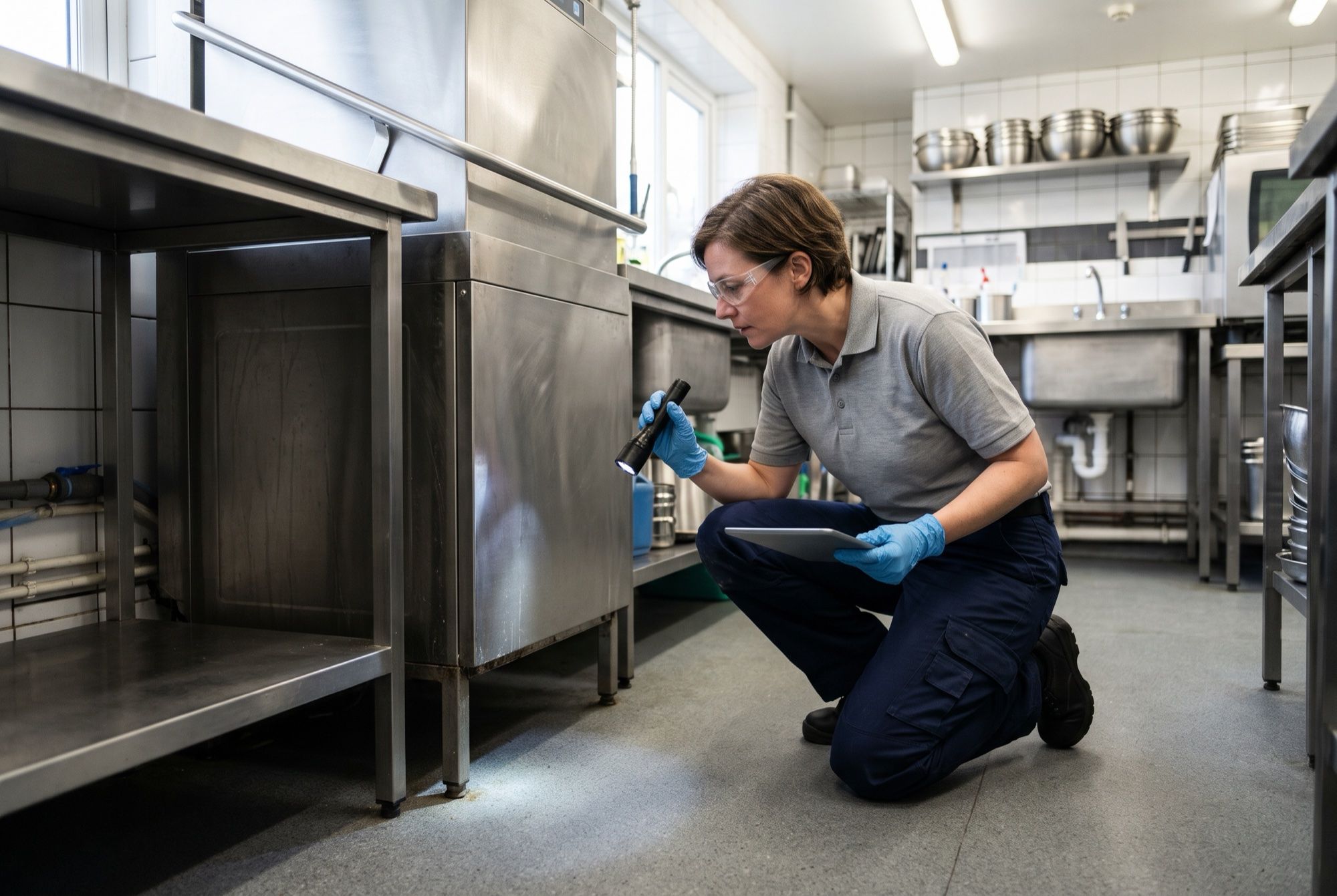
EnviroEx runs commercial pest control contracts and one-off treatments in Altrincham for town-centre shops, food businesses, offices, landlords and Broadheath retail units. We survey the site, set a visit schedule by risk, treat promptly and leave written reports ready for EHO or client audits. Phone or request a site survey to book.
Three kinds of commercial site in one town
Commercial pest control in Altrincham divides fairly neatly by location. Broadheath, laid out as an industrial district in 1885, is now a retail park on former industrial ground, with an Asda superstore in the district. The town centre keeps its market and takes in the Old Market Place, George Street and Stamford New Road conservation areas, along with other historic and listed structures. Then there are the regeneration sites: the Interchange, refurbished in 2015, and the Altair scheme on Oakfield Road, where building began in 2019.
Each setting brings a different pest pattern, and a contract that suits one will not fit the others.
Broadheath: retail on old industrial ground
Large retail sheds are straightforward to proof from the inside, but the ground beneath them is not. Drainage on former industrial land often includes runs and connections from earlier buildings, and rats exploit any break in them. Outside, service yards, waste compactors and pallets beside the dock doors give cover, and units near the Bridgewater Canal have water and vegetation within a short run of the building.
A typical Broadheath contract places tamper-resistant external stations along the yard and boundary lines, internal monitoring in stockrooms and goods-in, and checks on door seals and shutter bottoms at every visit. Stored-product insects are a risk wherever dry goods wait in a stockroom, and pigeons on canopy steelwork are a common finding, so our bird control service often works alongside the rodent programme on the same site plan.
Why do mice spread between town-centre businesses?
Historic town-centre buildings rarely stand alone. Cellars can run under neighbouring units, roof voids connect, and back yards may be shared by several businesses with different standards of waste storage. Mice exploit that structure easily, and a kitchen that does everything right can still find droppings because the source is two doors away.
Surveys here therefore cover the boundaries as much as the unit itself: party walls, service risers, floor voids under shop fittings and the routes to the yard. Offices above shops raise their own issues, with mice chewing cabling in floor voids and nesting in little-used storerooms. For restaurants, cafés and takeaways, our food premises pest control work adds the inspection-focused detail an environmental health officer expects, from proofing at wall and floor junctions to a sighting log that shows every report was acted on.
Are new units on regeneration schemes pest-proof?
Not automatically. New buildings can hand over with gaps around service penetrations, ducts and pipe boxing, open voids above suspended ceilings and doors without brush strips, and rats displaced by nearby groundworks will find them. For a business fitting out a unit in or near a scheme such as Altair, a pre-opening survey lets us list proofing for the shopfitter before ceilings close and set up monitoring from the first day of trading. Canopies and plant decks are easier to bird-proof at fit-out too.
How a contract runs here
A survey comes first, walked with the manager who knows the building, including yards, cellars and any space shared with other occupiers. The proposal sets out the pests covered, where each monitoring point goes, how many routine visits the risk justifies and what falls outside the contract. Town-centre visits are commonly booked before opening or after close, so routine work stays out of customers’ way.
Each routine visit ends with a written report against the numbered plan. Sightings between visits are logged and attended, and trends are reviewed with you so the frequency can come down as well as go up. Where the evidence points to the building fabric, such as a broken drain or gaps under a fire door, we either carry out the proofing or list it with photographs for the landlord.
Records, responsibilities and the lease
If you rent, tell your landlord or letting agent in writing, with photos and dates, and keep a copy. Pest problems that were there when you moved in, or that come from repairs the landlord should have made, are usually theirs to deal with, and a written record of each report helps if the problem drags on.
What we see with commercial pest control in Altrincham
- Broadheath's industrial district dates from 1885 and is now a retail park, and units on former factory land can sit over old drainage, so rats that keep returning there can point to a drain fault rather than poor housekeeping.
- The Bridgewater Canal has passed through Broadheath since the 1760s, so premises backing onto it need monitoring on the water side as well as around bin stores and doors.
- Where businesses near the market or in the Old Market Place, George Street and Stamford New Road conservation areas share walls, cellars or yards, one unit's mice can quickly become a problem for the whole row.
- A 2010 survey found close to a third of Altrincham's shops empty, and an unmonitored vacant unit beside occupied premises is one of the first things we ask about at survey.
- Town-centre regeneration, including the Altair development on Oakfield Road where building began in 2019, brings groundworks that can displace rats, so food sites nearby should step up checks while work runs.
How the job runs
- 1
Site survey and risk assessment
We walk the building inside and out, including bin stores, drains, voids, plant rooms and goods-in, and assess the pest risks your operation creates.
- 2
Written scope and site plan
You receive a proposal setting out pests covered, visit frequency, methods by area and exclusions, with a numbered site plan for your pest control file.
- 3
Initial treatment and proofing
Any active infestation is treated first. Entry points are proofed by us or listed with photographs for your maintenance team or landlord.
- 4
Routine inspections
Scheduled visits check every monitoring point and high-risk area, record findings and adjust the programme to what the evidence shows.
- 5
Reporting and review
Each visit produces a written report, and we review trends with you so the visit frequency and station layout stay proportionate to the risk.
Typical visits: A survey, then routine visits set by risk, commonly between four and twelve a year, plus reactive visits whenever activity is reported.
Safety: Wherever people or non-target animals could reach bait, rodenticide is used only in fixed, tamper-resistant stations in line with the product label and CRRU stewardship; insecticide work is timed to protect staff, customers and stock, and safety data sheets are supplied for your COSHH records.
Commercial Pest Control in Altrincham: questions we get asked
Rats keep returning to our Broadheath unit despite good housekeeping. Why?
Often because they are not coming from outside at all. Buildings on old industrial ground can sit over drains and connections that pre-date the current unit, and a cracked pipe or redundant branch lets rats surface under a floor or behind a wall. If baiting clears activity only for it to return, we recommend a CCTV drain survey, followed by repairs, sealing of redundant runs or a rat flap or non-return valve where the evidence points underground. Treatment continues meanwhile, recorded against the site plan.
The unit next to ours is empty. Can the council make its owner deal with pests?
Many councils run a pest control service for residents, but what is covered, who can book and the charges all vary and can change, so check the council's own pest control pages before you book. If you rent from a council or housing association, report the problem to your landlord first. If you would rather book a private firm, phone or use the enquiry form and we will arrange a survey.
Building work has started near our Altrincham premises. Should we change our pest control?
Usually, for as long as the works last. Excavation, demolition and drain diversions break into burrows and sewer connections, and rats pushed off a site look for the nearest building offering food and shelter. The town centre has seen large schemes such as Altair on Oakfield Road, so it is worth asking whenever a site near you is cleared or rebuilt. Ask us to add checks of external doors, bin stores and drain covers, and consider more frequent visits while groundworks continue. Keep a dated log of any activity, so that if a problem can be traced to the site you have evidence to share with the contractor or developer.
We run sites in Altrincham, Hale and Timperley. Can they share one contract?
Yes. Each site keeps its own survey, numbered site plan and visit frequency, set by its own risk, so a back office in Timperley is not visited as often as a kitchen in the town centre. The contract, reporting format and review meetings are shared, which makes it easier to compare sites and spot a problem that keeps recurring. Premises elsewhere in Greater Manchester, such as a warehouse on Trafford Park, can join the same arrangement.
What does a commercial pest control contract include?
A survey, a written scope and a numbered site plan, then routine inspections at the agreed frequency, checks of every monitoring point, treatment of the pests named in the contract and a written report after each visit. The scope also sets out how reactive callouts between routine visits are handled and what is excluded. Larger proofing works, drain repairs and pests not named in the contract are usually quoted separately, and we make that clear at the start rather than afterwards.
How many routine visits a year will our premises need?
It depends on risk rather than a standard package. We look at what you handle, how the building is put together, what surrounds it and any history of activity. Offices and dry retail commonly need fewer visits than kitchens, food stores or warehouses holding food, and audited sites may need more again, with periodic in-depth inspections. We set the frequency at survey, explain the reasoning in the proposal and review it as evidence builds up, so it can come down as well as go up.
What will an environmental health officer expect to see from our pest control?
Usually a pest control file that shows a working system: a site plan with numbered monitoring points, reports from each visit, records of sightings and what was done about them, product details and safety data sheets, and evidence that proofing or housekeeping recommendations were acted on. Officers also inspect the premises themselves, so a tidy folder will not cover gaps under doors or droppings behind equipment. We write our reports with that inspection in mind.
More in Altrincham
Last updated: