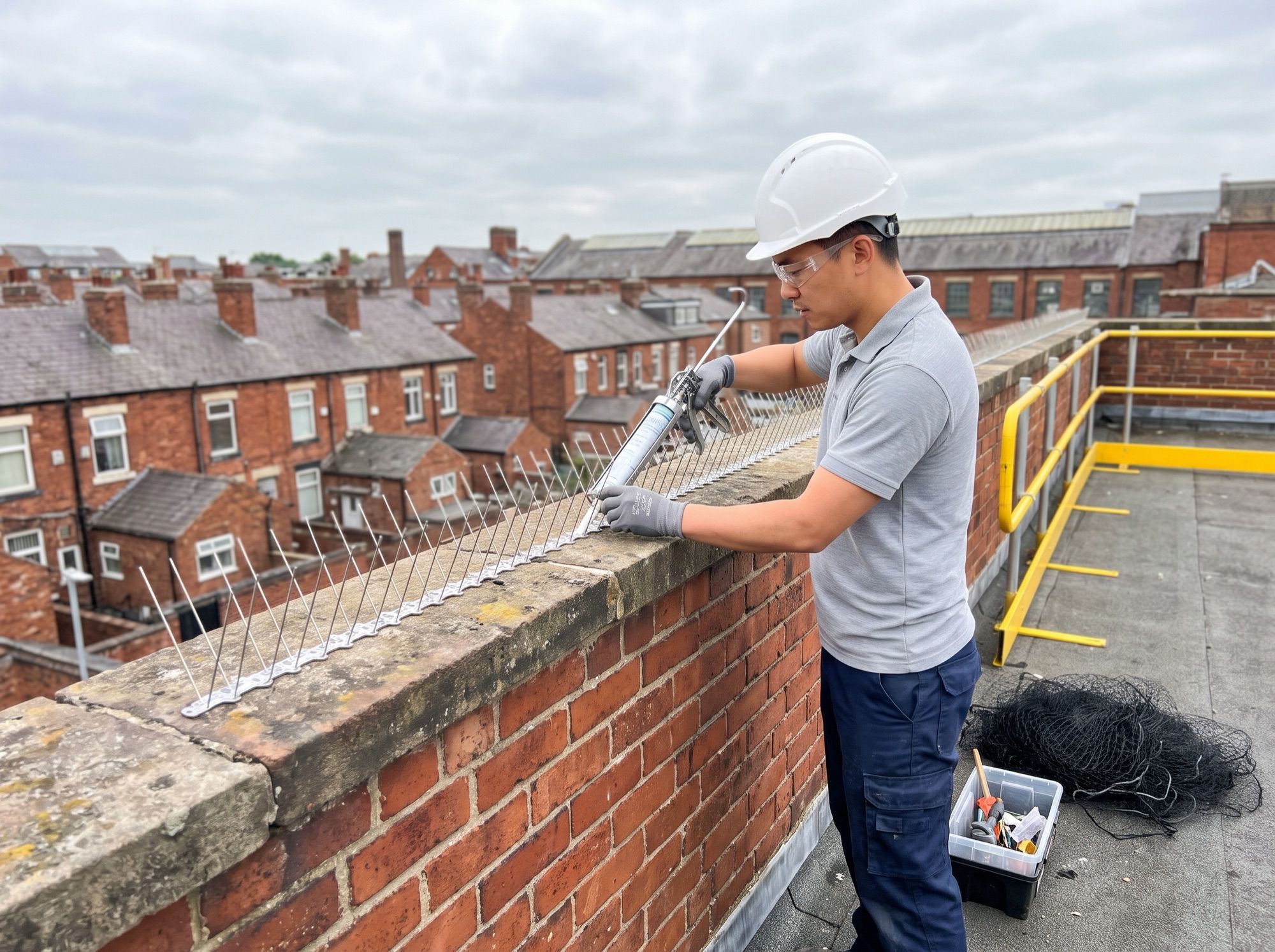
EnviroEx fits bird proofing in Altrincham, from town-centre frontages in the Old Market Place and George Street conservation areas to Broadheath retail units and homes in Hale, Bowdon and Timperley. We survey first, check for active nests, then fit netting, wire, spikes or gel to suit each ledge. Surveys are arranged promptly; phone or send an enquiry to book.
Why do pigeons settle on Altrincham’s town centre?
Feral pigeons need three things: a ledge out of the wind, food within easy reach and a quiet corner to nest. The centre of Altrincham offers each of them. The market still trades, shops and food businesses leave scraps behind, and the Interchange keeps people moving between trains, trams and buses with food in hand. The town centre takes in the Old Market Place, George Street and Stamford New Road conservation areas, where planning controls tend to keep features such as cornices, sills and chimney stacks that pigeons use as perches.
Because feral pigeons can breed in every month of the year, a building with open nest sites does not get a winter break. A pair that raises young on a sheltered sill this spring will often be joined by their offspring on the same frontage, and the fouling below grows with them.
What do we usually find on town-centre buildings?
Surveys of town-centre premises tend to turn up the same handful of problems:
- droppings streaking down from sills and cornices onto shop signs and doorways;
- nest material packed into parapet gutters and roof valleys, which then overflow into the building;
- upper floors that are empty or used only for storage, where a broken pane or open vent lets birds inside;
- pigeons sitting on projecting signs and lamps directly above the entrance customers use.
The last point matters most to retailers and food businesses, because fouling at the door is the first thing a customer, or an environmental health officer, sees.
Broadheath retail units and the canal side
Broadheath is a different setting. The old industrial district is now a retail park, with an Asda superstore in the area too. Retail park units are typically large sheds with canopies, signage boxes, roof edges and loading areas; pigeons roost on the canopy steelwork and drop down to whatever is spilled in car parks and around trolley bays. The Bridgewater Canal also passes through Broadheath, offering open water close by.
On these sites the work is usually netting across canopy frames and loading bays, spikes or wire on signage and roof edges, and bird curtains on doors that stay open for deliveries. Retail and trade operators with units on Trafford Park as well can have both specified to the same standard, and the proofing can be checked at routine visits under a commercial pest control contract.
Proofing within conservation-area and listed-building rules
Conservation-area status on its own does not usually stop small, reversible fixings, but listed buildings are another matter: works that affect their character generally need listed building consent from the local planning authority. We plan fixings so they go into mortar joints rather than carved stone where possible, use clear or colour-matched components, and choose post-and-wire or gel where spikes would spoil a frontage. Each proposal includes photographs marked with every fixing point, ready for a planning conversation if one is needed.
Homes from the commuter era
Altrincham grew as a residential area in the 19th century, and after the railway arrived in 1849 it became a home for professionals and industrialists working in Manchester. Many houses of that era, and plenty built since, have tall stacks, dormers and valleys where pigeons sit out of the weather. Solar panels added to these roofs create a dry gap that birds quickly occupy. A typical domestic job in Hale, Bowdon or Timperley combines chimney and ridge proofing with a solar panel skirt, fitted once any active nest has finished.
Keeping birds away once the work is finished
Proofing removes the ledge; housekeeping removes the reason to come back. Keep bins lidded and yards swept, especially behind food businesses near the market, and ask staff not to feed birds at break times. Check netting and wire after storms, because one loose panel can let a pigeon in and trap it. Food businesses should file the survey, specification and inspection notes alongside their food premises pest control records, so the next inspector can see that birds are managed as part of the wider pest plan.
What we see with bird control & proofing in Altrincham
- In the Old Market Place, George Street and Stamford New Road conservation areas, frontages usually suit low-visibility post-and-wire and gel, and fixings into a listed building may need listed building consent before work starts.
- On retail park units like those at Broadheath, the usual roosts are canopy frames, signage and roof edges above entrances and loading areas, where fouling lands on customers, trolleys and deliveries.
- Altrincham Interchange is the town's rail, tram and bus hub, and buildings near a transport hub often see pigeons loafing on their ledges between feeds on dropped food.
- Empty units and unused upper floors can give pigeons a broken pane or open void to nest in unnoticed, which is worth checking in a town where a 2010 survey found close to a third of shops vacant.
- Altrincham grew as a commuter town after the railway arrived in 1849, and on roofs of that era the usual trouble spots are chimney stacks, valley gutters and solar panels added later.
How the job runs
- 1
Survey and species check
We identify the species, how birds use each area, what the fixings will go into, how we will reach the work safely, and whether any nests are active or the building is listed.
- 2
Written proposal and method statement
You receive photographs, the system specified for each area, mesh sizes, access method and timing, with a risk assessment and method statement for your facilities team to approve.
- 3
Clearance and cleaning
Empty nests and fouling are removed, damped down and bagged, surfaces are disinfected, and we confirm no birds are inside any area that is about to be enclosed.
- 4
Installation
Netting, spikes, post-and-wire, gel, electric track or solar panel mesh is fitted to the agreed specification, timed around trading hours, deliveries or residents.
- 5
Handover and records
You get a record of what was installed and where, including the location of access zips and hatches in netting, plus the maintenance each system needs.
- 6
Inspection and upkeep
Netted areas and fixings are checked periodically and after storms, so a damaged panel is repaired before a bird gets in or becomes trapped.
Typical visits: Usually one survey visit and one installation visit. Large or phased sites, heavy fouling or an active nest that has to be left until it is empty can add visits, followed by periodic inspections.
Safety: Proofing excludes birds without harming them and uses no poisons. We check for live birds and active nests before enclosing an area, damp down and bag fouling rather than dry-sweeping it, and keep staff and the public out of the work zone.
Bird Control & Proofing in Altrincham: questions we get asked
Pigeons are nesting in an empty flat above our town-centre shop. What can be done?
Start with whoever controls the empty space, usually your landlord or the owner of the upper floor, because we need their access and agreement to work inside. We check for eggs or chicks first. Nests in use are protected under the Wildlife and Countryside Act 1981, and general licence GL41 allows feral pigeon nests to be removed only for specific public health or safety reasons and under its conditions, so in most cases that area waits until the nest is no longer in use. Birds inside are allowed to leave, fouling and nest debris are cleared with respiratory protection, and broken panes, vents and gaps are closed with mesh or boarding.
Do you proof houses in Hale, Bowdon and Timperley?
Yes. Larger and older houses often have tall chimney stacks, roof valleys, dormers and decorative bargeboards, each of which gives a pigeon a sheltered spot to sit or nest. Typical work is spikes or post-and-wire on chimney ledges and ridges, mesh behind gutters and around dormer cheeks, and a mesh skirt where solar panels have been fitted. Bowdon is one of Altrincham's conservation areas, so there we lean towards low-visibility fixings. We reach the work by ladder, tower scaffold or a small platform depending on height, and check for active nests before anything is enclosed.
We run a food business near Altrincham market. Will an inspector care about pigeons outside?
Potentially. An environmental health officer looks at whether pests could reach food, and birds count. Pigeons perching over a back door that stands open in warm weather, fouling a delivery area or getting into a store room would all be noted, and droppings at an entrance raise questions about cleaning. Log what you see, keep doors closed or screened, and ask for a survey of the ledges and canopies involved. Our report and photographs can go straight into your pest-management records.
We are fitting out a unit in one of the town's new schemes. When should bird proofing be planned?
Before the shopfitters finish, if you can. Mixed schemes such as the Altair development on Oakfield Road, planned to link to the Interchange, combine homes, shops and places to eat with new public space, and canopies, plant decks and signage on buildings like these give pigeons new perches. Ask the developer or managing agent what proofing the base build includes, because leases often reserve the exterior to the landlord. We can then survey the frontage and any terrace or service area and specify netting, wire or spikes to match the finish, with access points left for maintenance.
How can I get rid of pigeons legally?
Proof the places they roost and nest. The Wildlife and Countryside Act 1981 protects all wild birds, their eggs and any nest in use or being built, but excluding birds with netting, spikes, wire or gel is lawful as long as no bird is harmed or trapped and no active nest is destroyed. Lethal control of feral pigeons is possible under Natural England's general licence GL41 for specific public health and safety purposes, but removed birds are soon replaced while the building still offers a roost, so exclusion is the lasting answer.
Am I allowed to shoot pigeons in my own garden?
Only in narrow circumstances. General licence GL41 lets an owner or occupier act against feral pigeons only for the purposes it lists, such as preventing slips and falls or the spread of disease to people, and you must meet its conditions, including humane killing, as well as firearms law and basic safety. Shooting to stop pigeons eating bird seed or sitting on a fence is unlikely to fit those purposes, and in built-up parts of Greater Manchester it is rarely safe or practical. Proofing the roof, removing the food source and covering solar panels is the realistic route.
Can you remove a gull nest from our roof?
Not while it is in use, unless a licence is in place. Herring gulls and lesser black-backed gulls are not listed on Natural England's public health and safety general licence (GL41), so removing a nest that is being built or holds eggs or chicks normally needs an individual licence. Expect Natural England to ask for evidence of a genuine public health or safety risk and of the non-lethal options considered, so it is not a quick fix. Once the young have fledged and the nest is empty, it can be cleared. The lasting fix is to proof the roof between breeding seasons so gulls cannot nest there next spring.
More in Altrincham
Last updated: