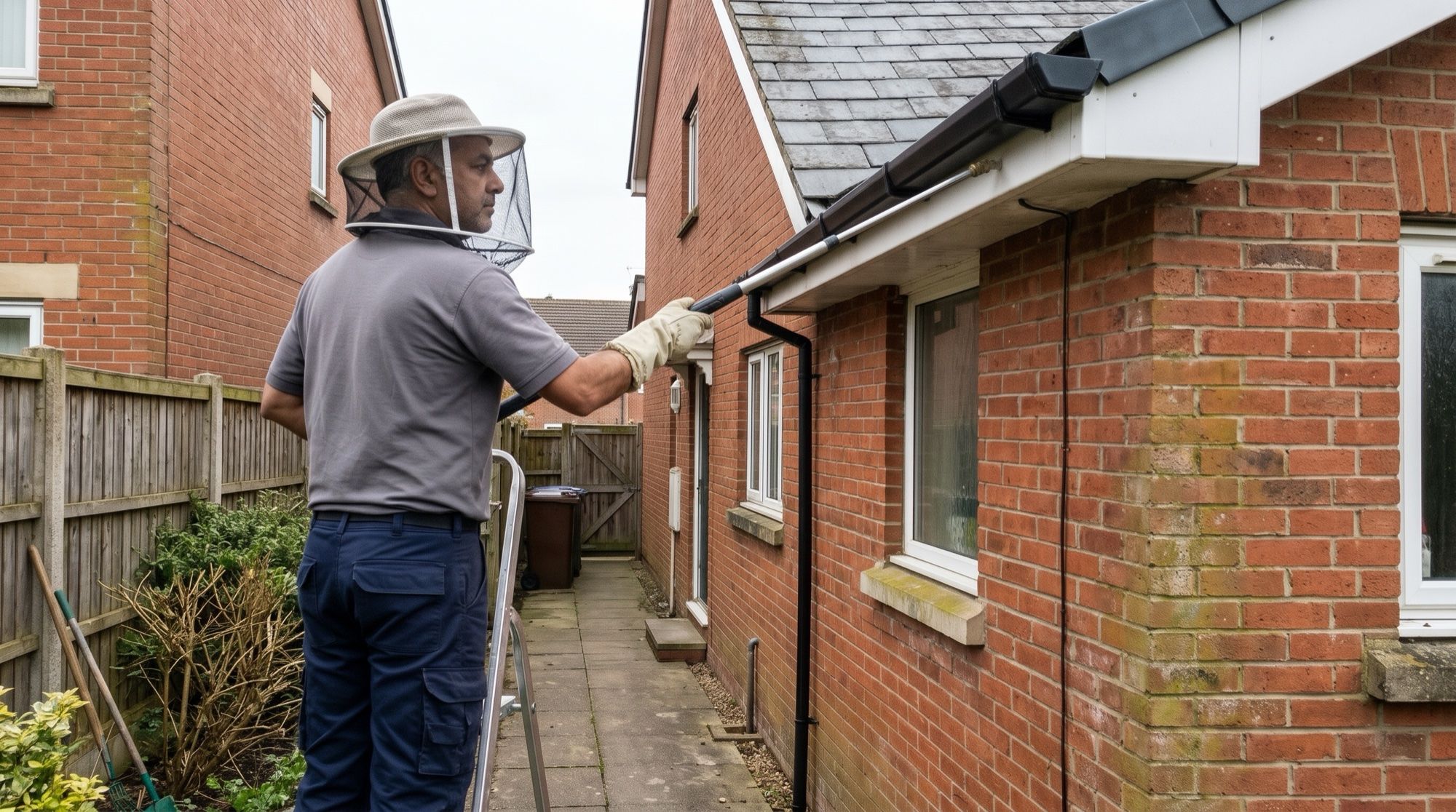
EnviroEx treats wasp nests for Altrincham businesses and households, from town-centre shops and offices to units on the Broadheath retail park and homes in Bowdon, Hale and Timperley. We confirm the species, treat the nest entrance and leave a written record. Visits are arranged promptly, around trading hours. Call or send an enquiry to book.
Why do Altrincham’s business premises attract wasps?
In spring a queen looks for a dry, enclosed void with a small way in. Altrincham’s commercial property offers three different versions of that.
The first is the historic town centre. The Old Market Place, George Street and Stamford New Road are conservation areas, and older commercial buildings of this kind typically carry timber fascias, sign boxes, parapet gutters and rear flat-roof extensions added over the years. Any joint that has opened up is a possible entrance, and businesses with tables outside feel the late-season effect when foraging workers turn to sugar.
The second is Broadheath, where the Bridgewater Canal passes through. The industrial area founded there in 1885 is now largely retail park and supermarket trading. On large retail and trade units we typically look where profile cladding meets the eaves, at roller-shutter housings, loading-bay canopies and bin compounds.
The third is newer development, such as the Altair mixed scheme on Oakfield Road, where construction started in 2019. Modern buildings are tighter, but a cladding joint or service penetration can still give a queen access to a hidden cavity. The first sign is often wasps in a stairwell, riser or plant room.
What do we typically find on Altrincham commercial sites?
On a town-centre frontage, the nest is most often behind a fascia or sign box, under failed flashing on a rear extension, or above a shop ceiling with its entrance at roof level. Offices above shops often see wasps indoors before anyone spots the flight line outside. On retail and industrial units the entrance tends to be high, at the eaves or ridge, and a large building can hold more than one colony, so we check every elevation rather than stopping at the first nest.
How does a wasp treatment run on Altrincham premises?
The method is our standard wasp nest removal process: confirm from a photo that it is wasps, find the entrance, treat into it with a professional insecticide dust or foam, then brief whoever is on site. What changes from site to site is the planning around it.
For shops and food businesses, we agree a time that keeps customers away from the entrance while the wasps are unsettled. On conservation-area and older buildings, we treat through the existing gap and do not drill into, fix to or open up the frontage. Where an entrance is beyond lance reach, we plan safe access at height and agree it with the landlord or managing agent of a multi-let building.
What should a business keep on file after the visit?
Every commercial visit ends with a written record: date, nest location, product used, technician and any follow-up. For a restaurant or café, it belongs in the pest-management section of your HACCP-based food safety records, which an environmental health officer may ask to see at inspection. For an office or shop, it shows the hazard to staff and visitors was identified and dealt with. On a commercial pest control contract, the nest is logged in the site file alongside routine visits; our food premises pest control page explains how that file is best kept.
Can wasp work be combined with bird proofing?
Often, yes. On older frontages, the ledges and sign boxes pigeons use often hide open joints that queens use too. When we survey a building for bird control, we record old wasp entry points so they can be sealed in the same programme of work. Winter suits that work, because wasp nests are dead and most wild birds are not nesting, although feral pigeons can breed all year. Before sealing any gap or treating a nest in a bird box or roof space, we check for active bird nests, because the Wildlife and Countryside Act 1981 generally protects a wild bird’s nest from damage or destruction while it is in use or being built.
What about homes in Bowdon, Hale, Timperley and Broadheath?
Altrincham grew as a commuter town after the railway arrived in 1849, and houses of that period commonly have slate roofs, timber soffits and loft spaces that suit a nest. Near its Broadheath factory, the Linotype company built 172 homes for its workers, and that estate is now a conservation area.
What should Altrincham premises do before next spring?
In late October most colonies are in decline or already dead, and an old nest is not reused. Mated queens are now hibernating in sheds, lofts and similar shelter, and each will look for a new site in spring, sometimes on the same building if the gaps are still open.
For businesses, move the entry points from this year’s job record onto the winter maintenance schedule: reseal fascia and sign-box gaps, replace perished eaves fillers on cladding, repair flat-roof flashings and make sure bin-store lids close. Kitchens with opening windows benefit from fitted insect screens. Then book a check in April or May, when a founding nest is about golf-ball size and easy to deal with.
What we see with wasp nest removal in Altrincham
- Historic buildings in the town centre's Old Market Place, George Street and Stamford New Road conservation areas commonly hide nests behind fascias, sign boxes and parapet gutters, so we treat through the gap the wasps already use rather than drilling into old fabric.
- Broadheath's industrial area, founded in 1885, is now mainly retail park, and on large retail and trade units the nest entrance is typically high up, at eaves fillers, roller-shutter housings or canopy edges, with foraging workers drawn to bin compounds late in the season.
- The Altair mixed development on Oakfield Road, where construction began in 2019, is part of the town centre's newer building stock, where a cladding joint or service penetration can give a queen a hidden cavity and the nest often goes unnoticed until wasps appear indoors.
- Altrincham grew as a commuter town after the railway arrived in 1849, and houses of that period commonly have slate roofs, timber soffits and loft spaces where queens settle in spring.
How the job runs
- 1
Confirm the species
From your description or a photo, we check it is wasps rather than bees or an Asian hornet, which follow different routes.
- 2
Find the entrance
We trace the flight line to the point the wasps use, which may be some distance from the nest inside a cavity or roof void.
- 3
Treat at the entrance
A professional-use insecticide dust or foam goes directly into the entrance, using an extension lance from the ground where height allows.
- 4
Safety briefing and record
We explain what to expect over the next day, mark any area to keep clear and leave a job record suitable for a pest-management file.
- 5
Check the result
Activity normally falls within hours and stops within a day or two. If it does not, tell us and we will reassess the nest.
Typical visits: One visit treats most nests; a second is occasionally needed for very large, hard-to-reach or multiple nests.
Safety: Keep children, pets, staff and customers away from the treated entrance for the rest of the day, do not block the hole, and do not try to remove a nest while it is still active.
Wasp Nest Removal in Altrincham: questions we get asked
Can you treat a wasp nest on a town-centre conservation-area building without damaging it?
Many councils run a pest control service for residents, but what is covered, who can book and the charges all vary and can change, so check the council's own pest control pages before you book. If you rent from a council or housing association, report the problem to your landlord first. If you would rather book a private firm, phone or use the enquiry form and we will arrange a survey.
We run a restaurant in Altrincham town centre. Can the visit happen outside trading hours?
Usually, yes. We agree a time with you, often before opening or after the last service, so diners and staff are not near the entrance while the wasps are disturbed. If outside tables are close to the nest, we will advise on closing them for the rest of that day. Inside the building, treatment stays well away from food preparation areas and food-contact surfaces.
We manage several units at Broadheath. Can you deal with nests across the whole site in one visit?
Yes, where access allows. We walk the whole site, including roof edges, loading bays and bin compounds, treat every active entrance we find and mark each one on the record, so tenants and the landlord can see what was done and where. Large buildings sometimes hold more than one colony, and a site-wide check avoids treating one nest and missing another. The entry points can then go onto the winter maintenance list.
Wasps keep appearing inside our Altrincham office. Does that mean the nest is inside the building?
Not always. Late in the season, foraging workers drift in through open windows looking for sugar. If they keep turning up in the same room or stairwell, especially around a ceiling light, vent or roof light, a nest in the roof void or a cavity above is more likely. We trace where they are coming from inside and out, treat the nest at its outside entrance and advise on keeping that area clear until activity stops.
We lease a unit in a multi-let Altrincham building. Is the wasp nest our job or the landlord's?
It depends on the lease. In many multi-let buildings the landlord or managing agent looks after the roof and external walls and recovers the cost through the service charge, while a full repairing lease can put more of that on the tenant. If the nest is in a common part, such as a shared roof void, the managing agent usually has to arrange access. Either side can book the visit, and we can send the job record and entry point to both so the repair is not left in between.
Can I get a wasp nest removed for free in Greater Manchester?
Usually not. Wasps are not generally treated as a public-health pest. Check your council's website for current pest control services and charges. Council and housing association tenants should ask their landlord first, as some include it. Otherwise private treatment is the route, and we will tell you plainly if the nest can safely be left alone.
Do you treat bees as well as wasps?
No. We do not treat honeybee or bumblebee nests. If your description or photo suggests bees, we will say so and point you to the right route: a local beekeeper for a honeybee swarm, usually found through the British Beekeepers Association, or patience for a bumblebee nest, which dies out naturally within the season. Tree bumblebees in bird boxes and soffits are a common mix-up in late spring and early summer, and their colonies are usually finished by mid-summer.
Can I leave a wasp nest until the winter?
Often, yes, if it is away from doors, windows, play areas and customer seating and nobody using the building has a sting allergy. Colonies die off in autumn and the old nest is not reused, so by late October most colonies are dying out or already gone. Leaving it is a poor choice when the nest is beside an entrance, inside a loft above bedrooms, or on trading premises, where staff and customer safety come first.
More in Altrincham
Last updated: