EnviroEx provides commercial and domestic pest control in Altrincham, including the town centre, Broadheath, Hale and Bowdon. We deal with rats, mice, insects and wasps, proof buildings against pigeons, and give businesses and landlords a written record after each visit. Surveys are arranged promptly; phone or use the enquiry form to book.
Broadheath: canal warehouses, factories and retail sheds
Broadheath shows Altrincham’s commercial history in layers. Warehouses stood beside the Bridgewater Canal here by 1767, two years after the canal reached the town. In 1885 around 250 acres were laid out as an industrial district, drawing firms such as Linotype and the Budenberg Gauge Company, and 14 companies were operating there by 1914. Most of that manufacturing has since closed or moved away. Broadheath is now a retail park, with an Asda superstore in the district too.
That history matters below ground as much as above it. Modern units on former industrial land can sit over a patchwork of old drainage, and a disused or broken connection gives rats a way into a building that never shows on the surface. Add service yards, waste compactors, pallets waiting by roller doors and, for sites near the canal, water and overgrown margins close by, and a familiar pattern follows: rodent activity at the perimeter, pigeons on canopies and flat roofs, and stored-product insects wherever goods sit too long.
Our commercial pest control contracts on sites like these usually start with external monitoring along yards and boundaries, a look at drain runs where activity keeps returning, and proofing of doors and shutters. Every station goes on a numbered site plan, so a store manager or auditor can match each report to a location. Operators who also run units on Trafford Park can keep both sites on the same reporting format.
Why do mice move between town-centre units?
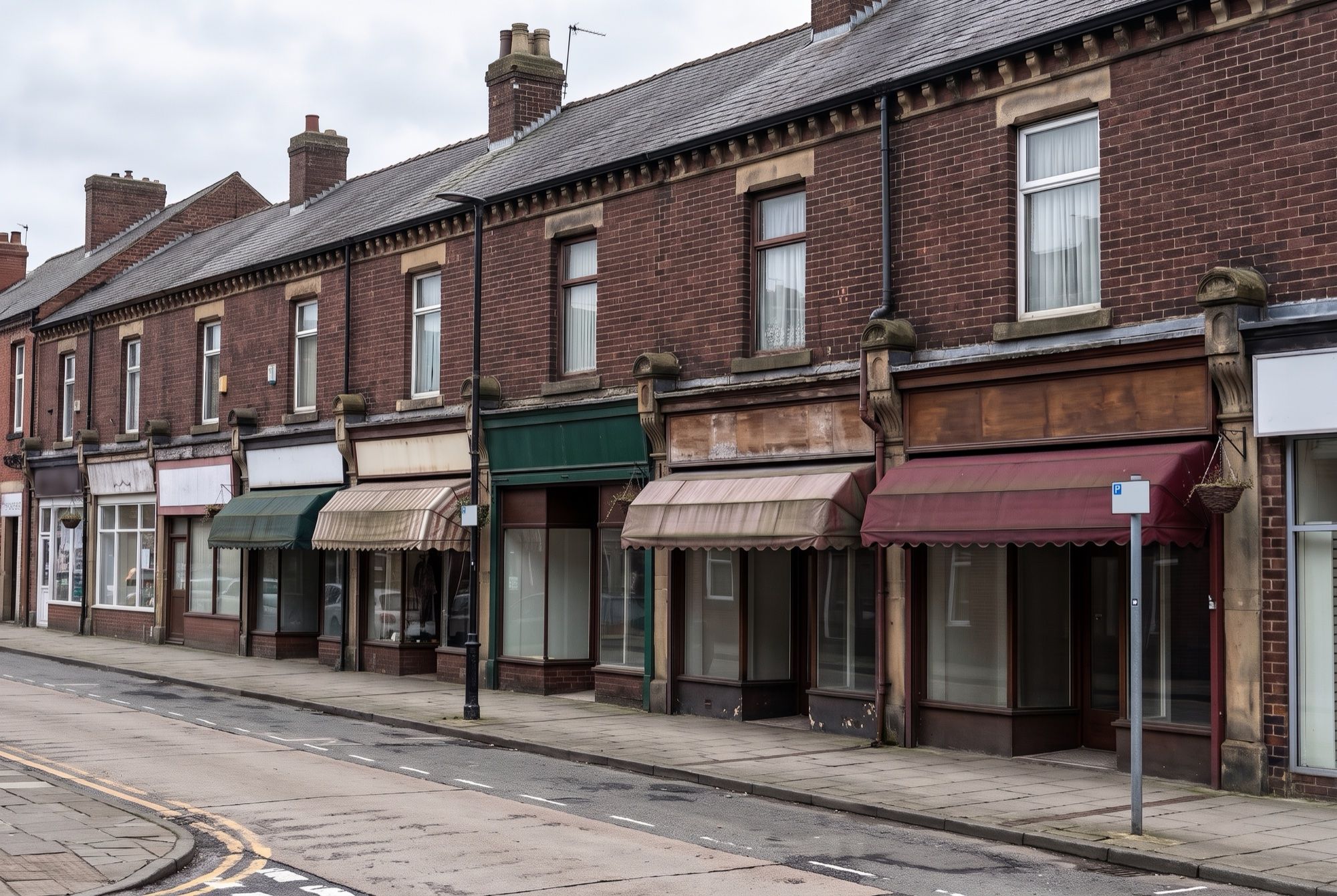
Altrincham still holds its market, and its town centre takes in the Old Market Place, George Street and Stamford New Road conservation areas along with other historic and listed structures. Older buildings of this kind were rarely designed with pest exclusion in mind. Where shops, cafés and offices share cellars, party walls, roof voids or back yards, mice can travel between units without ever crossing a shop floor.
That is why a spotless kitchen can still find droppings behind the fridge, and why our surveys ask who occupies the units either side and what sits above. For cafés, restaurants and takeaways, our food premises pest control work centres on what an environmental health officer is likely to examine: proofing at floor and wall junctions, a dated sighting log, and visit reports showing that each finding led to action. Under the Food Hygiene Rating Scheme, proofing and cleanliness count towards the structural score, while records showing that problems were acted on support the confidence-in-management score.
What does an empty unit next door mean for your business?
Town-centre retail declined as the Trafford Centre and a regenerated Manchester city centre drew trade away, and a 2010 survey found close to a third of the town’s shops vacant. Whatever the picture on a given street today, the risk from an empty neighbour is the same. A unit nobody visits gives mice an undisturbed nest site and pigeons an unused sill or broken upper window, and the problem then spreads to whoever trades next door.
Landlords and agents holding empty units should arrange periodic checks, keep doors and air bricks proofed and clear post and rubbish promptly. Tenants beside a vacant unit should log what they see and report it in writing, because responsibility for a shared wall or void is normally set out in the lease. Under the Prevention of Damage by Pests Act 1949, the local authority can require an owner or occupier to deal with rats or mice on their land.
Bird proofing on historic frontages and new schemes
Feral pigeons roost and breed on whatever a frontage offers, and historic buildings often carry cornices, string courses and deep sills. Where a building in the Old Market Place, George Street or Stamford New Road conservation areas needs proofing, our bird control surveys favour systems that are hard to see from the pavement: post-and-wire on ledges, gel on narrow mouldings and netting matched to the colour of the building. Fixing into the fabric of a listed building may need listed building consent, so every proposal photographs each fixing point.
Newer buildings bring a different brief. Altrincham Interchange, the town’s hub for trains, trams and buses, was refurbished in 2015, and building work on the Altair mixed development on Oakfield Road began in 2019, with a planned link to the Interchange. Canopies, plant decks and public space on schemes of this kind give pigeons perches above people eating and waiting, and proofing is far easier to design in before a flock settles than to retrofit afterwards.
Why do the canal and Timperley Brook matter for rat control?
Beyond the canal through Broadheath and past Oldfield Brow, the Environment Agency keeps a flood warning area for Timperley Brook at Altrincham. It runs from Green Lane to Woodlands Road and Canal Road, taking in areas around Woodlands Parkway and Deansgate Lane. Within five miles, river gauges also track the Bollin, Sinderland Brook, Baguley Brook and the Mersey.
Banks, culverts and overgrown margins give rats cover and an easy route between gardens and the backs of buildings, and heavy rain floods low burrows and pushes animals towards sheds, decking, drains and bin stores. Our rodent control work near these watercourses starts with drains and entry points rather than bait, follows CRRU stewardship guidance on rodenticide use, and keeps any bait inside tamper-resistant stations where children, pets or wildlife could otherwise reach it.
Homes: commuter-era houses and the Linotype estate
Altrincham grew as a residential area in the 19th century, and after the first train left the town in July 1849 it became a sought-after address for professionals and industrialists working in Manchester. Houses of that era commonly have deep roof voids, chimney breasts, suspended timber floors and air bricks, which give mice routes between rooms and next door, and lofts that wasp queens use each spring.
Near its Broadheath factory, Linotype built 172 homes for its workers, and the estate is now a conservation area, so external proofing there should respect the original detailing. Domestic visits across the town follow the same survey-first approach as our commercial work, with wasp nest removal, mouse proofing and pigeon proofing around chimneys and solar panels among the usual jobs. Landlords receive dated reports they can use to show a tenant’s complaint was dealt with, which matters under the Homes (Fitness for Human Habitation) Act 2018.
Local context that shapes pest problems in Altrincham
- The Bridgewater Canal was connected to Altrincham in 1765, warehouses had been built beside it at Broadheath by 1767, and it still passes through Broadheath and alongside Oldfield Brow. [Wikipedia, Altrincham]
- Broadheath's industrial area of about 250 acres was founded in 1885 and drew firms including the Linotype and Machinery Company and the Budenberg Gauge Company, with 14 companies working there by 1914. [Wikipedia, Altrincham]
- The former industrial area of Broadheath is now a retail park. An Asda superstore also trades in Broadheath, and Tesco, Sainsbury's and Marks & Spencer are among the town's other retailers. [Wikipedia, Altrincham]
- Competition from the Trafford Centre and a regenerated Manchester city centre hit town-centre trade, and a 2010 survey found close to a third of Altrincham's shops standing empty. [Wikipedia, Altrincham]
- The town centre keeps its market and includes the Old Market Place, George Street and Stamford New Road conservation areas, along with a Grade II listed clock outside the transport interchange. [Wikipedia, Altrincham]
- Building work on Altair, a large mixed development on Oakfield Road, started in September 2019, and the scheme is planned to link to Altrincham Interchange, the rail, tram and bus hub refurbished in 2015. [Wikipedia, Altrincham]
- After the first train left Altrincham in July 1849, the town and its surroundings became a sought-after home for middle-class commuters, with professionals and industrialists travelling into Manchester. [Wikipedia, Altrincham]
- Linotype built 172 homes for its workers close to its Broadheath factory, and the Linotype Housing Estate is now one of Altrincham's conservation areas. [Wikipedia, Altrincham]
- The Environment Agency's Timperley Brook at Altrincham flood warning area covers land from Green Lane to Woodlands Road and Canal Road, including around King George V Pool, Woodlands Parkway, Deansgate Lane, Brentwood Avenue and Newton Road; no warning was in force when checked on 24 October 2026. [GOV.UK Check for flooding]
- River level stations within five miles of Timperley Brook at Altrincham include the River Bollin at Bollington Mill, Sinderland Brook at Partington, Baguley Brook at Northern Moor and several points on the River Mersey. [GOV.UK Check for flooding]
Our services in Altrincham
Bird Control & Proofing in Altrincham
In the Old Market Place, George Street and Stamford New Road conservation areas we favour discreet post-and-wire, gel or colour-matched netting on frontages, while units on the Broadheath retail park are more often a matter of netting and spikes on canopies, signage and roof edges.
Commercial Pest Control in Altrincham
Broadheath, laid out as an industrial district in 1885, now trades as a retail park with the Bridgewater Canal running through it, so contracts there pair water-side monitoring with numbered station plans a store auditor can follow.
Rat & Mouse Control in Altrincham
The Bridgewater Canal through Broadheath and past Oldfield Brow, and Timperley Brook with its own flood warning area, give rats water corridors, and wet spells can push them off banks towards drains, yards, gardens and outbuildings.
Food Premises Pest Control in Altrincham
Where cafés, restaurants and takeaways near the market or in the town-centre conservation areas share cellars, walls or yards with neighbours, mouse proofing at those boundaries and a dated sighting log matter before an inspection.
Pest Control for Landlords in Altrincham
Landlords letting houses from the town's 19th-century commuter growth, or homes on the Linotype estate, should expect mice to use lofts, floor voids and shared walls, and need dated reports to show a tenant's complaint was acted on.
Wasp Nest Removal in Altrincham
Wasp queens choose sheltered roof spaces, eaves and wall cavities in spring, so houses from the town's 19th-century growth, and shop soffits or signage boxes above busy doorways, can hold sizeable nests by late summer.
Also available in Altrincham:
Pest control in Altrincham: your questions answered
Do you cover Hale, Bowdon, Timperley and Broadheath as well as central Altrincham?
Yes. Our Altrincham work covers both the WA14 and WA15 postcode districts, so Broadheath, Bowdon, Hale, Hale Barns and Timperley are in the same patch as the town centre, and Sale, immediately to the north, is covered too. A few addresses in these districts fall outside Trafford, so give us the full address when you get in touch and we will confirm the arrangements for that site.
Our shop is in a town-centre conservation area. Can bird proofing go on without spoiling the frontage?
Usually, yes. In the Old Market Place, George Street and Stamford New Road conservation areas we lean towards systems that are hard to see from the pavement: fine post-and-wire along ledges, gel on narrow mouldings and netting in a shade that matches the brick or stone behind it. Small, reversible fixings usually need no planning consent on their own, but works to a listed building generally need listed building consent if they affect its character. Our proposal photographs every fixing point so you can check with the planning service first.
We trade from the Broadheath retail park. Is pest control our job or the landlord's?
The lease decides. On managed retail parks the landlord or managing agent commonly looks after service yards, shared bin compounds, roofs and drainage, while each tenant handles the inside of its own unit. Retail park problems often start outside, in yards, bin areas or on canopies, so agree early who authorises proofing. We can send one report, with photographs, to both you and the managing agent, so each recommendation reaches whoever holds that responsibility.
Does the Bridgewater Canal bring rats into Broadheath and Oldfield Brow?
It can add to the pressure. Brown rats swim well, dig into soft banks and use towpaths and overgrown edges as cover, so gardens and buildings that back onto a canal tend to see more visits than streets further away. The usual way in is not the water itself but gaps under gates and doors, broken air bricks and defective drains. We check those routes first, then use traps or tamper-resistant bait stations where they are justified and proof the gaps we find.
We live near Timperley Brook. Are rats more likely after heavy rain?
Heavy rain can flood burrows along brook banks and send rats looking for drier ground, and the Environment Agency's Timperley Brook at Altrincham flood warning area takes in areas around Woodlands Parkway, Deansgate Lane, Brentwood Avenue and Newton Road. After a wet spell, look for fresh holes beside walls, sheds and decking, droppings in garages and drain covers that have lifted. Current warnings are on the GOV.UK flood service. If activity starts, a drain inspection is often the quickest way to find out whether rats are coming up from below.
Which council deals with pest problems at an Altrincham address?
Many councils run a pest control service for residents, but what is covered, who can book and the charges all vary and can change, so check the council's own pest control pages before you book. If you rent from a council or housing association, report the problem to your landlord first. If you would rather book a private firm, phone or use the enquiry form and we will arrange a survey.
Do you treat homes in Altrincham as well as businesses?
Yes. Alongside commercial work we treat houses and flats across the town. Common calls are mice in lofts and under floors, wasp nests in eaves, rats in gardens near the canal or Timperley Brook, and pigeons around chimneys or under solar panels. We survey first, explain the treatment and any safety steps for children and pets, and leave a written note of what was done. Landlords can keep that note as evidence that a tenant's report was acted on.
Nearby areas we cover
Last updated: