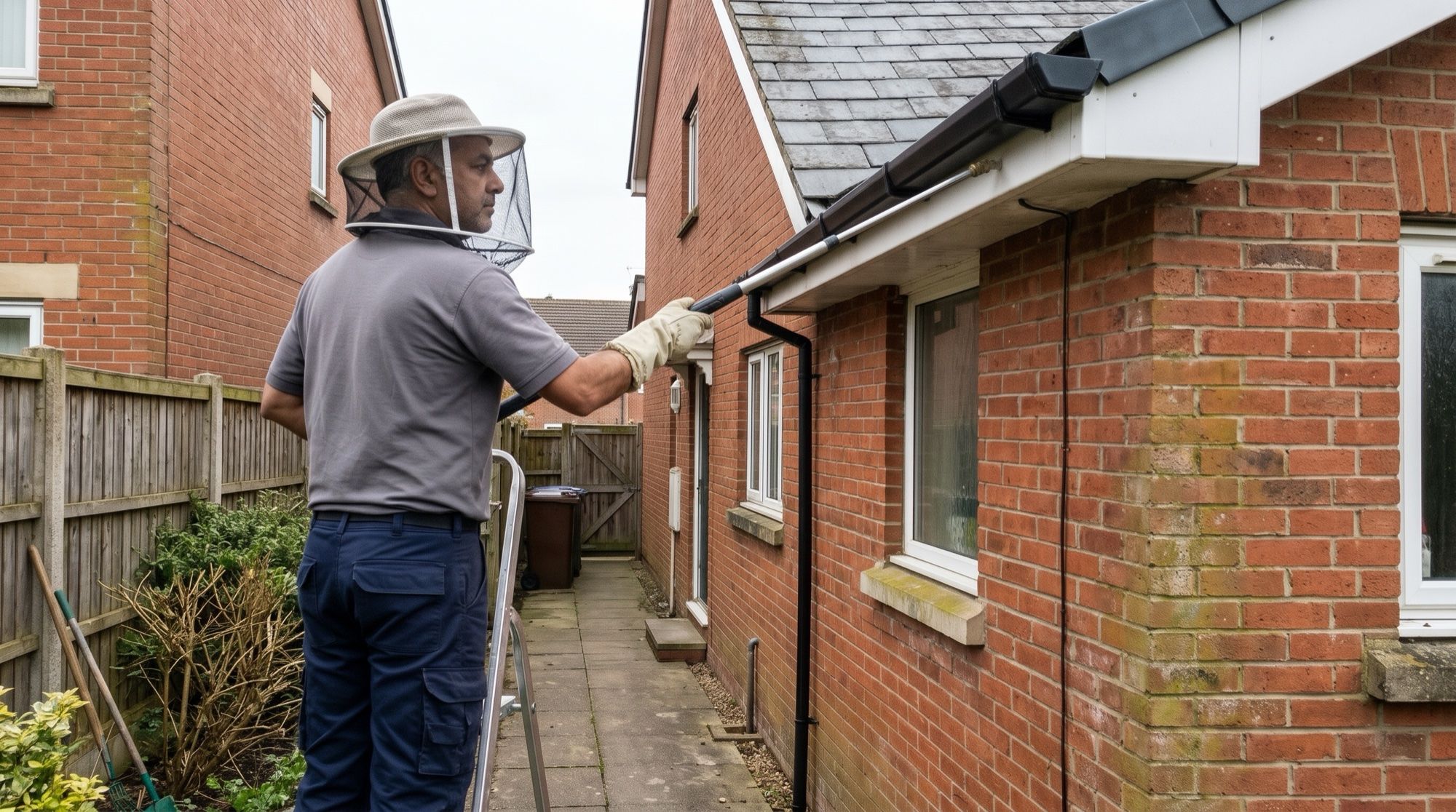
EnviroEx treats wasp nests at Bury shops, cafés, offices, mill buildings, rented homes and houses, including Prestwich, Radcliffe and Ramsbottom. We confirm the species, find the entrance, treat it with a professional insecticide and leave a written job record; most nests are inactive within a day or two. Phone or send an enquiry to book a prompt visit.
Wasps around food trade in Bury
Late in the summer a colony stops rearing new workers and its foragers turn to sugar, which is when wasps become a problem around food. Bury Market’s outdoor stalls, the café bar included in the market’s flexi hall scheme, and Prestwich’s high-street bars and restaurants all draw foraging workers in August and September.
Covered bins, quick clearing of drinks and sweet waste, and screened kitchen windows reduce the pressure, but a nest within a short flight of seating usually needs treating rather than tolerating. Food businesses should log the nest and its treatment in their pest-management file like any other activity, and our food premises pest control service can keep that file for you.
Where wasps build on Bury buildings
Commercial buildings have their own favourite spots. Town-centre retail, including the shopping developments at The Rock and Mill Gate, carries signage, canopies and roof plant that can hide sheltered gaps. Older mill buildings tend to have large roofs, louvres and tired flashing, and flat roofs on newer units collect nests at failed joints and behind cladding. Entrances on buildings like these are often high and hard to see, so the flight line is the best guide.
Homes follow the age of the stock. The terraces that ring the town centre are old enough for slipped slates, party-wall junctions and worn pointing to give queens a way in. Prestwich’s villas, built after the railway reached the town in 1881, tend to have big roof voids, deep eaves and timber soffits, while the streets added from the 1930s bring bay roofs and fascias that can shrink away from the brickwork. Radcliffe’s newer estates on former paper-mill land are likely to have cavity walls, where a queen can slip in through a weep vent and build unseen until workers start turning up indoors.
Why parks and moorland edges matter
Wasps build their nests from chewed wood fibre and feed their larvae on other insects, so property beside woodland and open ground can see more of them. On Prestwich’s western side, Forest Park takes in around 200 hectares, and Prestwich Clough is woodland open to the public. Ramsbottom sits on the Irwell in the West Pennine Moors, with Holcombe Moor, Harcles Hill and Bull Hill rising to the west. Sheds, fences and outbuildings near ground like this give queens weathered timber, and nests in garden structures are often found only when someone opens a door in August.
Treating nests on trading premises
Before any treatment we confirm the species from a photo or description, because bees are handled differently and neither we nor Bury Council treat them. On trading premises we then agree a time before opening or after close, set a small exclusion zone around the entrance and leave a job record for your file. One visit is usually enough. Where several nests turn up across a site or a rental portfolio, we group them into one round and record each separately.
Stopping a repeat next year
Old nests are not reused, but next year’s queens look for similar spots on the same building. Winter is the time for repairs: replace slipped slates on terraces, refix shrunken soffits on villas and inter-war houses, fit insect mesh over weep vents on newer homes without blocking them, and check signage, louvres and flashing on commercial roofs. A spring walk-round of known nest points, built into a commercial pest control contract or carried out by a landlord’s maintenance team, finds small nests while they are easy to treat. For homes and rented property, our domestic pest control and pest control for landlords services cover the same ground.
What we see with wasp nest removal in Bury
- Bury Market's outdoor stalls and the café bar included in the market scheme tend to draw foraging workers in late summer, so traders should keep waste covered and note any nest treatment in their pest-management file.
- Signage, canopies and roof plant on town-centre retail, including the shopping developments at The Rock and Mill Gate, and the louvres and flashing of older mill buildings can hide nest entrances that are hard to spot from the ground.
- Prestwich combines around 200 hectares of Forest Park on its western side and the public woodland of Prestwich Clough with railway-era villas and streets built from the 1930s, whose roofs and soffits are common nest sites.
- Newer homes, such as the estates on Radcliffe's former paper mill land, are likely to have cavity walls, where queens can enter through weep vents and build out of sight.
How the job runs
- 1
Confirm the species
From your description or a photo, we check it is wasps rather than bees or an Asian hornet, which follow different routes.
- 2
Find the entrance
We trace the flight line to the point the wasps use, which may be some distance from the nest inside a cavity or roof void.
- 3
Treat at the entrance
A professional-use insecticide dust or foam goes directly into the entrance, using an extension lance from the ground where height allows.
- 4
Safety briefing and record
We explain what to expect over the next day, mark any area to keep clear and leave a job record suitable for a pest-management file.
- 5
Check the result
Activity normally falls within hours and stops within a day or two. If it does not, tell us and we will reassess the nest.
Typical visits: One visit treats most nests; a second is occasionally needed for very large, hard-to-reach or multiple nests.
Safety: Keep children, pets, staff and customers away from the treated entrance for the rest of the day, do not block the hole, and do not try to remove a nest while it is still active.
Wasp Nest Removal in Bury: questions we get asked
Does Bury Council treat wasp nests?
Yes, at the time of checking. Wasps are on Bury Council's paid pest control list for households and businesses, charged per nest for domestic customers, and residents can book and pay online. The council does not treat bees. A private contractor tends to suit premises that need the visit timed around trade, a written record for a business file, several nests dealt with across a site or rental portfolio, or wasp treatment combined with other pest or bird work. Check the council's pest control pages for current arrangements before booking.
There is a nest near our stall or outdoor seating in Bury. Can you treat it without closing?
Usually, yes. We treat before opening or after close, when fewer people are about and most of the wasps are back inside. The entrance is treated directly, so only a small area needs keeping clear for the rest of the day; we move or close the nearest tables and put up signs where needed. At Bury Market, a nest in a shared structure such as a canopy, store or bin area is also a matter for market management, so tell them as well as booking your own visit. Keep anyone with a known sting allergy well away while the colony dies off.
We let houses in several Bury towns. Can you treat nests at more than one address in one round?
Yes. When a landlord or managing agent has nests at a few addresses at the same point in the season, say in Radcliffe, Whitefield and Ramsbottom, we can route visits so several are treated in a single round. Each property gets its own record of the nest location, the product used and any entry point needing repair, so the repair can be booked for the winter. The same applies to several nests across one shop, office or mill site.
Is a nest in the roof of a Prestwich villa harder to reach?
Sometimes. Older villas often have high eaves, tall chimneys and deep roof voids, so the entrance can sit well above normal ladder height. Most can still be treated from the ground with an extension lance. Where that is not possible we plan safe access, such as a roof ladder or a tower, in line with the Work at Height Regulations 2005 rather than working off an overstretched ladder, and we tell you before the visit if anything extra is needed. Please do not try to reach a high entrance yourself.
Can I get a wasp nest removed for free in Greater Manchester?
Usually not. Wasps are not generally treated as a public-health pest. Check your council's website for current pest control services and charges. Council and housing association tenants should ask their landlord first, as some include it. Otherwise private treatment is the route, and we will tell you plainly if the nest can safely be left alone.
Do you treat bees as well as wasps?
No. We do not treat honeybee or bumblebee nests. If your description or photo suggests bees, we will say so and point you to the right route: a local beekeeper for a honeybee swarm, usually found through the British Beekeepers Association, or patience for a bumblebee nest, which dies out naturally within the season. Tree bumblebees in bird boxes and soffits are a common mix-up in late spring and early summer, and their colonies are usually finished by mid-summer.
Can I leave a wasp nest until the winter?
Often, yes, if it is away from doors, windows, play areas and customer seating and nobody using the building has a sting allergy. Colonies die off in autumn and the old nest is not reused, so by late October most colonies are dying out or already gone. Leaving it is a poor choice when the nest is beside an entrance, inside a loft above bedrooms, or on trading premises, where staff and customer safety come first.
More in Bury
Last updated: