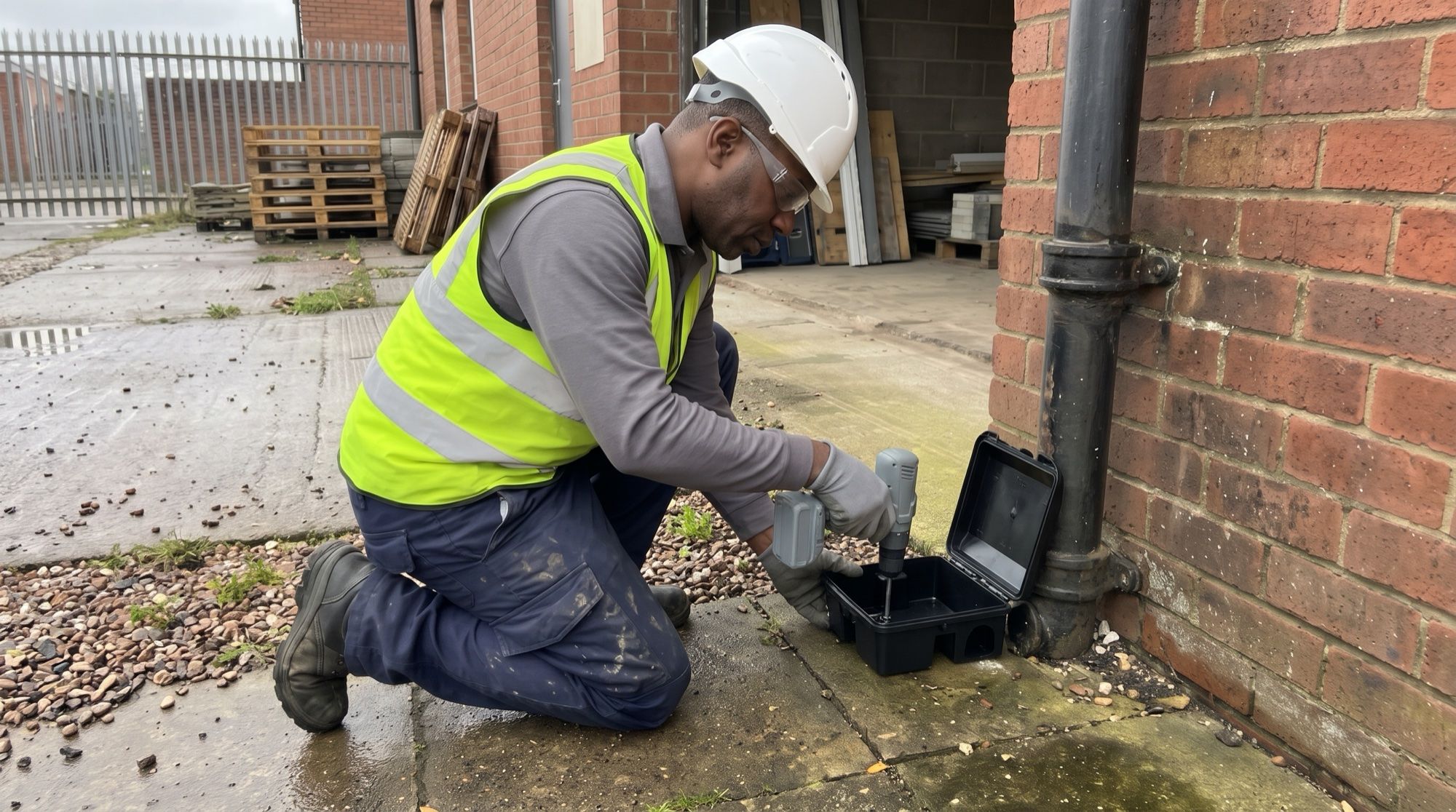
EnviroEx deals with rats and mice in Bury shops, food premises, mill buildings, rented homes and houses, including Radcliffe, Prestwich and Ramsbottom. We survey first, check drains and riverside boundaries, fit locked stations or traps, proof entry points and report in writing after each visit. Phone or send an enquiry to book a prompt survey.
Why rats follow the river through Bury
The Irwell divides Bury into east and west as it runs from north to south, and the Roch comes in from the east near Blackford Bridge. Riverbanks, culverts and outfalls suit brown rats, and the drains connected to them carry rats under streets and into buildings. In Radcliffe the disused Manchester Bolton & Bury Canal adds another corridor. A business backing onto any of these can have rats on its boundary long before one appears inside.
The 2015 floods matter here too. Both rivers reached their highest recorded levels that December, South Bury and North Radcliffe had the most flooded properties, and culverts overloaded in Tottington and Black Lane. Silt, scouring and ground movement after a flood can crack old pipes and open joints, and the damage may only show years later, as rats under a kitchen floor.
Buildings add the rest. The terraces that ring the town centre often share drain runs, and older mill buildings, of which Peel Mills on Castlecroft Road is one still in use, tend to have deep voids and old drainage of their own.
What we typically find, by type of premises
Bury’s premises fall into a few familiar types, from market stalls and the units at The Rock and Mill Gate to mill buildings, Prestwich’s restaurants and delis, town-centre terraces and Radcliffe’s newer estates. Each type tends to show its own pattern:
- Market stalls and stores: mice in stall storage and under counters, and rats at shared bin points and delivery areas.
- Units in managed shopping centres: mice moving through ceiling voids and service corridors between units, and rats around compactors and waste compounds.
- Mill and older industrial buildings: rats in drainage beneath ground floors, mice in deep roof spaces and redundant pipe chases, both helped by goods stacked against walls.
- Restaurant and deli kitchens: mice behind ranges and in dry stores, and rats in yards where waste waits for collection.
- Terraced houses: rats rising from cracked clay drains beneath kitchens and travelling along a row through shared runs.
- Newer estates: gaps around service entries, and activity displaced by groundworks nearby.
Surveying riverside and multi-let sites
Nothing goes down until we know which rodent is present and how it is getting in. On riverside sites that means lifting inspection covers, checking outfalls and boundary walls, and recommending a CCTV drain survey where a defect looks likely. In a shopping-centre unit or a divided mill, we agree with the managing agent where common-area stations will sit, so the landlord’s treatment and each tenant’s fit together rather than overlap.
Stations are locked and fixed in place, or enclosed traps are used where people and food are close, and any rodenticide is applied in line with its label and CRRU stewardship guidance. Every point is numbered on a site plan. Proofing we can fit on the day, such as steel mesh, brush strips, kick plates and cement-based filler, goes in early; larger repairs are photographed and passed to whoever is responsible. Food businesses and multi-let buildings often move onto scheduled monitoring through our commercial pest control contracts, and landlords can hand tenant reports and access to our pest control for landlords service.
Keeping rats out in Bury
- After high water on the Irwell or the Roch, check ground-floor doors, airbricks and inspection chambers before the weather turns cold.
- Keep commercial waste in lidded bins away from back doors, and have overflow collected rather than left in bags.
- In 2014 Bury became the first council in England to approve three-weekly grey bin collections. Whatever the current schedule, landlords of shared houses should match bin capacity to the number of occupants.
- If clearance starts near you on the Elton Reservoir or Simister and Bowlee land, ask for a monitoring check while the ground is opened up.
- In mills and divided buildings, report activity to the managing agent quickly, because mice in one unit can reach the next within weeks.
What we see with rat & mouse control in Bury
- The Irwell divides Bury into east and west and the Roch joins it from the east near Blackford Bridge, so on premises near either river we survey drains, outfalls and boundaries as well as the building itself.
- South Bury and North Radcliffe had the most flooded properties on Boxing Day 2015, and culverts overloaded in Tottington and Black Lane, so where rats keep returning to buildings in those areas a CCTV drain survey is often the next step.
- Terraced rows around the town centre, including Freetown, Fishpool and Pimhole, often share drain runs, so a landlord's rat report may need neighbouring houses checked rather than a single address.
- Traders taking space in the transformed Bury Market, where building work formally began in January 2025, can have station positions and closing bin stores planned into new stalls and stores from the outset.
- Proposals for up to 3,500 homes west of Elton Reservoir and the 1,550-home Simister and Bowlee allocation would bring extended groundworks near existing streets, which can displace rats into the nearest yards and gardens.
How the job runs
- 1
Survey and identification
We confirm whether it is rats or mice, map droppings, runs and gnawing, and trace the entry route through walls, voids, service ducts and drains.
- 2
Written treatment plan
You get a short plan setting out the method, where stations or traps will go, any proofing needed and what we need from you, your staff or your tenants.
- 3
Secure treatment
After a site risk assessment, tamper-resistant stations or traps go on active runs, with any rodenticide used in line with the product label and CRRU UK stewardship guidance.
- 4
Proofing and exclusion
Gaps around pipes, under doors, at airbricks and in drainage are sealed, screened or photographed and flagged for repair so the problem is not simply reset.
- 5
Follow-up and close-out
Return visits check activity, adjust placement and remove bait and bodies, finishing with a written report you can keep with your records.
Typical visits: Usually two to four visits: a survey and first treatment, then checks roughly every seven to ten days until activity stops. Food premises and larger sites often move onto a scheduled contract afterwards.
Safety: Rodenticide only goes inside locked, fixed, tamper-resistant stations or into voids children and animals cannot reach, and every station is marked on a plan. Where pets or young children share the space, we often use enclosed traps in those areas instead.
Rat & Mouse Control in Bury: questions we get asked
Bury Council prices domestic rat treatment as a block of three visits. Will three visits be enough?
For a straightforward job it often is, but we set the number by what the survey finds rather than by a fixed package. A mouse problem in a single shop can close quickly once the entry route is proofed. Rats fed by a broken drain beneath a riverside unit or a terraced kitchen keep coming until the defect is repaired, so we do not sign the job off until the repair is done or booked. Each visit ends with a written report showing what was found and why another visit is or is not needed, which is the evidence a landlord's file or an inspector will want.
We rent a unit in an old Bury mill. Who deals with rats in the shared areas?
Start with your lease. Common parts, roof spaces and shared drainage are usually for the landlord or managing agent to maintain, while each occupier looks after its own unit and housekeeping. Rodents ignore those lines, so the most effective arrangement is one survey of the building, stations in common areas agreed with the landlord, and separate findings for each tenant. We can report to both, which helps when a defect in the structure needs repair.
Will building work at Elton Reservoir or Simister push rats into our premises?
It can. Land west of Elton Reservoir is proposed for up to 3,500 homes and a new link road, and the Simister and Bowlee allocation is set to deliver 1,550 homes, 1,350 of them in Bury, so as those schemes progress, clearance and drainage work could continue nearby for some time. Disturbed burrows send rats looking for cover in the nearest yards, gardens and bin stores. If work starts next to you, ask for a baseline survey and monitoring, and keep proofing up to date.
Do you treat rats at market stalls as well as in the market's shared areas?
Yes. Individual traders can book us for their own stall, store or unit, and we can work with market management on bin stores, loading areas and common spaces. The two need to fit together, because stations on one pitch do little if the shared waste point beside it is uncontrolled. Treatments stay well away from open food and food-contact surfaces, visits are timed outside trading hours where possible, and each trader gets a record to keep for an environmental health officer.
Will one mouse sighting affect our food hygiene rating?
Not automatically. The inspector scores what they find on the day across food hygiene and safety, the condition of the structure and confidence in management. A sighting that was reported, treated, proofed and recorded shows your controls working. Live activity, droppings near food, gaps left open or missing pest records count against you, and where there is an imminent risk to health the council can close premises with a hygiene emergency prohibition notice. Early action and a clear paper trail make the difference.
Who pays for rat control in a rented property, the landlord or the tenant?
It depends on the cause and the tenancy. In most tenancies, section 11 of the Landlord and Tenant Act 1985 makes the landlord responsible for keeping the structure, exterior and drains in repair, so rodents getting in through defects usually fall to the landlord. The Homes (Fitness for Human Habitation) Act 2018 also requires the home to be fit to live in. Where an infestation comes from how a tenant stores food or rubbish, the tenancy agreement may put the cost on them. We can report directly to the landlord or managing agent.
Do I have to report rats to the council?
The Prevention of Damage by Pests Act 1949 requires the occupier of land, other than agricultural land, to tell the local authority in writing if they know rats or mice are living on or visiting it in substantial numbers. The council can then require treatment or structural work. Whether your situation meets that threshold depends on the circumstances: a few droppings in a store room is not the same as an established colony. A treatment plan backed by written visit records shows the problem is being dealt with.
More in Bury
Last updated: