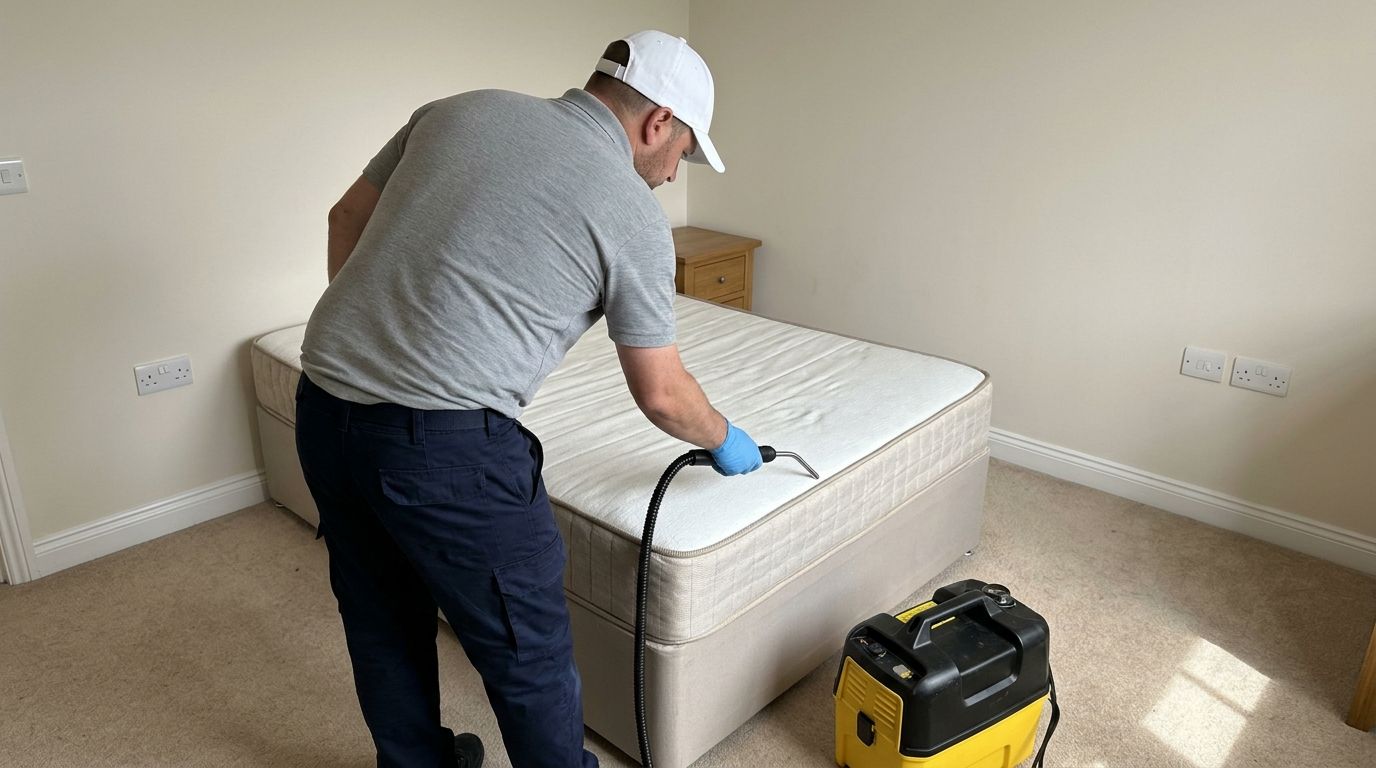
EnviroEx treats bed bugs in Fallowfield, M14, for student accommodation providers, shared-house landlords, letting agents and householders. We inspect the affected room and any rooms connected to it, give written preparation guidance, treat with residual products, desiccant dust and steam, then return after two to three weeks. Call or send an enquiry to book a prompt inspection.
Why do bed bugs turn up in Fallowfield every autumn?
Bed bugs do not come from dirt; they arrive with people and their things. Fallowfield sees that movement on a large scale. Students account for more than half of its residents, and at each end of the academic year large numbers of suitcases, duvets, mattresses and second-hand sofas change rooms, houses and halls within a few weeks.
The building stock does the rest. Terraced houses were the most common type of home sold in Fallowfield in the year to May 2026, and many near the campus are let room by room to students. Once a single introduction settles into one bedroom, the gaps around radiator pipes, under skirting and beneath floorboards give the bugs a route to the next door along the landing.
Waste adds a third route. The Fallowfield Brow, the group of terraced streets opposite the campus that takes in Langley Alley and Furness Road, has an ongoing flytipping problem, and dumped mattresses and bed bases are exactly the kind of item that moves bed bugs between houses. A bed base that looks clean on the pavement can still hold eggs in its stapled seams.
What do we usually find in Fallowfield shared houses and student blocks?
In shared terraces, the first room affected is rarely the only one. We typically find the heaviest evidence in the bedroom of whoever first noticed bites, with lighter traces in the room next door or directly above, and sometimes in a sofa in the shared lounge. Bed frames bought flat-packed and assembled in a hurry, with loose joints and hollow sections, give eggs plenty of hiding places.
In purpose-built and converted student blocks, the picture is different. Rooms are smaller and more uniform, but corridors, shared kitchens and service risers connect them. While the university rebuilds its older halls, it was reported in 2024 to expect to take private leases in the interim, so some students may live in privately run buildings whose operators need their own response plan rather than a university contract.
Owner-occupied homes are not immune. There, cases usually trace back to travel, a visitor’s luggage or second-hand furniture.
How does a bed bug job run in an M14 shared house?
The process matches our standard bed bug treatment, adapted for houses where five or six unrelated tenants share one front door.
- Coordinated access. We agree a date with the landlord or agent, and the agent notifies every tenant, because the rooms around the affected one need checking too.
- Inspection and mapping. We confirm bed bugs, then record which rooms show activity, which are clear, and where monitors go.
- Preparation sheet per tenant. Each occupant gets the same written guidance, so one tenant’s laundry routine does not undo another’s.
- First treatment. Residual insecticide goes into frame joints, skirting and furniture crevices, desiccant dust into voids, and steam onto mattresses and upholstery.
- Follow-up at two to three weeks. We treat nymphs that have hatched since the first visit and re-inspect the monitored rooms.
- Closing report. The landlord receives a report showing rooms treated, products used and the outcome, ready for the property file or a dispute.
Timing around the student year matters. Treating during changeover, when rooms are empty, is quicker and more thorough than working around exams or occupied bedrooms. If an infestation is found mid-term, we plan visits around the tenants’ timetable and keep the follow-up date fixed.
Stopping the next introduction in Fallowfield
Bed bugs cannot be proofed out of a building the way rats can, so prevention here comes down to habits and checks at the points where they arrive.
For landlords and agents, that means an inspection at every changeover, zipped encasements on supplied mattresses, interceptor monitors under bed legs, and a clear written route for tenants to report bites. Sealing gaps around pipes and skirting between let rooms slows spread if an introduction does happen. Our pest control for landlords service can build changeover checks into a portfolio schedule.
For students, the habits are simple: check luggage before and after travel, wash and dry bedding on a hot setting when moving in, and leave alley furniture where it is. For operators of private blocks, a trained cleaning or maintenance team that recognises the early signs, plus a written plan for taking a room out of use, will catch most problems before they spread along a corridor.
What we see with bed bug treatment in Fallowfield
- Students are more than half of Fallowfield's population, so bed bug introductions tend to cluster around the end and start of each academic year, when luggage, bedding and second-hand furniture move between halls and shared houses at once.
- Flytipping is an ongoing problem on the Fallowfield Brow streets, including Langley Alley and Furness Road, and a dumped mattress or sofa carried indoors is a ready way for bed bugs to reach the next terrace.
- Terraces were the most common type of home sold in Fallowfield in the year to May 2026, and once one is split into let bedrooms the bugs can follow pipe runs and gaps under skirting from one tenant's room to the next.
- With older campus halls closed for redevelopment, the university was reported in 2024 to expect to take private leases in the interim, so some students may live in privately run buildings that rely on their own pest arrangements rather than a university contract.
How the job runs
- 1
Inspection and confirmation
We check mattress seams, bed bases, frame joints, headboards, skirting, sockets and nearby furniture to confirm bed bugs and map how far they have spread, including adjoining rooms where relevant.
- 2
Written preparation guidance
You receive a preparation sheet covering what to launder at 60°C, what to bag, what to leave in place and why furniture should not be moved to other rooms before treatment.
- 3
First treatment
We treat harbourage with a combination of residual insecticide, desiccant dust in voids and steam on mattresses and upholstery, choosing products to work around known insecticide resistance.
- 4
Follow-up treatment
We return after two to three weeks to treat nymphs that have hatched from eggs laid before the first visit, and re-inspect every treated area.
- 5
Final check and report
When no live activity is found we close the job with a written report covering rooms treated, products used and advice given, ready for landlord or accommodation records.
Typical visits: Usually two treatment visits two to three weeks apart; heavy infestations, cluttered rooms and connected HMO rooms or flats can need a third visit or more.
Safety: People and pets stay out of treated rooms until surfaces are dry, usually a few hours, and we confirm the re-entry time for the product used. On mattresses and children's furniture we favour steam and only products whose label permits that use.
Bed Bug Treatment in Fallowfield: questions we get asked
Can you inspect a Fallowfield student house between tenancies?
Yes. The weeks between one tenancy ending and the next starting are the easiest time to find and treat bed bugs, because rooms are empty and beds, bases and sofas can be checked without disturbing anyone. We inspect each bedroom and the shared lounge, treat any room where evidence is found, and leave a dated report per property, which gives a landlord or agent a clear record of the condition the house was in before new tenants moved in.
One bedroom in our shared house has bed bugs. Do all the rooms need treating?
Not always, but they all need checking. In a shared terrace the bugs can move through gaps around pipes and under floorboards, and a sofa in the shared lounge may be involved if the affected tenant sits there in the evenings. We inspect the rooms either side, above and below, treat every room with confirmed activity, and use monitors in the others so any spread shows up before the follow-up visit.
Is it safe to take in a mattress or sofa left out on a Fallowfield street?
We would advise against it. Flytipping is an ongoing problem around the Fallowfield Brow, and a mattress or sofa left in an alley could have come from any house, with no way of knowing why it was thrown out. Bed bugs and their eggs hide deep in seams, piping and the underside of bases, where a quick look will not find them. Taking one indoors is a common way for a house that had no bed bugs to end up with them.
Will Manchester City Council treat bed bugs in my Fallowfield flat?
Many councils run a pest control service for residents, but what is covered, who can book and the charges all vary and can change, so check the council's own pest control pages before you book. If you rent from a council or housing association, report the problem to your landlord first. If you would rather book a private firm, phone or use the enquiry form and we will arrange a survey.
I am a student and found bed bugs just before going home. What should I do?
Tell your landlord, agent or accommodation office in writing straight away, and leave the bed and furniture where they are so the room can be treated. Do not take untreated bedding or clothes home: wash what you need on a hot cycle, tumble dry it, and pack it in sealed bags. Check your suitcase seams and zips before packing, and keep the case off the bed. Agree access for the inspection while you are away, so treatment can start before you return.
How do I know it is bed bugs and not fleas or mosquitoes?
Bed bug bites usually appear on skin exposed in bed, such as the face, neck, arms and shoulders, often in a line or small cluster. Flea bites tend to sit around the ankles and lower legs and usually point to a pet or a previous occupant's pet. The bites alone are not proof, though, because reactions vary and some people do not react at all. Look for evidence instead: small dark spots on mattress seams, rusty smears on sheets, pale shed skins or live insects. A clear photo or a specimen sealed in a bag lets us confirm before treatment.
Should I sleep in a different room if I have bed bugs?
In most cases, no. Bed bugs follow the person they feed on, so moving to the sofa or a spare room tends to spread the infestation into furniture that was clean. Keep sleeping in your own bed, with freshly laundered bedding and the bed pulled slightly away from the wall. Once treatment is in place, you sleeping there draws the bugs out across treated surfaces, which helps the treatment work. If you are in an HMO or a hotel, tell the landlord or manager rather than moving rooms yourself.
Do I need to throw my mattress away?
Usually not. Most mattresses can be treated, and fitting a zipped encasement afterwards traps any bugs left inside and makes future checks easier. Throwing a mattress out can make things worse if it is carried unwrapped through hallways and stairwells, shedding bugs and eggs on the way. If a mattress is badly damaged or heavily infested and you decide to replace it, wrap it fully in plastic before moving it, mark it as infested and arrange disposal promptly rather than leaving it in a shared bin store.
More in Fallowfield
Last updated: